• To do with chard

    So, how about another chard recipe?


    The thing about chard is that it keeps growing and growing and growing. Barbara Kingsolver said (in her book Animal, Vegetable, Miracle) that if she had to move to a retirement village and could only grow one vegetable (or maybe it was only one plant), she would choose Rainbow Swiss Chard. I think she might be on to something (actually, I think she’s on to a lot of things, but I won’t go into that right now): it’s pretty in a leafy, green way, it produces excessively and continuously, and it is downright infested with nutrients.

    The other day (there’s that phrase again) I clicked on Epicurious and skimmed through the chard recipes, searching for new flavor combinations. It appeared that golden raisins and chard are a standard configuration, and nuts—pine nuts and almonds, especially—are often in attendance.

    First, I attempted a pie with chard, pine nuts, golden raisins, and orange zest, and, right before serving, a dusting of confectioner’s sugar. It was good (Mr. Handsome said he though I was on to something) but seemed lacking—I think it might be improved by some ricotta and caramelized onions. Maybe I’ll try it again later.
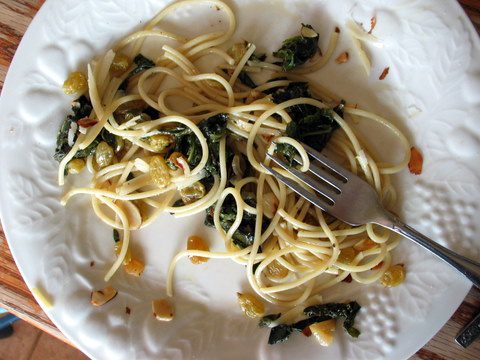

    The second recipe I made was much better, I thought. It was a spin on the chard-golden raisin-nut trio, with some caramelized onions and Parmesan cheese thrown in for excitement. I served it over spaghetti, and the following day the leftovers were eaten atop soba noodles, but it would be equally great over brown rice.

    Spaghetti with Swiss Chard, Raisins, and Almonds
    Adapted from a recipe on Epicurious that originally came from the February 2008 issue of Gourmet.

    The original recipe called for a quarter teaspoon of Spanish smoked paprika. I didn’t have any, so I left it out (and sprinkled in a little regular paprika which did pretty much nothing). If you have the smoked paprika and give it a try, let me know how it turns out. If it’s good, I might have to go out and buy some.

    I never weigh my chard; I simply fix a large bowl of the chopped leaves and call it good. If I were forced to measure, I would guess I used about a heaping gallon of leaves, loosely packed.

    1 onion, peeled and sliced into thin rings
    2 tablespoons olive oil
    2 pounds Swiss chard, center ribs discarded and leaves roughly chopped
    ½ cup golden raisins
    ½ cup water
    1/4 cup chopped raw almonds
    1 teaspoon butter
    ½ cup freshly grated Parmesan cheese
    salt and pepper, to taste
    1 pound spaghetti

    Melt the butter in a small skillet and add the almonds. Stir them around until they are golden brown—it should only take a couple minutes. Set them aside.

    In a large soup pot, saute the onions in the olive oil for about ten minutes, or until they are starting to brown. Add the chard and toss gently until it has wilted. Add the raisins and the water, put the lid on the kettle, and cook for 7 to 10 minutes over medium heat, stirring occasionally. Season with the salt and pepper.

    While the chard is simmering, cook the spaghetti according to package instructions.

    To serve, pile a scoop of chard on top of some spaghetti and sprinkle it with cheese and nuts.

    Variation: In place of the spaghetti, use cooked brown rice.

    About one year ago: Homemade Yogurt.

  • Eggs and Potatoes

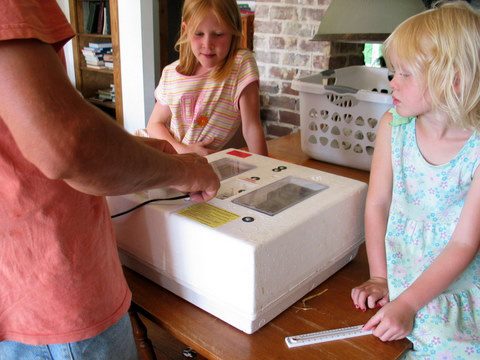
    Mr. Handsome brought home a friend’s egg incubator and now we have thirty-some eggs cooking in the back hall.


    The kids are excited, but to their little, only-in-the-present minds the twenty-one days they have to wait is a forever-long eternity.


    They ought to try a 42 week-long pregnancy. Now that’s waiting.

    ***

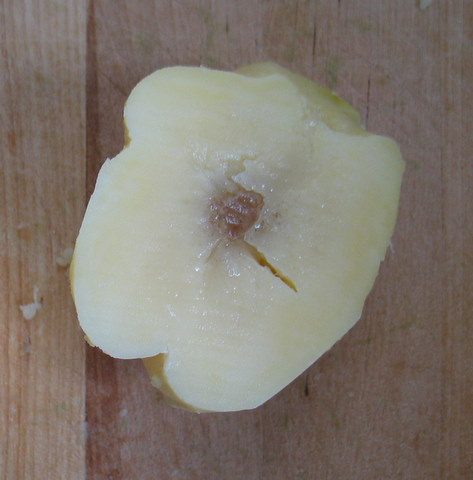
    Why are the insides of my larger potatoes rotten? The outsides of the potatoes are gorgeous and firm, but the very centers are often yucky.

    And in the same potato-y vein: Why is it that when I boil my potatoes, the outsides stay firm while the very centers tend to get a bit mushy-slimy? Does it have anything to do with the fact that I test the potatoes for doneness with a fork—do the fork marks allow for the boiling water to enter and sog up my potatoes’ insides?
    ***

    Coming home from church on Sunday I realized that I had no quick food on hand for lunch. If it had been just us, we might have eaten granola and yogurt and called it a meal, but Yo-Yo had a friend along and I felt responsible for providing something a bit more well-rounded.

    The day before I had cooked some starches to have on hand for the following week—a pot of brown rice and a large pile of new potatoes that I boiled, peeled, and then stuck in the fridge—so those were the foods I had to work with. Not very exciting, huh?

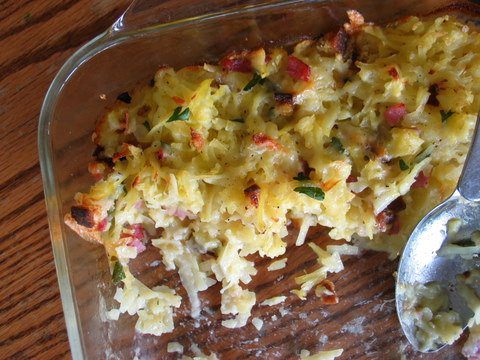
    Once home, the kids ran off to play and I headed to my cookbook shelf to work on the food situation. I found just what I was looking for: a quick variation on scalloped potatoes that called for grated cooked potatoes with cheese, onions, and bread crumbs and then melted butter and milk poured over top. I set to work, adding some chopped ham to the potatoes, and for a side vegetable, putting a pot of peas on to boil. (Dessert was raspberry-lemon cake, whipped cream, and seedless raspberry sauce, all pre-made.)

    The verdict? Mr. Handsome and I both loved the potatoes—pure comfort food and better than macaroni and cheese—and Yo-Yo’s friend had three helpings.


    All in all, it was a pretty fine solution to a last-minute, no-thinking-ahead meal. In fact, it was almost exciting!

    Cottage Potatoes
    Adapted from Mennonite Country-Style Recipes by Esther H. Shank

    Add sausage or bacon in place of the ham, or omit the meat altogether.

    8 cups cooked, peeled, and grated potatoes
    1/2 cup minced onion
    2 tablespoons parsley, chopped
    1 teaspoon salt
    1/4 teaspoon black pepper
    ½ cup bread crumbs
    ½ cup deli ham, chopped fairly small
    1 cup cheddar cheese, grated
    1 ½ cup milk
    4 tablespoons butter

    Heat the milk and butter in a saucepan till the milk is hot and the butter has melted. Stir in the salt and pepper. Set aside.

    In a large bowl, combine the grated potatoes, onion, bread crumbs, ham, parsley, and cheese and stir to combine. Put the mixture into a greased 9 x 12 baking dish, pour the hot milk over top, and bake, uncovered at 350 degrees for 30 minutes.

    One year ago: Fruit Cobbler. (Excuse the dark, night-time pictures.)

  • A potential problem

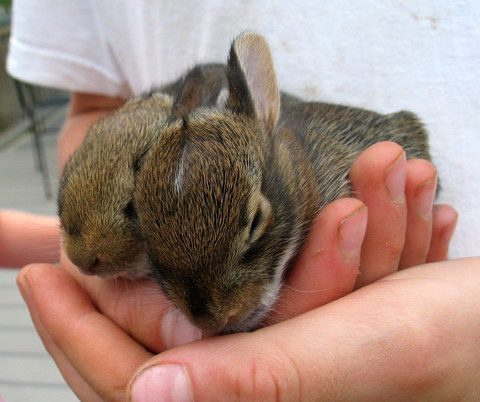
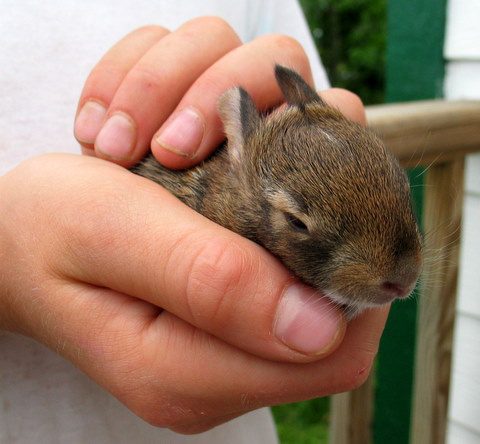
    On Sunday afternoon the dog unearthed a rabbit nest, and then the kids gallantly saved two bunnies from a set of frothing canine jaws.


    The word “saved” is ambiguous. Saved for what? To be butchered? To be fed to the dog? To die from starvation? Seeing as I don’t care much for rabbits, particularly the wild kind, I wasn’t too thrilled—whatever would we do when the bunnies grew into two adult garden-loving rabbits?—and I told them so.


    But then I remembered the hours of fun I had with my friend Amber back when we were little girls and turned part of her barn into an animal hospital and spent hours trying to feed and coddle their viciously wild barn cats. It was so much fun to (try to) take care of those little kittens, pretending that their survival depended on our hard work and loving care.

    Fast forward twenty-five years and here I was, my delighted children clustered around me, their hands cupping two, real-life, side benefits of country living, looking at me expectantly, hopefully. (It didn’t escape me that I was being handed a free, hands-on educational experience, not that I was about to do any teaching).

    “Go out to the barn and find a cage,” I said. The kids gasped with surprise (am I really that strict?) and then yipped with joy and tore off to round up all the things that two little bunnies could ever possibly need.


    When Yo-Yo came in and asked me to look online to see what bunnies eat, but I pointed him to the world books instead, telling him to look it up himself. He yanked the thick blue book off the shelf and ran back outside where I could hear him reading out loud about grasses and climate and such. Later when they asked for milk to feed the bunnies, I did find a little medicine dropper for them and show them how to wiggle the tip in behind the rabbits’ clenched front chompers and gently squeeze the milk in, drop by drop, looking all the while for the occasional throat twitch that would indicate it was indeed swallowing. (Feeding the bunnies did tug on my heartstrings, just a little).

    The children have been faithfully feeding the bunnies milk and slipping them bits of carrot and snap pea and cuddling them in all their free time, but then the inevitable happened: the littlest Bunny Foo-Foo died. “Are you sure?” I asked, going outside to investigate.

    They lifted the bunny and hung it upside-down to show me how very dead it was. (Mr. Handsome thinks it had internal injuries—the dog, you know…)

    “Okay, then, go throw it on the burn pile” (the burial ground for most of our dead, wild animals). They obeyed, no tears or drama whatsoever.

    The remaining Bunny Foo-Foo appears to be thriving, jumping so high he bangs his head on the roof of his dog-carrier cage. The kids are determined to sell it for the bargain price of five dollars, but I told them I doubted they will have many buyers clamoring to snatch up their pet.

    I’m not too worried about this potential problem yet, figuring I have plenty of time to let it work itself out before I will have to step in and make any decisions. I’ll let them nurse it back to health, raise it, and then, if it hasn’t taken a bite out of a child’s finger, died or escaped, we’ll deal with it then. They can play with their new pet as much as they like as long as they are gentle the the bunny, as long as they take turns holding it without fighting with each other (we’re not doing so well on that one), and as long as they washed their hands with soap after each visit to the bunny’s house, and as long as they keep it out of my house.

    About one year ago: Work. (It looks like we won’t be getting any blueberries this year—our local blueberry farm closed their PYO option after being open for only two days. I’m sorely disappointed and am taking this misfortune as a sign that we need to get busy and plant ourselves some blueberry bushes.)