• Staying on track

    You guys hold such power over me. You know that, right? It’s like I’m a puppy on a chain, and you hold the other end. Sometimes you yank my chain just to see me bark. Other times you tie me up to a tree and walk off, leaving me alone to howl at the moon. Sometimes you relax your grip, content to let me take you for a zig-zaggy hike through the bunny trail-infested woods, and other times you take a firm grip on the chain and strike out on a path of your own choosing, expecting that I’ll trot along faithfully at your heels, which I do, wiggly-waggly hindquarters, puppy dog eyes, and all.

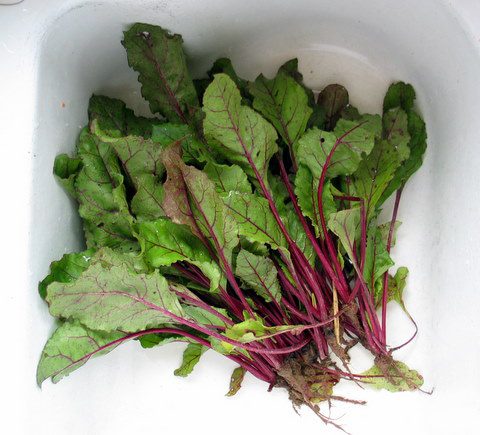
    Zoe grabbed hold of my chain this morning when she asked how I freeze spinach. I was going to talk about something else, but well, once my tail commenced to thumping, I (almost) totally forgot what I was going to say.


    I had planned to tell you about freezing spinach, like four weeks ago. In fact, I had taken pictures of the whole process, but then I decided not to write about it after all. Another bunny must have run in front of my snuffling nose.

    Thanks, Zoe, for getting me back on track.

    How to Freeze Spinach

    Wash the spinach, and lay it out on a bath towel to air dry. There is no need to get it totally dry; you are going to steam it, after all.

    Steam the spinach. I do this by putting about an inch of water in my steamer, keeping the water below the level of the spinach because I don’t want to boil the spinach. I then stuff the steamer with as much spinach as possible.


    I clap the lid on the steamer and let it steam till the spinach is bright green and wilted (once in a while I gently toss the spinach with a pair of tongs so that it steams evenly).


    Transfer the spinach to a colander and allow to drip-drain.

    Now, my mother taught me to lay the spinach out, piece by piece, on cookie sheets lined with plastic wrap, repeating the process till I had two or three layers of spinach, each layer separated with a sheet of plastic wrap, and up until this spring this was how I froze my spinach (although the last time I did this I made the mistake of using wax paper instead of plastic wrap and the spinach froze to the paper and I had a dreadful mess on my hands).


    Then I would put the trays of spinach in the freezer until the spinach was frozen solid, and once the spinach was frozen (it took about an hour), I quickly transferred the stiff leaves into pint-sized plastic bags.


    But then Mr. Handsome walked into the kitchen while I was painstakingly putting the individual leaves of spinach into bags and asked, “Why do you lay the spinach out like that? Why don’t you just stick it into a bag?” I didn’t know. So I called mom and asked her, and she didn’t know. So I called my girlfriend Amber and she said that she just freezes it in 10-ounce portions since that’s how it’s sold in the store and that’s the amount that most recipes call for. So now I do it Amber’s way. It’s easier and it takes up less freezer space, too.

    I realize there’s more than once way to slice an onion, so … how do you freeze spinach?

    (Click here to learn how I freeze Swiss chard.)

  • Tweaking my methods

    I haven’t written about sourdough bread in for forever, I know. It’s not that I’m not making bread, because I am. It’s just that I’ve said pretty much all I want to say about it. I’m fairly stable in my bread-baking routines, and stability is boring when it comes to writing.


    My bread-baking routine is as follows. About once a month I get my starter out of the fridge and feed it for a day. The next day I bake two loaves, and I double the amount of starter so that the following day I have enough starter to bake six loaves. Depending on our need, freezing space, and my schedule, I may bake another six loaves on day three, or I may make bagels or some other specialty bread. Then the starter goes back into the fridge and I forget about it for several weeks.

    Despite the lack of creativity, I do tweak my methods once in a while. I’ve read about all different kinds of sourdoughs and all different baking methods, and what I’ve learned has led me to suspect that sourdough bread is very forgiving and that rigorous schedules needn’t be followed to the letter in order to make good bread. So this last time I baked, I decided to shake my system up a bit and try something new. I mixed up a batch of country white bread (with some whole wheat thrown in), but instead of proofing it in the fridge overnight, I let it rest in the fridge for only a couple hours before pulling it out and allowing it to proof at room temperature for another couple hours before baking. It turned out lovely—sourdough bread in one day.

    I’m not going to be updating this blog much anymore (that probably goes without saying), choosing instead to pour all my energies into the main blog, but I’m leaving this up as a resource. Which is all it really is anyway.

    Happy baking!

  • To share with friends

    Beeeeep. The computerized woman on my Balding Brother’s answering machine had finished its speech about all the possible ways I could get in touch with my brother and was now giving me a turn to talk.


    “Hey guys. It’s me,” I said, with characteristic informality. “We’re making ice cream right now and wondered if you would want to come over to help eat it. We are going to try to get the kids to bed early tonight and it is 6:30 now, so that means you can stay till about, oh, say 7:30. If you get this message, call me back; otherwise, too bad for you—you lose out.”


    My sis-in-law called back five minutes later. “We were outside eating supper when you called. What time should we come?”


    Since I was feeling a little bad (but only a little) about feeding my children just ice cream for supper, I threw the leftovers from the previous night’s supper into a glass serving bowl, heated them up in the microwave, and then carried the bowl out to the porch where my kids were excitedly greeting our guests and devouring the sweet cherries that my sis-in-law had brought along. I fork-fed my little birdies while trying (rather unsuccessfully) to carry on a conversation, and ended up eating much of the bowl’s contents myself. It was the brown butter noodles and peas, so I didn’t mind too much.

    When Mr. Handsome finished with the cranking, I headed back inside to load up a tray with serving bowls and spoons, the bowl of freshly sliced and sugared strawberries, and the jar of granola.


    We dug in, scooping the soft ice cream into our bowls, piling on the strawberries and then finishing off the whole glorious mound with a couple scoops of granola.


    A storm was coming; the flies were thick. We had seconds, and I finished off the scrapings from the bottom of the canister.


    “The rain is coming!” Miss Becca Boo yelled. “I can hear it!” Sure enough, the rain was coming from the north, sweeping down the valley towards our house.

    As the wall of rain washed over our house, my brother grabbed the diaper bag and my sis-in-law grabbed the baby. “Just set our bowls out in the yard to wash them,” my brother said, and then they sprinted to their car, the rain pelting them every step of the way. It was 7:30 on the dot.

    (Mr. Handsome took advantage of the water streaming from the rain gutters, using it to rinse out the ice cream canister.)

    Old-Fashioned Vanilla Ice Cream


    Summer evenings when I was growing up, my parents would call up some friends to come over for homemade ice cream. It was the real deal—mostly cream with some milk, raw eggs, sugar, and vanilla. We usually made plain vanilla ice cream, choosing to serve the toppings (usually fruit and granola) separately, but once in a while they cranked the crushed fruit into the ice cream. That was about as fancy as it got.

    Nowadays, people make their ice cream fancy-schmancy, with add-ins of every type—real vanilla beans, saffron (I tried it and it made the ice cream look and taste vaguely like poop), cream cheese, chocolate, peanut butter (I have yet to tell you about this one)—and because everyone is concerned with salmonella, almost all the recipes instruct you to make a cooked custard for your base. I thoroughly enjoy the rich, store brand-type ice cream with its custard base, but those ice creams don’t have anything over this old-fashioned, soft serve-style ice cream.

    This ice cream is best eaten fresh (once frozen it becomes rock hard and loses much of it’s charm), and because the recipe makes a fair amount, you’ll probably want to call some friends to come share in the feast. If you do end up with leftovers, freeze them in little one-cup containers—they will be delicious in smoothies.

    1 quart cream
    1 cup milk
    1 cup sugar
    2 eggs
    1 teaspoon vanilla

    In a medium-sized mixing bowl, beat the eggs with an electric mixer for 2-4 minutes until thick and creamy. Add the sugar, vanilla, and milk and beat some more. Add the cream and mix to combine. (Conversely, you can mix all the ingredients together with a whisk and then pour the mixture through a fine-mesh sieve to remove any little bits of unblended egg yolk.) At this point you can refrigerate the mixture till you are ready to freeze it, or you can freeze it right away.

    Freeze according to your ice cream maker’s instructions. Serve plain, or with fresh fruit.

    Updated on May 5, 2011
    Strawberry Ice Cream
    Omit the milk, increase the sugar to 1 1/4 (or maybe even 1 ½ cups), and add 1-2 cups crushed strawberries.