• A sauce to crow about

    Have you ever heard of tempero?

    I hadn’t, not until several months ago when I had that coffee date with my friend Michael Ann and she enthusiastically enlightened me. She said, “All you do is blend up onions and garlic and herbs and leeks with lots of salt and then you keep it in your fridge for months and you can add it to everything—soups, eggs, beans, meats, whatever.

    I was dubious. “Doesn’t it make all your food taste the same?”

    “No,” she said. “I’ll send you the recipe.”

    And she did. I read it and filed it away until last Thursday when I unsuccessfully tried to pull my garlic. The stalks kept breaking off in my hand, leaving the fat garlic heads buried, or worse, only half the bulb came up, so I had to go fetch a shovel and dig the bulbs up (and then I still had trouble—those were some stuck heads). I wove the intact heads of garlic into two braids and set aside the mutilated heads till the following day when I would have more energy to figure out how to deal with them.

    When I woke the next morning, I pondered my options (one of which was this, but I read somewhere that this is an excellent breeding grounds for salmonella—is that true?), and it was about then that I remembered Michael Ann’s tempero (pronounced “temPAREoh”). Didn’t it call for a lot of garlic and onions? I flipped through my red, three-ring recipe binder until I found her neatly typed recipe. I noted happily that I had everything but the leeks and scallions; I would increase the onions and call it even.

    Out to the garden I again went, this time to pull some of the bigger onions and pick the basil and parsley, and then I commenced to peeling and chopping and processing, all the while basking in the sanctimonious bubbly feeling that washes over me whenever I combine multiple, fresh ingredients in a single recipe. It’s a pleasant sensation indeed when my everyday grind melds with both the practical and the gourmet. It makes me feel like crowing.

    Of course I didn’t know for sure if the recipe itself would be any good. I was still a little doubtful, though I certainly had no right to be considering that my friend is an absolute whiz in the kitchen and has a genius for the savory (you ought to taste her killer soups). But still…

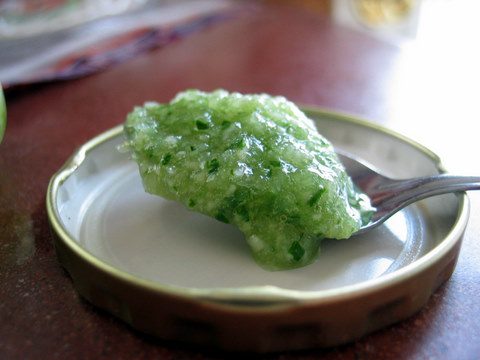
    I should definitely not have doubted her. In less than a week I have used up over a cup of the pungent green sauce. So far I have used tempero in the following ways: simmered with unsalted, precooked pinto beans; sauteed with zucchini; briefly cooked in hot oil as a base for wilted Swiss chard; mixed into the sausage I was browning (it made the sausage extra salty, but I’ll be adding it to a soup later); and stirred, uncooked, into tuna salad.

    In regards to the question I first asked Michael Ann—whether or not tempero will make all your food taste the same—it won’t, at least not any more than adding onions and garlic to all your savory dishes makes them taste alike. It’s like a liquid version of seasoned salt, and while I’m not one for seasoned salt, I do add fresh garlic and onions to most of my savory dishes, and in essence, that’s all this is—instead of having to peel and chop my garlic and onions every time I need them, I can simple dump in a blob of tempero. It’s a marvel!


    I did a little research after I made the tempero and found some information that made me fall in love with the sauce even more than I already have, as if that’s possible. Rita says (the post also contains her recipe), “It works almost like your signature flavor that everyone can recognize on your cooking without really knowing where it comes from… that certain something that makes your dishes unique.” Is that not totally classy? Don’t all cooks secretly lust after a signature flavor? (Don’t even try to tell me I’m the only one—you can’t fool me.)

    And if you want to read more about the history of the Brazilian sauce and how to use it, click here.

    Tempero
    From my friend Michael Ann.

    Notes from Michael Ann: “Remember that the tempero is made up of raw ingredients and is not intended to be a sauce itself or to be used on its own. The mixture is an ingredient in other recipes and most of the time will be cooked with them. Keep it in the refrigerator to add to other sauces and recipes in small amounts, starting with half a tablespoon and tasting as you go.” All the tempero needs is a quick sizzle in some oil before adding the other ingredients, or it can be added directly to simmering soups and sauces. It also serves as a rub for meats. The options are countless, countless, I tell you.

    And she adds, “Warning: It’s hell on the eyeballs with all those onions.” True, I screamed and hollered and jumped about, but it wasn’t all that bad, nothing a brave grown-up couldn’t deal with. The pain was short-lived, and the payoff is tremendous—the stuff lasts for months.

    I’m giving you Michael Ann’s recipe as is, but I omitted the scallions and leeks and upped the onions to three pounds. You could also add green pepper, if you wish.

    2 1/4 pounds (about 4 large onions) onions, peeled and coarsely chopped
    10 ounces (about 9 medium-size heads) garlic, peeled and coarsely chopped
    2 cups kosher salt
    1 ½ leeks, washed and coarsely chopped
    ½ bunch (about 1 ½ cups) parsley, stems discarded
    2 cups basil leaves
    ½ bunch scallions, both the white and green parts, coarsely chopped

    Mix all the ingredients together in a large bowl. Working in batches, add the vegetables to a food processor and process until smooth. Transfer the batches to a large bowl and combine until the entire mixture is smooth. Transfer to lidded glass jars (or plastic containers) and store in the refrigerator (or freezer) for 6-8 months.

    Yield: A generous eight cups.

    About one year ago: What to do with brown bags.
  • A sweet tale

    I apologize to all of you who have grown weary with my incessant prattling about chard and red beet greens and chicken and potatoes (there was a red raspberry dessert thrown in there, too, but come on, it had a fruit) and have grown desperate for something purely frivolous, like, say, ice cream.


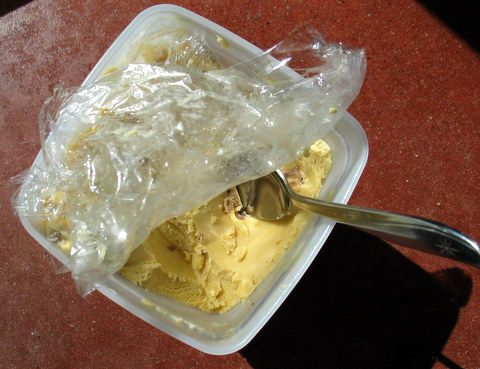
    How about it? Are you up for some creamy peanut-buttery ice cream, thickly studded with chopped-up peanut butter cups? Yes?


    Okay, but first I’m going to tell you a story.

    Once there was a little girl who didn’t get store-bought ice cream very often. Her parents made fine homemade ice cream, but, like white bread and celery, ice cream was a rare treat. The girl grew up and went to college where there was lots of ice cream in the cafeteria, and she ate it frequently, especially the soft serve. But then she got married, and because for the first time she had a fair amount of extra cash, a car, and easy access to the grocery store, she discovered the endless varieties of Ben and Jerry’s and thought she had finally died and gone to heaven (part of that floaty feeling might have had something to do with having just married the most gorgeous man alive). But then she and her husband left their comfortable middle-class existence with easy access to chain groceries that sold Ben and Jerry’s and flew to sweaty-hot Nicaragua where there was no decent ice cream to be found, though there was some fabulous Guanabana yogurt. When they came back to the states three years later they had a little boy and no money, and then the handsome husband caught cancer, found a job, and got cured, and the girl, who was now a young woman, caught another baby in her tummy and developed a fearsome sweet tooth, and then Ben and Jerry’s ice cream went on sale and because they had some money again thanks to the husband’s new job, the young woman brought cartons and cartons of the ice cream home from the store and she ate them every single night and gained forty pounds. After which she pushed out a little girl, rested for a few weeks, and then plunked the little boy and the baby girl into a clunky stroller and pushed them around their hilly neighborhood in an effort to shrink her buns and belly (she stopped eating Ben and Jerry’s, too). Years passed and not only did they acquire two more children and a vasectomy, they also purchased a used hand crank ice cream churn from a yard sale, a country house (not from a yard sale), and some milk shares from a local farm. Today, the young woman, who isn’t so young anymore, though she isn’t quite middle-aged either, has taught herself how to make thick, rich, creamy ice creams that taste just like Ben and Jerry’s, if not better, and even though they have more money than they ever had before and the chain grocery store is just ten minutes away, they hardly ever, maybe even never, buy Ben and Jerry’s. The end.


    Peanut Butter Cup Ice Cream
    Adapted from… oh dear, I don’t know where! Some place on the net, I guess. Sorry.


    Do not use the miniature peanut butter cups; use the full-size cups, okay?

    And I tell you to reserve part of the chopped candy because I’ve discovered that they don’t mix in evenly—often the ice cream at the bottom of the churn has only a few bits of candy while the ice cream at the top is loaded. Reserving some of the candy allows you to add it at the end when you’re serving the ice cream, or transferring it into freezer containers, creating an ice cream with even candy distribution.

    1 cup sugar
    4 eggs
    1 cup milk
    3 ½ cups cream, divided
    1 cup creamy peanut butter
    1 tablespoon vanilla
    12-16 peanut butter cups, roughly chopped and divided

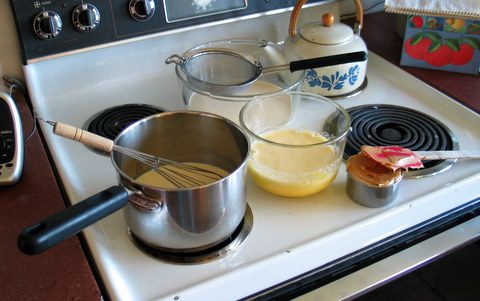
    Put the sugar and eggs in a mixing bowl and beat with a handheld mixer for about three minutes.

    Heat the milk and one cup of the cream in a saucepan. Once hot, slowly add the milk and cream to the egg-sugar mixture, beating on low speed all the while. Then, dump the tempered eggs and milk back into the saucepan and stir over medium-high heat until the mixture has thickened slightly (do not boil). Remove the saucepan from the heat and pour the mixture through a fine-mesh strainer.

    Whisk the peanut butter into the egg-milk mixture. Add the remaining cream and the vanilla. Chill the ice cream base in the refrigerator for 6 hours or overnight.

    Churn the ice cream. When it is almost done, add three-quarters of the chopped peanut butter cups and finish churning. When transferring the ice cream to freezer containers (or eating it), stir the remaining bits of candy into the parts of the ice cream that are candy deprived.

    One year ago: Apricot Pandowdy. And a year and a day ago: Grace’s Vanilla Pudding and Baked Oatmeal. I was a blogging fiend, back in the day.

  • Sniffing for cake

    I don’t know how those kitchen-tester, experimenter-type people do it. You know who I’m talking about, right? I’m talking about the cooks that are behind the scenes of cookbooks and culinary magazines, but specifically (for the next few paragraphs anyways) about those people who work for the magazine Cook’s Illustrated. Those Dudes and Dudettes slave away in the magazine’s test kitchen for hours at a time tweaking and tasting and tasting and tweaking till they find The Perfect Whatever It Is They Are Searching For. And then they tell you what they’ve learned.

    No, that’s not quite right. They tell you every little detail of how they learned what they learned, so that you can be sure to appreciate the fact—the fact!—that they have fairly outdone themselves bringing you The Best There Is. They try to be generous and gracious, but you can’t help but hear their behind-the-scenes self-righteous sniffing.

    You’re not familiar with the magazine? Okay, let’s take, for example, the question of prepeeled garlic. You didn’t know there was a question about prepeeled garlic? Well, there is, or rather, there was. See, somebody (the editor, perhaps?) wondered what the difference was, if any, between jarred, prechopped garlic and fresh garlic. The question (probably written in beautiful calligraphy on a parchment scroll and bound with a satin ribbon) was delivered (by a thirteen-year-old boy in purple tights) to the Dudes and Dudettes in the magazine’s kitchen. Of course the D and D’s didn’t do a simple taste test, oh no-no-no-no-no! They, the dear souls, got down and dirty in their quest to answer the all-important question set forth before them. As a stringed quartet played Vivaldi over in the corner by the industrial stoves, they spun and twirled around the kitchen making aioli sauce (two batches, of course), sauteed garlic with spaghetti (again, two batches), and stuffed rolled flank steaks (yep, two batches). The tasters (seated in a red-carpeted dinning room) gave mixed reviews, and the final verdict (written on another, slightly larger scroll) stated that prechopped garlic would not store as well as the fresh raw cloves, but that there was not much difference in taste (and with that, the music soared gloriously, and the kitchen staff bowed and curtseyed as we gratefully applauded). The end.

    Um, hello? I’m pretty sure I already knew that fresh garlic lasts longer than the prechopped stuff (though I never thought to thunk it), and I can guarantee that it didn’t take multiple batches of flank steak and spaghetti for me to figure that out. (That I don’t even know how to cook flank steak is irrelevant.) However, I do understand that documented—and published!—scientific evidence is worth more than my practical, day-in-and-day-out kitchen wisdom. And so I bow my head in meek submission.

    Okay, okay. I’ll stop now. The magazine does hold helpful information (I did check it out of the library, after all), and I enjoy flipping through its pages, gleaning tidbits. But there is something off-putting about the magazine, not because they have a goal to obtain the perfect Whatever It Is because all cooks strive for this, but because they claim that they have. Cooking is such a personal thing and everyone has different preferences, so for them to assume that they hold the Golden Answer strikes me as being a little presumptuous.

    But maybe that’s just because I can’t stand to see anyone else carting around more than their fair share of the gold.

    Anyway, my point to all this was that just thinking of all that excessive food prepping and testing makes me bone weary. (And besides, who eats all that food? I worry over things like that; I can’t help myself.) As for me, I’m feeling pretty whipped after playing around with a raspberry-lemon buttermilk cake, doing my darndest to grab hold of some of that flashy culinary gold. I made it three times. Three times is about all I can handle, so it’s a pretty good thing that I struck pay dirt on the third try. Or maybe I just gave up and decided it was easier to be content.


    I unwittingly started my cake marathon when I made Deb’s Raspberry Buttermilk Cake. To start with, I only made a couple practical changes—I doubled it, and I used frozen raspberries instead of the fresh, plus, I sprinkled one cake with plain white sugar and the other pan with Demerara sugar. Some daring changes, huh? But then we tasted it and Mr. Handsome thought it needed more lemon, so back to the drawling board I went. (And right there is when I started hearing little Cook’s Illustrated voices in my head: “I’m going to make this cake perfect, I tell you, simply perfect.”)

    The second time around I reduced the buttermilk by a quarter cup and added a quarter cup of fresh lemon juice instead. I also upped the lemon zest, three times over. The resulting cake was definitely more lemony, but all the berries sank to the bottom and the cake had a more sponge-like texture. (“Drat this cake! Don’t tell me I’m going to have to do something crazy like beat the egg whites. This is supposed to be a simple cake. A simply perfect cake.”)


    Round three involved two parts buttermilk, one part yogurt and one part milk (because I ran out of buttermilk, not because I was intentionally trying to be complex), no lemon juice, three-plus times the amount of zest, and fresh berries because they are now in season and I had just picked a bowlful.

    I pulled the cake from the oven. I looked at it. I sniffed it. I tasted it. And then I smiled.


    And now (drum roll, please) I present you with, a la The Cook’s Illustrated Testing Method (sniff, sniff), the perfect, absolutely perfect, Raspberry-Lemon Buttermilk Cake.


    Actually, I think this cake would also be good as muffins, maybe with a layer of streusel hidden in their middles, or with blueberries in place of the raspberries (blueberries and lemon, oh my). See, I’m not really Cook’s Illustrated material—there’s just too many good options out there. Besides, I haven’t the endurance or the ego.

    Well, it might just be the endurance part I’m missing.

    Seriously, though, this cake is good. It’s simple and elegant, but not too showy. It’s just the thing to have on hand, like at all times. (I tried serving the cake with seedless raspberry sauce and some whipped cream, but I think I like it just as well, and maybe better, all by itself. Sweet and simple, and perfect. Sniff.)


    Raspberry-Lemon Buttermilk Cake
    Adapted from Smitten Kitchen

    Deb’s recipe made one round, 9-inch cake, but I doubled it. The way I see it, if you’re going to go to all the trouble to measure, mix, and bake you might as well make a fair amount. Besides, the cake freezes well, so I doubt you’ll regret the extra (we whipped through the six cakes I made in less than a week). But if you’re feeling conservative, go ahead and halve the recipe. It will still be sniffably perfect.

    2 cups flour
    1 teaspoon baking powder
    1 teaspoon baking soda
    ½ teaspoon salt
    ½ cup butter
    1 1/3 cups sugar, plus 3 tablespoons for sprinkling
    1 teaspoon vanilla
    the zest from one lemon, or a minimum of 3 ample teaspoons
    2 eggs
    1 cup buttermilk (or ½ cup buttermilk, 1/4 cup plain yogurt, and 1/4 cup milk)
    2 cups raspberries, fresh or frozen

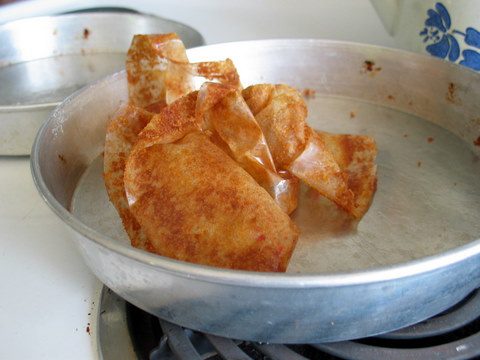
    Grease two 9-inch cake pans and line them with wax paper circles. (To make my wax paper circles, I set the cake pan on the wax paper, trace around it with a pencil, and then cut out the circle and press it into the bottom of the greased pan.)

    Cream together the sugar and butter. Add the vanilla, eggs, and zest and beat some more.

    Measure the dry ingredients into a separate bowl.

    Add the dry ingredients to the creamed butter alternately with the buttermilk.

    Divide the batter between the two pans. Sprinkle the raspberries evenly over the cakes, and then sprinkle over the sugar.

    Bake the cakes at 400 degrees for 15-20 minutes. Allow them to cool for ten minutes before inverting the cakes onto a cooling rack and peeling off the wax paper. To freeze, wait till they have cooled to room temperature before wrapping well in plastic wrap and transferring to the freezer.

    One year ago: Angel Bread.