I’m a long-time reader of Milva’s blog, so when she agreed to be interviewed, I was thrilled. Even though I don’t know her know her, for years I’ve counted her as a key person in my little circle of homeschooling mentors. Her insights — in all their earthy, practical, and gracious glory — both ground and inspire me.
Hi, everyone! I’m Milva McDonald, my husband is Glenn Dickson, and we live in Massachusetts.
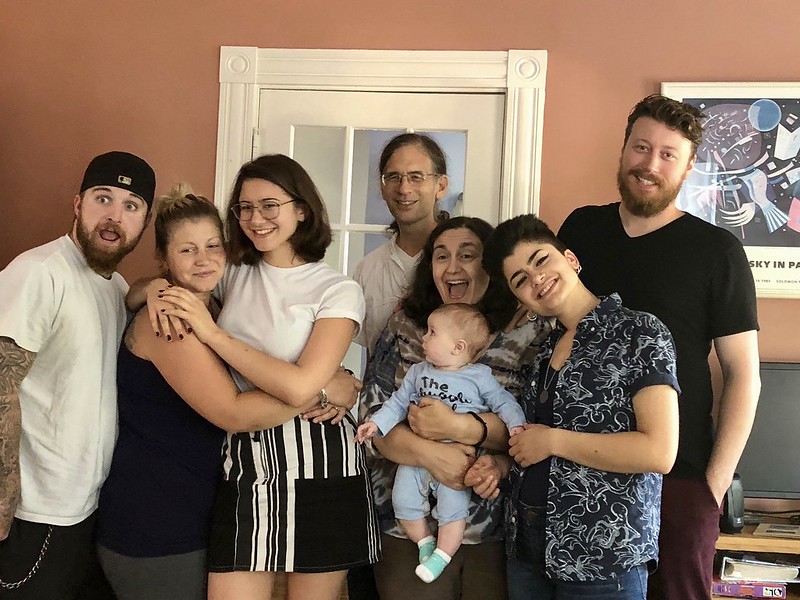
Us (2018).
My oldest, Justine Buckley, is 35 and also lives in Massachusetts with her husband and two boys (2.5 and 9 months). She works in a supervisory capacity as a behavior specialist at a day program for adults with developmental disabilities.
My 33-year-old son Eric McDonald lives in Montreal with his wife and their newborn daughter who arrived this past New Year’s Eve. He’s a full-time folk musician, playing mostly Celtic, although the pandemic has turned that upside down!
My third is Claire Dickson, 23, graduated from college in 2019 — the spring before she enrolled, I happened to be interviewed for an article in Boston Magazine, and when they found out she was going to Harvard, they surprised us by putting her on the cover! She is now living in New York City, making music, thinking about grad school, and enjoying life.
My youngest, Abigail Dickson, 22, graduated from college in 2020 with a degree in Women and Gender Studies and a minor in theatre arts. Because of the pandemic she moved back home. She’s teaching virtual Shakespeare classes to local homeschooled kids, has joined the board of the local farmers market, and is thinking about running for office.
Why did you decide to homeschool?
Like many parents, I couldn’t wait to send my kid to school. We had made financial sacrifices to move to a community with a “good” school district, but by October of Justine’s kindergarten year, the rose-colored glasses were off.
I don’t know what I’d envisioned – interactive, creative, interdisciplinary projects and lots of good books? Instead, there was busy work and Disney movies. Coloring in the lines was more important than using your mind or imagination. Worse than that, it quickly became clear that the kids were already being tracked. Justine, a people pleaser who paid close attention to the teacher and could follow directions quite well, was at the top of the pyramid. As a classroom helper I’d heard firsthand the teacher’s judgments about the other kids. When Justine started repeating them, I knew something had to give.
I started exploring options, and during that process I asked a homeschooling friend for information. (Until I’d met her when I was in my early 20s, I didn’t even know homeschooling existed, and I didn’t tell her what I really thought: that is nuts!) She handed me reading material including an essay by John Taylor Gatto called “The Crisis of Compulsory Schooling.” I read it and knew I wouldn’t send my kids to school. I call it my one and only conversion experience.
It’s really important to point out, though, that while my impetus to homeschool began because of dissatisfaction with my daughter’s school experience, our continuing to homeschool had less to do with a rejection of school and more to do with the fact that homeschooling worked so well for us.

Abby’s birth.
Describe your homeschool style and how it evolved.
When I started homeschooling in the early 1990s, I thought we’d be doing school-at-home. That didn’t last very long. When the workbooks and assignments didn’t go well I decided to forget about them, at least for a little while, and focus on settling into our new situation and getting to know the handful of other local homeschooling families. Justine was already beginning to read, wrote voraciously with “invented spelling,” was good with numbers, and was always working on some project or other of her own. As I observed her doing deep dives into stuff that interested her, it was clear she was learning plenty, so we stuck with that unschooling approach.
Since that word has evolved and changed so much over the years (there are even “unschooling schools” now!), I call what we did “slow” homeschooling, a phrase I and a couple other parents in my homeschooling community thought of over coffee some years ago (and then I wrote a book about it). Values of slow homeschooling include trusting kids, lots of play, nature, family relationships, and connecting with the wider community.
When all the kids were home, what was the homeschool routine like?
In my family, things were pretty mellow. We’d go to homeschool park day, the library, nature walks, things like that, but just as often the kids were busy engaging in some kind of pretend play, listening to story tapes (we didn’t have a TV), putting on puppet shows, making art or music, playing in the yard making fairy houses or taking care of our ducks, or whatever struck their fancy. This self-sufficiency when it came to filling their time left room for me and my husband to pursue our own work.
As they got older, the kids joined book clubs and writing groups with their homeschooling friends, played organized sports, did lots of theater and music, and generally pursued what they cared about. As teens the kids also got curious about school and academics and started enrolling in community college classes, as well as finding volunteer jobs and internships in their areas of interest.

Abby with our ducks.
What steps did they have to take to get into college?
For college applications, we had to create a high school transcript. My kids had to write essays and, depending on the school, supplemental short answers or essays. The kids had to ask teachers and mentors to write recommendation letters. They had to take whatever standardized tests were required by the schools. If they felt they had materials — for example, music recordings — they wanted the admissions department to consider, they submitted them. My kids who applied to music schools had to attend auditions. Some schools did interviews, others didn’t.
The schools are looking for the same thing regardless of how the potential student was educated: they want to see how you spent your high school years, how you made use of the resources that were available to you, and (through the writing samples) get to know you a bit.
What did you do to have to meet your state’s homeschool requirements?
Some people think Massachusetts’ homeschool requirements are excessive but that’s not been my experience. Homeschool oversight, which involves submitting an annual education plan including a form of evaluation — this can be test scores, dated work samples, or the most widely used, a progress report — is outlined in case law and operates at the local level. It sounds very complicated on paper but in practice it’s pretty simple. Most states have volunteer organizations to delineate their reporting requirements. I encourage any new homeschooling family to reach out to these grassroots groups for the lowdown in your state.
What were some of the challenges of homeschooling?
One of the biggest challenges for me was dealing with sporadic doubts. If my kids were eschewing writing, or seemed to be terrible spellers, or had no interest in math, I’d wonder, will they be able to write? Balance their checkbook? Survive in college? Mostly these insecurities were fleeting, thanks to support from my current spouse and homeschooling community.

Apple picking: my husband and the kids (2000).
What did they say that helped you work through your worries?
My husband is way more laid back than I am, and he’s not as prone to doubts or anxieties, so he was pretty much a pillar when I needed it. The community is so important because it allowed me to observe and be in relationship with kids other than my own. It was really helpful to see kids just ahead in age of mine, happy and thriving. At support group meetings or at the park, I could lay out my concerns and other parents would be there with stories, ideas, and affirmations.
Your children are from two marriages. How did you navigate homeschooling through a divorce?
My older kids spent a couple of years in school after my first marriage broke up, which was hard because I couldn’t wait to start homeschooling again. It was also challenging at times to deal with an ex-partner who wasn’t always on board with homeschooling, especially since he’d been so gung-ho about it while we were married. Fortunately, the homeschooling wasn’t an issue in the divorce, just in our parenting post-divorce. It was important to me to try and respect the wishes of my kids’ father, so I definitely did things I wouldn’t have done otherwise, like enroll the kids in certain classes and hire a math tutor.

Claire, with fancy bread she made.
What did you most enjoy about homeschooling?
I just loved the lifestyle. I loved the synergy of our slow homeschooling, the way it allowed us to be in tune with each other, enjoy each other’s company, learn from each other. I loved hanging out at the park with other parents while the kids played. I loved not having to enforce bedtimes or drag kids out of bed in the morning. I loved the gatherings, the field trips and folk dances and performances and potlucks. I particularly loved getting to know my kids’ idiosyncrasies and passions, and watching and supporting those passions as they grew.
What has homeschooling taught you about our culture’s view of education?
Homeschooling allowed me to understand the folly of the dominant culture’s focus on testing and evaluation, especially when it comes to children. Kids need the freedom to experiment, explore, and make mistakes, all of which are essential components of learning. Without the rewards and punishments of gold stars, grades, and the like, kids are more likely to be intrinsically rather than extrinsically motivated to read, learn, and create.
The more I absorbed this, not just by reading or hearing about it, but by living it with my own kids, the more I was able to expand my own capacity for learning. For example, we hear all the time that making mistakes is an integral part of learning, and most of us have experienced that to some extent, but at the same time our school and cultural conditioning fixates us on being correct. Slow homeschooling helped me begin to let go of that kind of counterproductive perfectionism.

Backyard reading: Abby.
What were your main homeschooling resources?
Without a doubt, our number one resource was the public library (or libraries; we went to several). That’s where we went regularly to get books, participate in programs, and even gather – most libraries have community rooms and we used them for play rehearsals, creative writing workshops, Valentine’s Day parties, and history fairs. We could also get library passes to cheaply visit museums, nature sanctuaries, historic houses, and more.
Nature was also important for us. We enjoyed walks in the woods (where I could observe my kids collecting materials for fairy houses, hunting for lady’s slippers, and munching on pine needles and exclaiming “Vitamin C!”), getting together with friends at the beach or the lake, or climbing mountains.
Our local support group was a major resource – weekly park days were essential, allowing parents to connect and brainstorm while kids engaged in free play.

Claire and Abby, at the New Bedford Whaling Museum.
Tell us more about how your local homeschooling support group.
The first support group I joined in 1991 had fewer than a dozen families. We created a paper newsletter every month and got together often. There were no classes or other offerings for homeschoolers, so we created our own. We organized field trips, put on plays, gathered for book clubs and science fairs and math groups, went to the beach, for walks in the woods – you name it.
It’s ironic, but it seems to me that the exponential growth in the number of homeschoolers has in some ways made it more difficult to find community. When I started out, we needed each other, and we stuck together.
Do you have any resources to recommend?
For homeschoolers in Massachusetts, AHEM — Advocates for Home Education in Massachusetts, a group that I helped to found — helps navigate the state’s homeschool requirements. Also, they offer a page of curated recommendations for books here.
My friend Sophia Sayigh and I wrote Unschoolers, a series of fictionalized vignettes about homeschooling families. Every family is different, and even in the same family every day is different!
When my kids were younger, I got a huge amount of support from the Growing Without Schooling magazines that came to my mailbox every month (they’re archived here).

Abigail as Benedick in Much Ado About Nothing
How did your homeschooling evolve when the kids reached their teen years?
I wouldn’t say there was much of a shift. The play-centered lives we’d always lived continued, but the kids’ interests began to crystallize.
My son Eric developed a major interest in animals and started volunteering at the local science museum’s live animal center and doing wildlife care at an Audubon sanctuary. At the same time his interest in folk music blossomed and he hung out at the local folk music club, performing at open mikes and making connections.
Claire, who had always loved singing, developed an obsession with jazz and spent hours learning about and performing it. She started entering competitions and enjoyed some amazing opportunities, including going to the Grammy Awards and becoming a US Presidential Scholar in the Arts.
When Abigail was thirteen, she decided she wanted to play major Shakespearean roles. Fat chance for a young girl, right? Undeterred, she started her own youth theater company and went like the blazes for a few years, mounting more than a dozen Shakespearean productions starting with “Hamlet” in our backyard and simultaneously offering a fantastic resource for her homeschooled peers and the community. One of my favorite stories regarding that time is when a neighbor told me his four-year-old kid got up the day after the show and said, “So, are we going to see some Shakespeare today?”
Some other involvements: my daughters were co-founders of the Boston Area Homeschoolers’ Queer-Straight Alliance, which we think may have been one of the only homeschooler-specific LGBTQA+ groups in the country. Claire interned for Elizabeth Warren’s first senate campaign and spent several election days as a poll watcher even though she couldn’t yet vote. She also volunteered for The Samaritans and worked as a project assistant for a psychologist at Mass General Hospital. Abby became a stage management intern for a professional theater company at 15, a job usually reserved for college students, and continued to work with that company in various capacities for several years.
I don’t think I could begin to tell you everything my kids did when they were teens. I’m sure I don’t even know about all of them!

Abby, after directing ASP’s first-ever youth-led production.
I’m impressed by their initiative!
I saw my role as seeking resources and opportunities that might interest my kids, then giving them the choice about whether they wanted to take advantage of them, but just as often they found their own opportunities.
Funny story: when Eric was a teen and I was in a tandem nursing fog, I remember him handing me forms to sign related to an opportunity he wanted to pursue at the science museum, but it wasn’t until the end of the summer when I got an invitation to an event — a celebration of the program in which Eric been participating — that I realized he’d landed a coveted summer internship completely on his own steam.
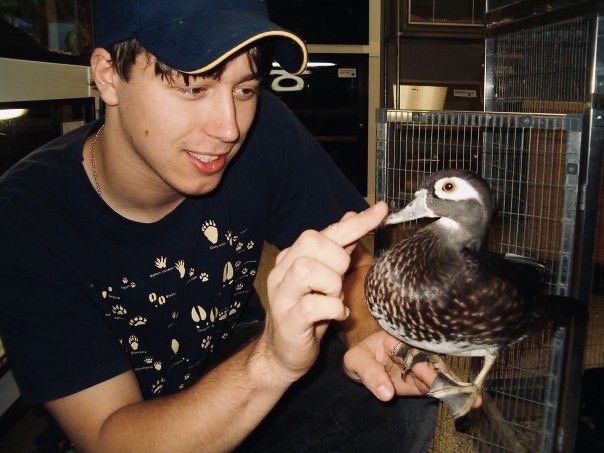
Eric, wildlife care.
What advice do you have for parents who are considering homeschooling their children?
*Avoid dumping a ton of cash into a curriculum or other resources at the outset.
*Give as much time and space as you are able for “deschooling,” the adjustment period after leaving school.
*Build a support network.
*As you’re searching for resources, don’t forget you can create your own. What are you good at? What does your kid love? Don’t get discouraged if something you organize flops, just try again!
*The decision to homeschool is not set in stone. If it doesn’t work for your family, you can always go back to school.
*Be flexible. What works one day, or month, or year, might not work the next.
*Give your kids a voice in the process.
*Prioritize play.
And remember: Don’t forget to have fun! Before you know it, your kids will be grown.

Me and the kids (2015).
Thank you so much, Milva, and congratulations on the new grandbaby!!
To the rest of you: check out this gorgeous article in Mothering magazine written by Milva and her daughter Justine about the births of Milva’s younger two children. Reading it, I cried. (ALSO, the midwife’s quote, “Long is not wrong” applies to so many things, including how people learn. . . and now I have a new motto!)
This same time, years previous: Samin’s soy-braised beef short ribs, overnight baked oatmeal, what kind of stove should we buy?, the quotidian (1.25.16), the quotidian (1.25.16), hobo beans, first day of classes, housekeeping, corn tortillas, thoughts.


