Meet Emma, our new (one-horned) Jersey cow.

We bought her last week from a friend of ours, the same friend who is loaning us the milker. This is her second pregnancy (the first time, she raised her birth calf, plus one more) and she’s due mid-May. Our friend says she has a sweet and gentle temperament, and she’s A2-A2 — some people say the milk of an A2-A2 is easier to digest, so I’m curious to see if my husband does better with her milk. (He still uses store-bought lactose-free milk on his cereal and takes a lactose pill whenever he eats dairy.)
When my daughter and husband drove in with Emma, Daisy went absolutely berserk.


Frantic with excitement, she bellowed and ran back and forth, slipping and falling and frothing at the mouth. She even tried to stick her head through the gate. (Can you imagine if she’d gotten stuck?!)

She was so aggressive and desperate that we started to worry she might try to jump over the fence, or else trample Emma when we let her into the field.

She didn’t, though. Butterscotch and Daisy both chased Emma around for a bit, but things soon settled. Daisy’s even a little scared of Emma now — when Emma’s eating, Daisy hangs back, which is hilarious considering how Daisy towers over Emma.

So, what’s our plan, you ask?
Well….we’re not exactly sure, but the general outline goes like so: We’ll milk Daisy until we’re established with Emma’s milk and once that’s going okay, we’ll probably sell Daisy. In the next couple months, we’ll breed Butterscotch — we’re buying her from our daughter — in hopes of a spring delivery, and then we’ll flip back and forth between the two cows, selling off their calves as we go.
One possible new development: we are considering separating Emma and her calf, switching to twice-a-day milkings, and bottle feeding the calf its portion of milk. Since mama cows hold back the cream for their calves, we’re more likely to get a lot more cream if we separate them, and I would love to start making our own butter and sour cream.
So. That’s the big picture plan, but it’s kinda loose. We know things can go sideways at any point. We might decide it’s too much, or we only want one cow, or no cow. Who knows.
Having a family milk cow started out as an experiment, but it turns out it’s not as overwhelming or complicated as we feared. And it’s good for us! Even though my husband is adamant he’s not a farmer, I’ve noticed that getting outside every morning and completing a one-off task makes him more focused — the structure and routine seems to ground him — and for me, our mornings together in the kitchen have been one of the best things about having a cow. While he strains the milk and washes up, I make his breakfast and lunch, stir the sourdough, brine the cheese, whatever. Working together, we feel more like a team: I’m taking care of him, and he’s taking care of me. It’s nice.
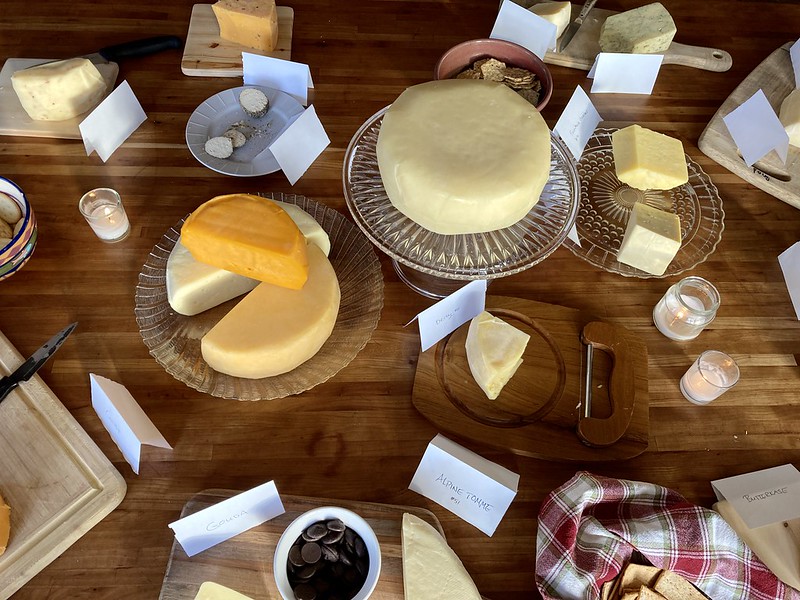
There is one big problem, though: our family is dwindling. While we love everything about having a cow — the routine, the self-sufficiency, the steady supply of fresh milk, the cheesemaking — finding a balance between supply and demand is challenging. Now that I’ve experimented pretty heavily with cheesemaking, I’m ready to pull back a bit (a cheese per week sounds about right) so we’ve got to figure out a way to pace ourselves.
Maybe we should get a couple piggies?
This same time, years previous: sunshine cakes, do you fight with your spouse?, the coronavirus diaries: week six, feeding my family, gado gado, beginner’s bread, right now, wrangling sheep, crispy almonds, fun and fiasco: chapter two, deviled eggs, on fire.
