• No longer deprived

    I’m here! I’m back! Did you miss me?

    Our internet connection was out due to one humdinger of a gorgeous snowstorm. It was rough, I tell you—three-and-a-half days without blogs, email, twitter, grooveshark, and my recipe index.

    I feel I’ve lost touch with the rest of the world when my internet connection falters. I guess that just goes to show how distorted my concept of reality is.

    Oh well, the little antennae thingy that got snowballed up on yonder mountain has been un-snowballed (I threatened [only to Mr. Handsome, not to Zeke, the internet guru] to hike to the top of the mountain and fix the thing myself, that’s how frustrated I’ve been), and here I am. And here YOU are. I missed you, my bloggy friends.

    More on The Storm and Life In General soon.

  • Scholarly stuff

    As I’ve said before, I don’t follow any particular curriculum when it comes to homeschooling. I prefer to choose bits and pieces of stuff from a variety of places, relying heavily on the library. I like the freedom that comes from doing things how I (or my kids) want to do them and when I (or my kids) want to do them.

    This past week I got a letter from our public school system asking if we wanted to sign up for a special homeschool curriculum provided (and paid for) by the public school system. Free materials? It sounded like a nice deal—I could use them if and when I saw fit—but then I read the next line: Your children would be required to take the SOLs at the end of each year.

    Erp-erp-erp-erp! RED ALERT! RED ALERT!

    Um, thanks, but no thanks. I tossed the letter in the trash.

    Seeing as I’m considering doing away with grades all together (I would rather simply state the kids’ ages instead of pigeon-holing them in a particular grade level) because I think I’ll be homeschooling for the long-haul (at least through 8th grade, maybe) and I’m not following grade levels now as it is. But any switch I make would be more in theory than in real life since at church the kids are divided up by grade, and I don’t make a practice of rocking the boat everywhere I go. (I don’t make a practice of going many places, either.)

    Anyway, the reason I’m writing about this stuff is because we just got some new non-standard educational books in the mail and they are really cool and I wanted to show them to you.


    The first one is Material World: A Global Family Portrait by Peter Menzel. The book is a photo-documentary of thirty families from all over the world, divided by continent, one statistically-average family per country, thirty countries in all. Each section starts with a picture of the family posing with all their possessions on the outside of the house.


    Beside the introductory picture is a list of the family members, as well as a list detailing all the objects in the photo. The next several pages of each section are filled with pictures of the family going about their daily lives, as well as a blurb by the photographer in which he shares some anecdotes of the time spent with the family.


    There are also statistics about the country as a whole and another list with the statistics of that particular family. Yo-Yo is fascinated by one statistic in particular: the family’s per capita income. “They earn as much in a year as Papa earns in a day (or week or month)!” They are also fascinated with how many hours each parent works and that the women usually work more hours than the men.


    So many discussions and applicable lessons can come from this one book. Some ideas include: a) having the children make a list of all our possessions; b) selling some of our possessions and donating the money to an aid organization; c) just plain weeding through our material excess and foisting it off on Gift and Thrift; d) including the children in our annual bet; e) inviting guests of other nationalities for dinner and getting them to tell us stories from home; f) better yet, getting them to cook an ethnic dinner for us; g) preparing a dish from the country under scrutiny using Extending the Table cookbook, and so on.

    When it comes to teaching (and gaining) perspective, this book is a gem.

    Speaking of gems, we have started chemistry.


    I read about Theodore Gray in my Home Education Magazine and then promptly ordered two of his books: The Elements: A Visual Exploration of Every Known Atom in the Universe and Mad Science: Experiments You Can Do at Home—But Probably Shouldn’t. We are reading through the first book, taking an element at a day.


    It’s way above the kids’ heads (and a bit above mine), but they’re getting the gist of the idea—that our physical world in made up of 118 elements that can not be taken apart into something smaller though they can be joined together to make something new, like pencils, blood, and pavement.

    The first few pages of the book outline the periodic table, but the bulk of the book is dedicated to the elements themselves. Each element has two pages: the first is a photograph of it in its raw form (if possible) and the second page lists the details—the atomic weight, density, radius, and crystal structure, as well as interesting tidbits (“sulfur is also one of the three basic ingredients of gunpowder, and thus has the blood of millions on its hands”) and examples of the different forms the element takes on in everyday life.


    This book makes me want to construct models of atoms, so I may need to find a standard chemistry 101 book as well as a kit for the next teaching episode.

    How much do you remember from your highschool chemistry class? Are you up for a pop quiz? Can you identify these elements?

    Element Number One:


    Element Number Two:


    Element Number Three:


    Element Number Four:

    Element Number Five:

    The experiment book is pure fun, but at this point it’s still mostly for me since the kids don’t quite get Gray’s subtle humor or the bizarre dangerousness of some of the experiments (though his opinion on safety goggles comes across nice and loud).


    But that’s okay, we’ll read bits and pieces and over time and they will absorb some of what it means. If nothing else, I hope it gives them an appreciation for chemistry.

    Okay, kids, here’s a cooking project for you. Dig out the fire extinguisher that’s buried behind the box of recycling under the kitchen sink, empty it into a pillow case, and whip yourself up a nice bowl of ice cream. (He doesn’t say it exactly like that.)


    Needing a new pair of pantyhose, anyone?


    And in this maverick fashion, we learn.

    About One Year Ago: Lemon Cheesecake Tassies.

  • Most excellent

    It used to be, in the day before food blogs, or at least in the days before I knew they existed, I would go to Barnes and Noble or Books-A-Million, buy a coffee, and then lose myself in the cookbook section. I carried a little notebook and pen with me and whenever I spied a recipe that appealed to me, I wrote it down. Sometimes I would hit the bookstores with a certain type of food in mind, like smoothies or tarts, but more often than not, I just free-wheeled my way around. In this way I discovered some real keepers—the pesto torte for one.

    On one such visit, I fell in love with The All-American Cookie Book. I pointed it out to Mr. Handsome (he must of been along with me which was pretty unusual since he hates hanging out in commercial establishments, including restaurants [woe is me!]) and later on (the same night? a month later?) I discovered the coveted book lying on my pillow when I went upstairs to our bed under the eaves.

    Over the subsequent years, I have made many a cookie from that book, but one of my favorites (of all the cookies I’ve tried, I’ve latched on to two in particular) is the Cranberry-White Chocolate Cookies.


    Oh my stars and heavenly angels, these cookies are dangerous addicting: rich, chewy, tender, tart, sweet, creamy, crunchy.


    Wait. Did you catch that? Let me run those adjectives past you again. Listen up real good.

    Rich.
    Chewy.

    Tender.
    Tart.
    Sweet.
    Creamy.
    Crunchy.

    That’s a heck of a lot of variety in one little cookie! These babes are over-achievers. They are go-getters. They are Something Else.


    These cookies remind me of the ice cream from Cold Stone Creamery in that they have almost as many add-ins as they do base. There doesn’t seem to possibly be enough dough to hold the giant pile of nuts, chocolate, and fruit together, but never fear, there is. Everything melds together perfectly.


    I munched my way through the mixing (Ooo! there’s a piece of chocolate… Ooo! lemme try a fresh cranberry with ANOTHER piece of chocolate … Ooo! how about a dried cranberry with a fresh cranberry AND a pecan … Ooo! now I need to taste them ALL together … and repeat) and baking (Oops, that cookie cracked in half … Oops, THAT cookie cracked in half …. Oops… and so on and so on) of a double batch and now I feel slightly ill.


    Yet I still have to engage in psychological warfare to keep my butt in this chair and my fingers on the keyboard and away from the rows of cookies.


    Cranberry-White Chocolate Cookies
    Adapted from The All-American Cookie Book by Nancy Baggett

    Nancy says that the lemon glaze in optional, but I beg to disagree. It’s true, the cookies are plenty delicious without the icing, but the citrus-y tang in the icing blends perfectly with the cranberries, cinnamon, and chocolate—the two forces working together knock the cookies completely out of this world.

    I use the glaze very sparingly, so one recipe is enough for a double batch of cookies.

    Update December 17, 2022: these are often too flat and delicate. Add a couple tablespoons more flour next time.

    1 cup butter
    1 cup packed brown sugar
    1 large egg
    1 ½ teaspoons orange zest
    2 ½ teaspoons vanilla
    1 2/3 cups white flour
    1 teaspoon cinnamon
    1 teaspoon baking powder
    1/4 teaspoon baking soda
    1/4 teaspoon salt
    1 ½ cups (6 ounces) chopped pecans
    1 ½ cups (6 ounces) dried cranberries
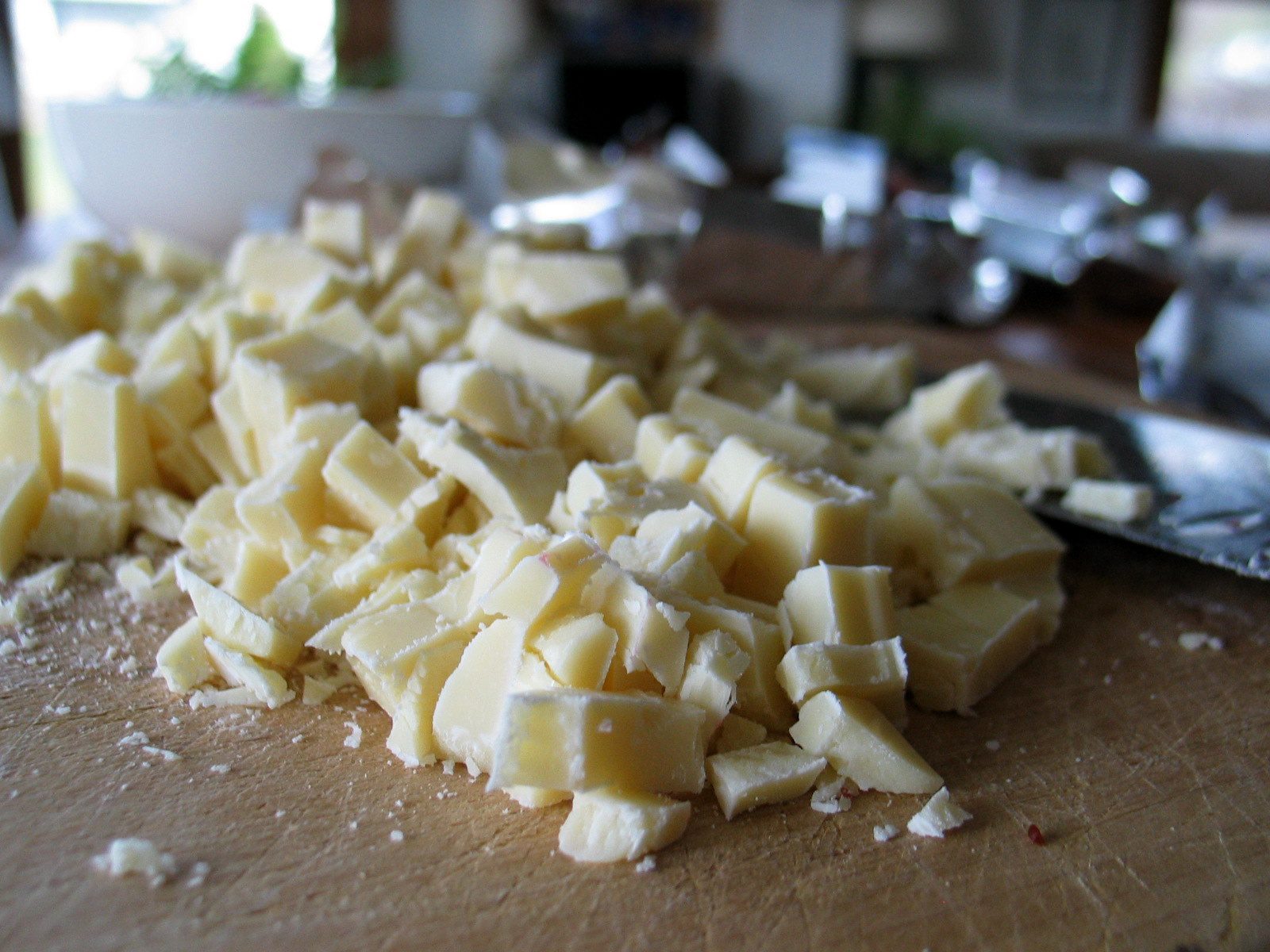
    1 1/3 cups (8 ounces) white chocolate, chopped
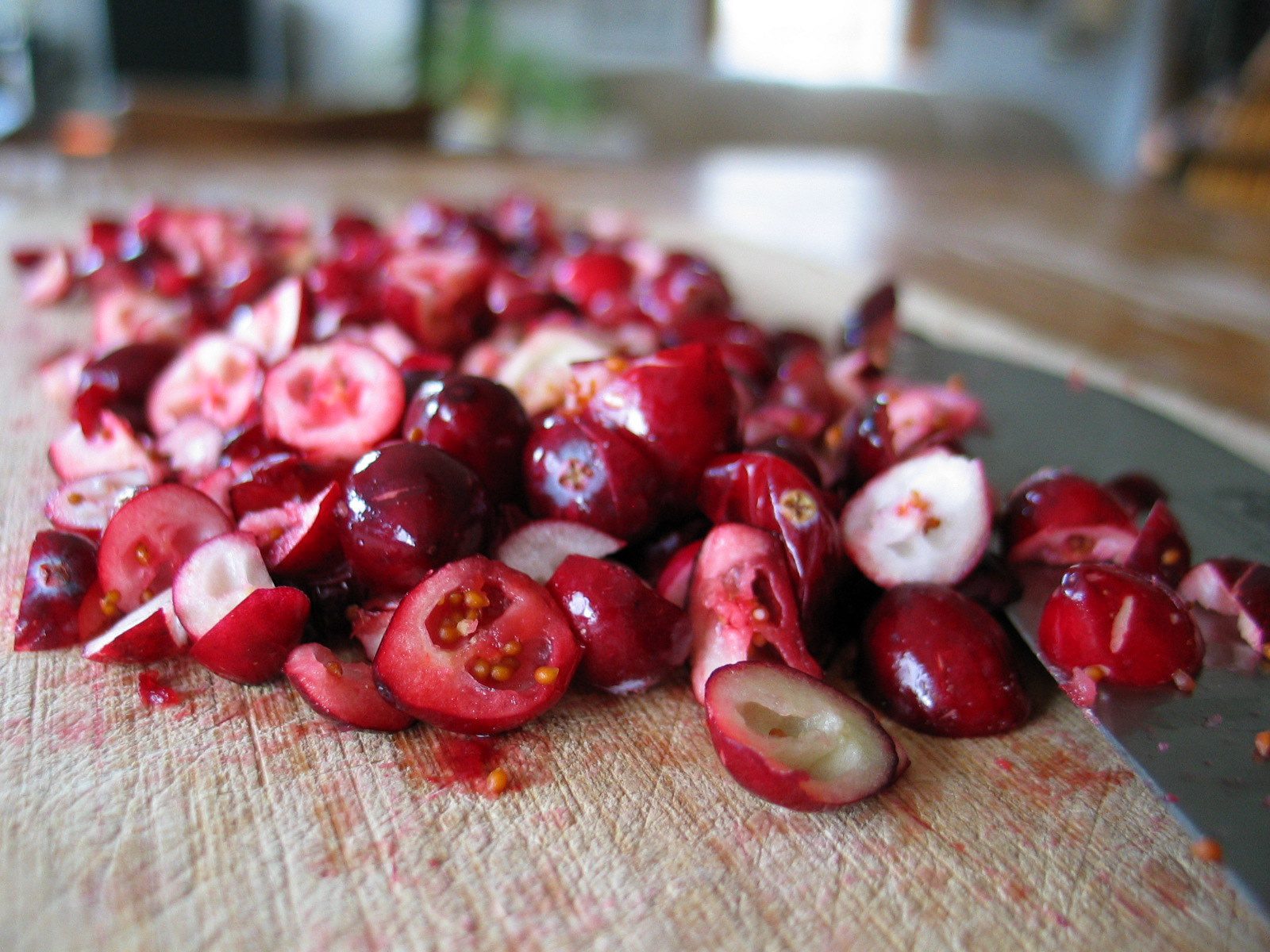
    ½ cup fresh cranberries, chopped
    1 recipe lemon glaze (recipe follows)

    Cream together the butter and sugar. Add the egg, zest, and vanilla and beat some more.

    In a separate bowl, stir together the flour, cinnamon, baking powder, baking soda, and salt. Add the dry ingredients to the butter mixture and beat together.

    Add the nuts, fresh and dried cranberries, and white chocolate and stir to incorporate.

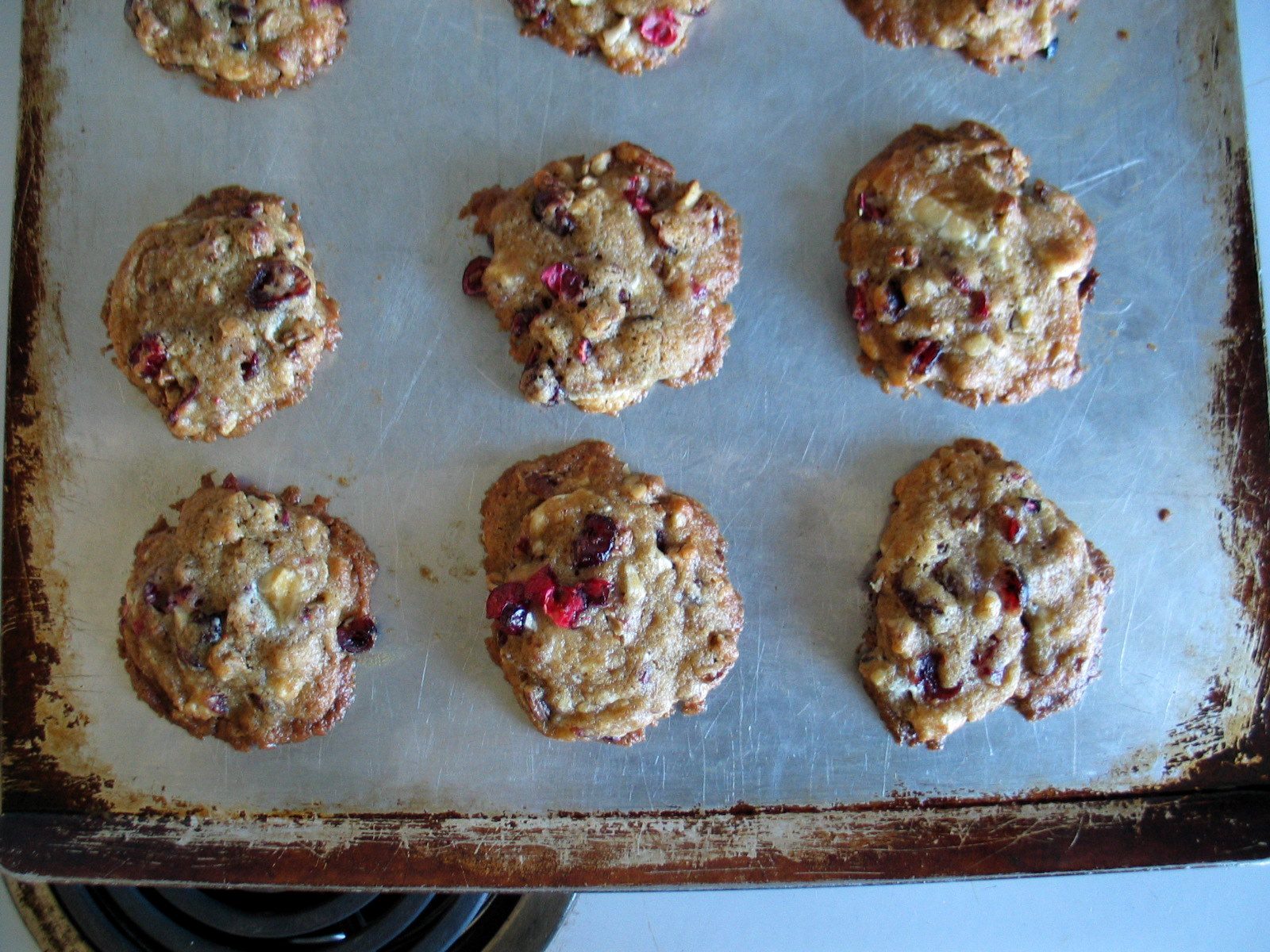
    Scoop out the cookies, about a tablespoon of the dough per cookie, and place them on a greased baking sheet, leaving about two inches between cookies as they will spread a bit. Bake the cookies at 350 degrees for about ten minutes, or until the edges are lightly brown but the centers are still soft but no longer wet.

    Let the cookies remain on the baking sheets for at least a minute, but no more than two (if left on the tray too long, they will harden and then crumble when you try to lift them off), to firm up a bit. Transfer the cookies to a cooling rack to cool completely.

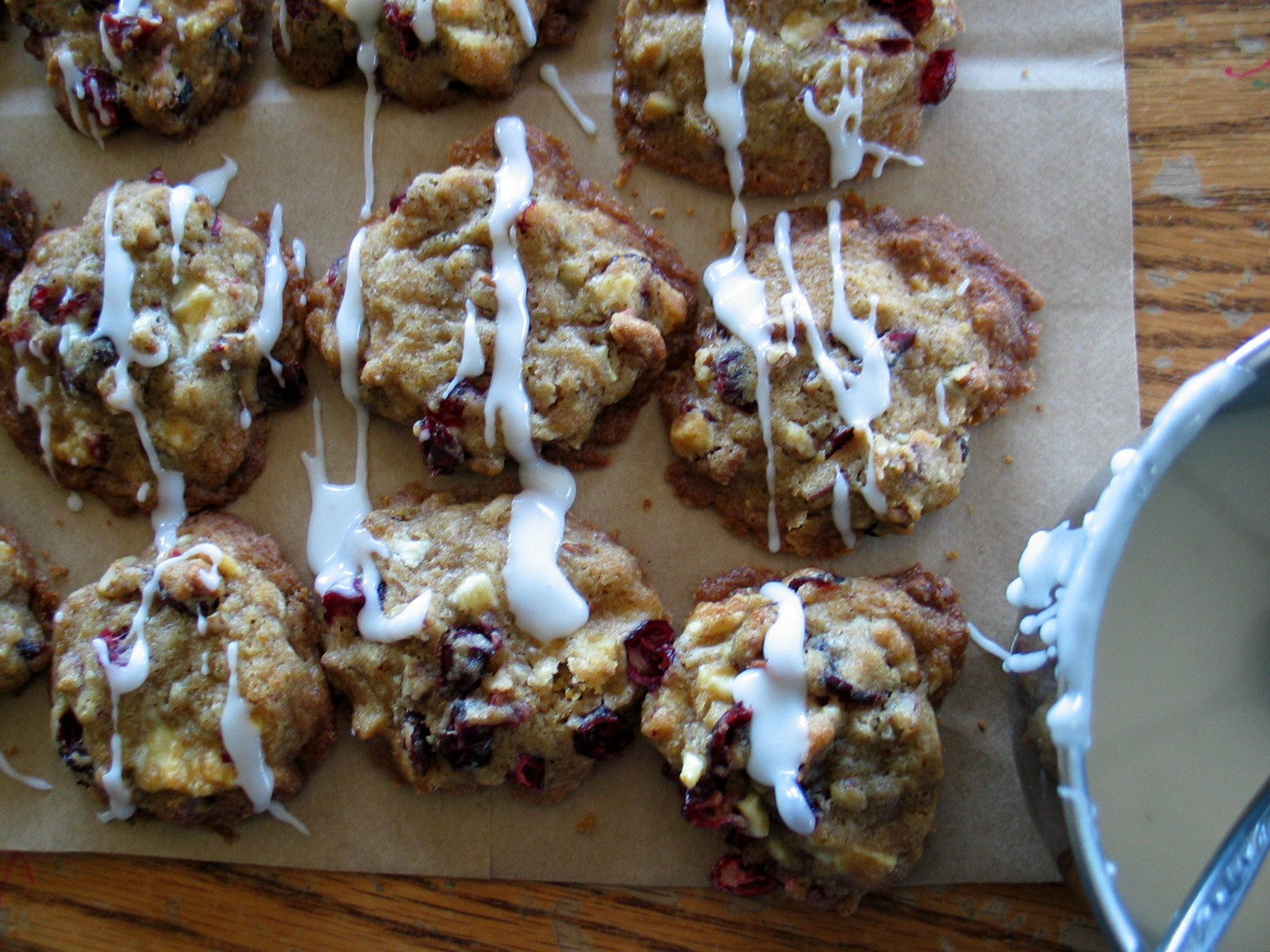
    To drizzle the glaze over the cookies, place the cookies close together on a cut-open brown paper bag (when done, just chuck the paper in the garbage—makes for easy clean-up) and wave a fork-full of icing back and forth over the cookies to make a pretty pattern. When the icing has hardened, store the cookies in plastic containers between layers of wax paper (so they don’t stick together) and freeze.

    Yield: About 3 dozen cookies

    Lemon Glaze
    1 cup powdered sugar, sifted
    1 tablespoon fresh lemon juice
    1/8 teaspoon vanilla
    1-2 teaspoons water

    Mix together, adding more water if necessary in order to make a glaze thin enough to drizzle.

    About One Year Ago: Walnut Balls.