• An effort

    I’m feeling mentally stodgy and sluggish. My mind isn’t a-simmer with things to write about, but I want to produce something—the chicken-cheese lasagna sitting on the counter waiting to go into the oven wasn’t enough of a creative production, I guess. (Maybe I should announce a game, such as “Incite Mama JJ: The person to suggest the topic that gets her the most fired-up wins.” Then again, that sounds rather dangerous. I don’t think I want to go there.)

    In an effort to get my mental juices a-flowin’, I perused the chapters of our book, looking for some inspiration. The chapter on marital conflict holds all sorts of juicy stories, but they are long (we fight a lot) and detailed (to be fair, all sides must be duly expounded upon), making it rather difficult to find a post-appropriate excerpt. However, I did pick out one of the shorter stories to share. Maybe I’ll dig into the bigger picture later.

    So, in regards to marriage…

    ***************************************

    Mr. Handsome and I have at various times sought outside help. Before our engagement we met with two people from my congregation to ask if they saw any red flags in our relationship. None? Okay then! On to premarital counseling and the wedding!

    Off and on, since then, we have gone for counseling. Nothing earth-shattering has ever resulted from the sessions, though I always secretly hope that the counselor will wave a magic wand and say, “Sha-zam! This is The Problem and this is The Fix!” But a third person’s observations of our interactions forces us to articulate our thoughts and challenge each other in a more civil fashion than what usually happens when we’re in our home, out of sight of critical eyes.

    We’ve also resorted to pop psychology from books and magazines. In one of those articles (I don’t remember which magazine I found it in) I read about a marriage covenant, so I got Mr. Handsome to sit down with me to outline our goals for our relationship so that we would have something to refer to when we had to make an important decision. Mr. Handsome was grumpy about the whole thing, but I persisted, typing up the results and sticking the paper to our fridge.

    I’ve also read a book about love languages, the different ways that people give and receive love. Several months ago I proposed to Mr. Handsome that for one week we try to love the other person in the ways they want to be loved, not how we think they should be loved. Much to my disgust, he declined. “I don’t know how you want to be loved, and I don’t know what I want.”

    “Bullcrap!” I yelled. But he wouldn’t budge.

    This past weekend I proposed it again—“what do you have to lose, huh?”—and to my delight he agreed. We even shook on it. So from Saturday night at midnight till this Saturday night at midnight I am to think of what he needs and wants, anticipate him, and do everything in my power to make him happy.

    But for me, the converse is much more difficult. How can I let go of my expectations and have faith that he will rise above his chronic self-absorption, as mom so nicely describes it, to take care of me?

    Last night, coming home late, I caught myself wanting to complain about the unswept floor. He usually cleans it if I’m gone, and often when I’m not. Let it go, I chided myself. Just trust him. However, I wasn’t able to completely refrain and scrutinized the floorboards a little too pointedly (nagging dies hard). He noticed, but instead of making a snide comment or ignoring me, he said cheerfully, “Don’t worry, I’m going to sweep in a minute.” The communication was dizzying! Here was my knight in shining armor, broom in hand, fighting for my needs. I nearly swooned.

    So maybe this would be a good new rule: just love your mate in his lingo.

  • And thus begins

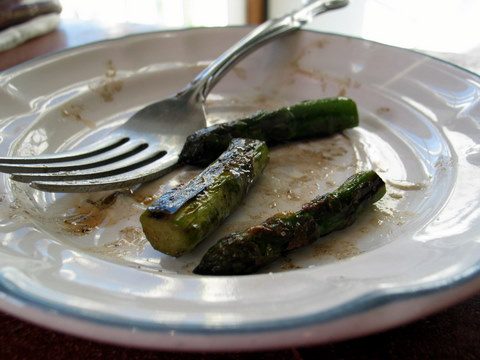
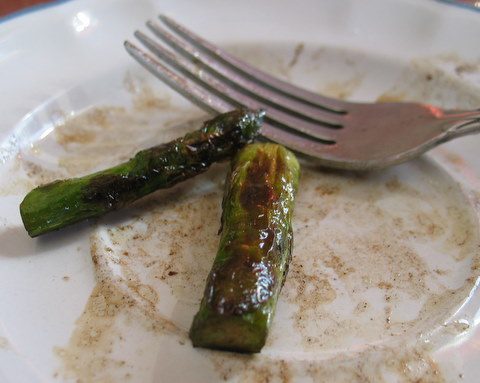
    I picked the first asparagus yesterday afternoon. There wasn’t much, just enough for Mr. Handsome and me to each have a serving (we told the kids they couldn’t have any; half-hearted reverse psychology that didn’t work).


    When the asparagus pops up I feel like shouting with happiness “Now we won’t die of scurvy!” Because my basement is still well-stocked, despite my best intentions, with oodles of canning and freezing, I think this asparagus-induced relief must be some sort of primal response that all people have: Green things in the spring make us feel that we can go on.


    I ran down cellar and brought up three trays of canned goods to restock our jelly cupboard. I’m attempting to be ruthless with the consumption of our jar-ed produce. It’s easier to fight my hoarding instincts when there is asparagus.


    In her book Animal, Vegetable, Miracle, Barbara Kingsolver says all sorts of notable things about asparagus, my favorites of which are:

    *Contrary to lore, fat spears are no more tender or mature than thin ones; each shoot begins life with its own particular girth.

    *Older, healthier asparagus plants produce chunkier, more multiple shoots. Underneath lies an octopus-shaped affair of chubby roots (called a crown) that stores enough starch through the winter to arrange the phallic send-up when winter starts to break. The effect is rather sexy, if you’re the type to see things that way. Europeans of the Renaissance swore by it as an aphrodisiac, and the church banned it from nunneries.

    *The earliest recipes for this vegetable are about 2, 500 years old, written in ancient Greek and Egyptian hieroglyphics, suggesting the Mediterranean as the plant’s homeland.

    *Asparagus even inspired the earliest frozen-food industry, in the first century… all so it could be served with a big ta-daa at the autumnal Feast of Epicurus.

    *It’s best eaten the day it is cut, period …. The fresh stems have the tight, shiny sex appeal of dressed-up matrons on the dance floor of a Latin social club, but they lose their shine and crispness so quickly when the song is over. The sweetness goes starchy.

    *It’s distinctive tang derives from glutamic acid, which Dr. Ikeda named “the fifth taste,” or umami.

    *Europeans celebrate the short season of abundant asparagus as a form of holiday. In the Netherlands the first cutting coincides with Father’s Day, on which restaurants may feature all-asparagus menus and hand out neckties decorated with asparagus spears.


    Skillet-Blackened Asparagus

    asparagus, washed, trimmed, and cut into two-inch spears
    butter
    salt

    Put a cast-iron skillet (should be big enough so that it will hold all the asparagus in one layer) on the stove and turn the burner to medium-high heat. When the skillet is hot, add the butter (don’t be shy) and scrape it around until it has melted.

    Add the asparagus, spreading it out to cover the skillet’s bottom. Allow it to cook for a minute or two before giving the first stir. Salt liberally.

    Keep an eye on the asparagus, giving it an occasional stir or shake until it is no longer watery (the water comes from the asparagus itself—do not add any) and the spears are partially blackened.

    Serve immediately.

  • Burnished


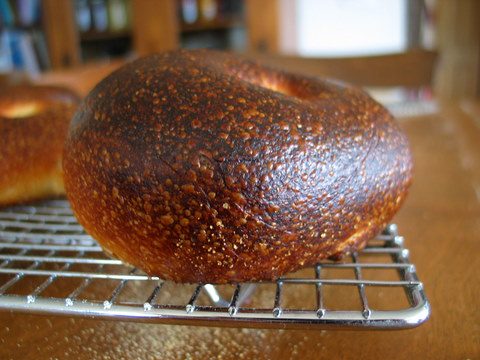
    Burnished. This was the word that popped into my mind when I made these bagels. If someone could’ve seen inside my head, they would’ve thought me certifiably psycho: They are soooo burnished! Shiny and burnished…glossily burnished. Sleekly and sexily burnished. Buuurnished.


    These, hands down, are the best bagels I have ever made.


    I have another recipe for bagels of the commercial yeast variety, and even though I like them a lot, invariably some of the bagel bottoms end up dense and gummy, like noodles. But these, well. I had not a single—not a single!—flop.


    We tore into them while they were still warm. At first I was disappointed because the texture was more bread-like then chewy bagel-like. But after the bagels cooled to room temperature and sat for several hours, they transformed into delicious burnished chewy-nesses. And by day two they were even chewier.


    This is one of the faster sourdough recipes. Just throw all the ingredients in the mixer (the recipe calls for a lot of starter, which is always a plus in my book because then I can get away with making just one recipe for the day and don’t have to feel like I need to make a variety of different breads just so I can use up all the starter), knead it for eight minutes, shape the bagels (it’s actually a fun activity and not a chore at all), put them on two trays, cover them well, and transfer them in the refrigerator to proof till the next day when it’s time to boil and bake them. After a brief dip in a pot of boiling water and fifteen minutes in a hot oven, they are done.


    I will be making these beauts every time I do a round of sourdough baking. They are an essential bread, one I’ve resolved to have on hand at all times.

    Bagels
    Adapted from Nancy Silverton’s Breads from the La Brea Bakery

    Update September 10, 2022: I think the bagels need more salt. Might want to consider increasing to 4 teaspoons.

    Update October 13, 2022: this recipe is easier, faster, better!

    12 ounces (1 ½ cups) cool water
    2 teaspoons yeast
    13 ½ ounces (1 ½ cups) white starter
    2 pounds (6 ½ cups) high-gluten flour or white bread flour
    6 tablespoons wheat gluten (if not using high-gluten flour)
    1/4 cup sugar
    4 teaspoons salt
    2 tablespoons barley malt syrup
    6 tablespoons milk powder

    Day One:
    Put all the ingredients in your standing mixer and mix on low speed for one to two minutes. Turn the mixer up to medium speed and mix for another 8 minutes, or until a thermometer reads 75 degrees when plunged into the dough. Let the dough rest for ten minutes.

    Line two baking sheets with parchment paper and sprinkle them with cornmeal or semolina flour.

    Divide the dough into 18 four-ounce pieces. Roll each lump of dough into a 6-8 inch rope, then loop it around so that the ends overlap by about 1-2 inches. With the fat overlapping part of the bagel in the palm of your hand and the skinny part of the bagel over the back of your hand, press your hand down on the counter and roll back and forth, pressing the bagel ends together. (It’s much easier than it sounds.) Repeat with all the lumps of dough.


    Place the shaped bagels on the prepared baking sheets, leaving an inch or two between each bagel.


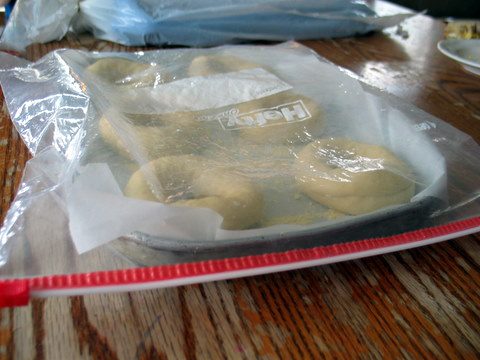
    Slip the sheets of bagels into a large bag, tie it shut, and put them in the refrigerator to proof for 12-24 hours.


    Day Two:
    Remove the bagels from the refrigerator, uncover them, and let them proof at room temperature for about 20 minutes.


    Put about four inches of water in your widest (not deepest) kettle and bring it to a boil. (You may want to add something to the water to enhance the bagels, but it isn’t necessary. Brown sugar, baking soda, or salt are the most common additions, I think.) At the same time, preheat your oven (and baking stone, if using) to 450 degrees.

    When the water is rapidly boiling, gently drop in three or four bagels. Boil for 20 seconds on each side, flipping them over with a slotted spoon.


    Carefully remove the bagels, one at a time, from the water and place them, smooth side up, on the preheated baking stone (that you generously dusted with cornmeal after heating). Once your baking stone is filled, bake the bagels for 15-20 minutes.


    Wait to boil the remaining bagels until the first batch is out of the oven since it is important to get the bagels out of the boiling water and into the oven as quickly as possible—you don’t want the boiled bagels to sit around at room temperature for too long.

    They keep well at room temperature for two or three days. If freezing, cool completely before bagging.

    Note: I’m submitting this post to Yeast Spottings.