• Making me think

    Some thoughts to chew on, from Marianne Williamson.

    “Our deepest fear is not that we are inadequate. Our deepest fear is that we are powerful beyond measure.

    It is our light, not our darkness, that frightens us. You are a child of God. Your playing small doesn’t serve the world.

    There’s nothing enlightened about shrinking so that other people won’t feel insecure around you.

    We were born to make manifest the glory of God that is within us. It’s not just in some of us, it is in everyone.

    And as we let our own light shine, we unconsciously give other people permission to do the same.

    As we are liberated from our fear, our presence automatically liberates others.”

  • The fourth plague

    “What is the purpose of flies, anyhow?” I blurted.


    Friends and family had joined us for dinner and we were still lounging about in our chairs, sated with the multiple pieces of pie we had just eaten: quiche, chickpea and chard, peach, rhubarb, blackberry, and sour cherry (yes, I was a bit insane to undertake such a project, but by the time I realized that, the work had been completed and we were happily full). The annoying black critters were zipping about our heads as energetically as ever, reminding me of the question that Yo-Yo had posed to me earlier and prompting me to toss it out to the group.

    The answers were varied: “For the frogs … A plague to keep us humble … It flies in the face of reason.” In other words, nobody knew.

    Our fly infestation hit an all-time high the following night. When we got up from dinner we discovered that the kitchen floor was covered with flies. Every time one of us walked to the fridge, to the stove, to the sink, swarms rose up into the air, a seething cloud of filth. It was unbelievably disgusting.

    We quickly went about washing dishes, putting food away, hanging an extra fly tape, and vigorously smacking the darn things in a wild wholesale slaughter. I went from one side of the kitchen smack-smack-smacking with my Tiny-Little Brother coming along behind with the vacuum suck-suck-sucking. As soon as he cleaned one area of the floor and moved to the newest battlegrounds, I went back to the cleaned section and dirtied it all over again. After about fifteen minutes of methodical mass murder, we were down to a permissible number of flies.

    The next morning Mr. Handsome attempted a homemade flytrap. I chuckled, but didn’t poke too much fun—if his method worked, I was willing to wreath our house with syrup-and-vinegar-filled plastic milk jugs.


    But it didn’t work, and we’re back to our standard green-and-yellow art decor—at least it matches rather well with our table lamp. Kind of whimsical, I think. The gooey flies occasionally drip off down on to the table, so it’s advisable not to eat raisin bran anywhere in the vicinity.

    During fly season I spend a lot of time thinking about shoofly pie. For real. I go around saying: I am so sick of these flies! This is disgusting! This is unspeakable! Scram! Get out of here. Die! SHOO! And then I think: Pie.

    Shoo + Fly = Pie. It’s a basic cultural/culinary equation. It’s like that word association game that tells how smart you are. Someone shouts out “murder” and then you say “knife, dead, cold-blooded, assassin, and flyswatter!” Or they call out the word “fly” and you say “buzz, annoying, filthy, flyswatter, and pie.” Then the evaluator knows that not only are you a certifiable genius, you also hail from hearty Pennsylvania Dutch farmer stock. Moo.


    In between smashing flies and wiping them up (yes, I’m the heavy-handed swatter-er type—the flatter the fly the better), I’ve been attempting to perfect my shoofly pie recipe. My standard recipe comes from the More-With-Less Cookbook. It’s a cake-top pie with a gooey bottom, but I have trouble with the bottom goo bubbling up and out, leaving me with a mostly dry pie and a very stinky kitchen.


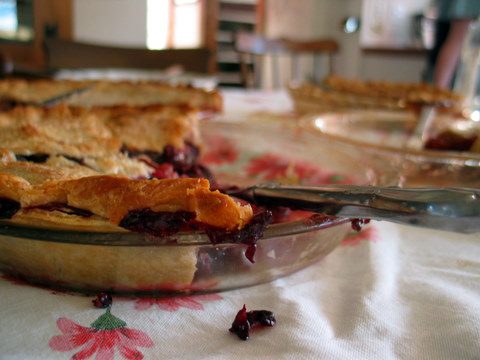
    Then I tried the shoofly pie from The Pie and Pastry Bible. That recipe called for coffee in the liquid mixture, as well as cinnamon and nutmeg, and was baked in a cream cheese crust. It was altogether a different animal from the other recipe, full of complex, intense flavors.


    Even though that recipe (pictured above) was quite elegant, I’m going to go ahead and give you the recipe for the shoofly pie from the More-with-Less Cookbook since it is the most traditional recipe that I know. If you have a shoofly pie recipe that is your all-time favorite, please pass it on to me (keeping in mind that it must have a gooey bottom). There’s a chance it might become my favorite recipe, too.

    Shoofly Pie
    Adapted from the More-with-Less Cookbook

    I suggest using an unsulfured molasses, such as Grandma’s—sulfured molasses has a bitter flavor. If the molasses flavor is still too strong for your taste, you may want to substitute part of the molasses with some light corn syrup, King syrup, or maybe even some maple syrup, though I haven’t tried that myself.

    This pie, if done properly, yields a layer of gooey, molasses-ness at the bottom and a moist cake-top. Make sure your pie crust has no holes or cracks where the liquid filling might leak out, and take care not to over-fill the pie. Mark my words, it is better to throw out a couple tablespoons of filling than to burn up the extra on the floor of the oven!

    1 cup flour
    ½ cup brown sugar
    2 tablespoons butter
    1 cup molasses
    1 egg, beaten
    1 cup water, divided
    1 teaspoon baking soda
    9-inch pie crust, unbaked

    Using your fingers, mix together the flour, brown sugar, and butter until crumbly and fine. Set aside ½ cup of the crumbs to sprinkle on top the pie before baking.

    Dissolve the baking soda in 1/4 cup of warm water (not hot, as hot water will activate the baking soda and cause it to lose its magical powers).

    In a large mixing bowl stir together the molasses, egg, remaining 3/4 cup of water (cold this time—you don’t want to cook the egg), and then add the dissolved baking soda. Add the crumb mixture (not the reserved half-cup portion) and stir well before pouring into the pie shell. Sprinkle the remaining crumbs over the top.

    Bake the pie for about 35 minutes at 375 degrees, until no longer wibbly-wobbly and the cake top springs back when you touch it with your finger.

    Serve warm with cold milk, whipped cream, or vanilla ice cream.
  • How it came to be


    I’ve been planning to post this chicken dish, one of my favorite recipes from the More-With-Less Cookbook. I was going to talk about how my children are gong-ho over it and how Sweetsie ate three pieces the night I served it (not to mention the piles of brown rice, green beans, applesauce, etc). But then, this past Sunday our class had the privilege of discussing the story of the renowned cookbook with the deceased author’s husband Paul who, lucky-for-us, attends our church.

    Like me, most of the other class members had grown up with the book and are plenty used to tossing around the term “more-with-less.” Our class had been discussing the economy (among other things) and found ourselves musing over how our parents’ generation was so much more thrifty than our generation is now. And then we started talking about the cookbook that had come out when we (some of us, anyway) were just little squirts running around in cloth diapers, and had been so formative in shaping our present-day Mennonite identity. As we talked it gradually dawned on us that Hey! The one person who knows the most about the book attends our church. Let’s get him to come talk with us!

    And so he did. Paul came prepared with notes that he had unearthed from some archives and with a tote bag full of cookbooks, one of which was his wife’s own personal copy. He also had copies of the German and Japanese translations, as well as the cookbook’s sequels and the children’s cookbook (which I couldn’t help squealing over: I cooked out of this!). We passed them around, sniffing the old-book smells, trying to sound out the German word(s) for baking powder (I think), and pointing out favorite recipes, all the while listening to Paul as he talked.

    The More-With-Less Cookbook came about as a result of the food shortage crisis in the mid-1970’s. During that time the Mennonite Church sent out a memo (which Paul wrote) to all the churches urging members to, among other things such as cutting back on gas usage, reduce their food expenditures and donate the saved money to Mennonite Central Committee.

    Over a picnic supper one night, some friends said to Doris and Paul, “What we need is a new Mennonite cookbook.” The idea stuck with Doris and she eventually decided she’d like to tackle such a project. Her only hesitation was that the current Mennonite cookbook, Mennonite Community Cookbook by Mary Emma Showalter, was extremely popular, practically the bible of Mennonite cooking, and Doris didn’t want to trod on Mary Emma’s toes. Doris finally decided to contact Mary Emma and ask her blessing on the project, which Mary Emma gracious granted. (By the way, when I was in college I cleaned Mrs. Showalter’s house a couple times—the only thing I remember is that I didn’t know how to replace the foil under the electric stove’s burners and she had to show me.)

    Doris sent out recipe requests to people all over the country, and especially to people who were living overseas (or who had lived overseas) and knew an extra thing or two about making do with less. Recipes poured in, were tested, and in less than two years about one-fourth of the recipes they had received were published in the cookbook.

    They printed fifteen thousand cookbooks at the first printing, though they were worried they might not all sell. It was a needless worry—the books sold almost before they hit the shelves, and they had to print another ten thousand every couple weeks to meet the demand. Today over 800 thousand More-With-Less Cookbooks have been published. (Paul said that Doris decided to keep the first ten thousand dollars from the royalties as payment for her two years of work—any money that exceeded that went to Mennonite Central Committee. Paul followed the same policy when Living More-With-Less was published. I think he said that the books earned MCC well over a million dollars.)

    Doris was working on her second book, Living More-With-Less, when she died in the late 70s. The sequels to the More-With-Less Cookbook, Extending the Table and Simply in Season, came out in 1991 and 2005 respectively. I call the series the Mennonite Cookbook Trilogy, and they are my go-to gifts for weddings and graduations and housewarmings.

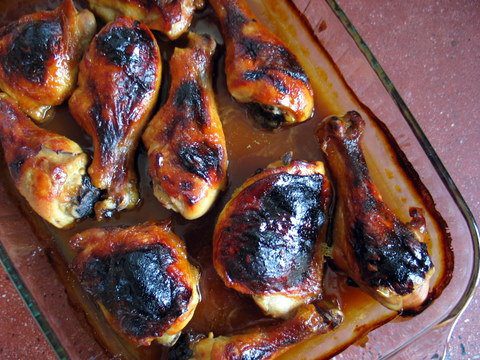
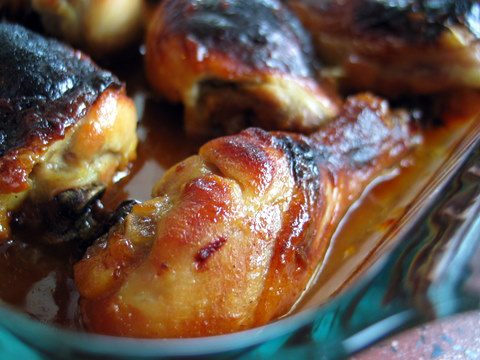
    Honey-Baked Chicken
    Adapted from the More-With-Less Cookbook.


    I upped the amount of butter and honey (and the seasonings accordingly) in order to make the dish a little saucier, but even so, it’s not an overly-saucy dish. All the saucy drippings get squabbled over and greedily slurped up.

    My mother sometimes substitutes brown sugar for the honey.

    You could cut back on the butter, if you are so inclined. Maybe add some chicken stock instead.

    1 3-pound chicken, cut up
    ½ cup butter
    ½ cup honey
    2 tablespoons mustard
    1 1/4 teaspoon salt
    1 1/4 teaspoon curry powder

    Arrange the chicken pieces in a 9 x 13 pan.

    Melt the butter in a saucepan and add the rest of the ingredients, stirring until combined. Pour the warm sauce over the chicken pieces.

    Bake the chicken, uncovered, at 350 degrees for 60-90 minutes, periodically spooning the sauce over the chicken pieces. The chicken is done when it is nicely browned.

    Serve with rice.