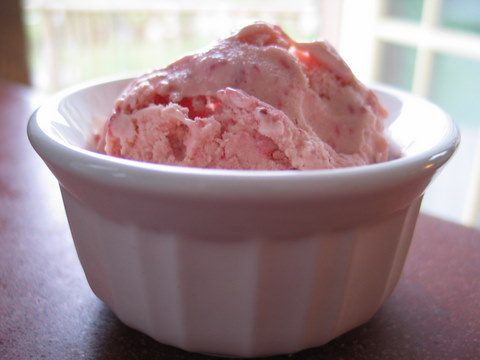
• A last hurrah

    I’m cramming in the kitchen. I have so much to bake/cook/create and so little time. I know why I’m panicking, though. It’s because this is the last I’ll have any amount of time for creative cooking before the garden takes over and I’ll be hunched over a hot stove, slinging food into the freezer/canner at breakneck speed.

    It makes no sense really. It seems like summer would be the best time to experiment with all sorts of new recipes: pestos from different herb combinations, unusual green bean dishes, exotic berry tarts, etc. But by the time the produce starts rolling in, I’m just scrambling to keep my head above water and have zero time to ponder and experiment.


    Because for me, experimentation is a time-consuming affair. First, I read. I type an ingredient into Epicurious, or look it up in the back of a cookbook (Simply in Season is my go-to book for this kind of research), and then I browse through the recipes, looking for ones that we’ll like, that use up a lot of the specific ingredient (a half cup of fresh peas isn’t going to make a new recipe worthwhile when I have an abundance of peas), and that aren’t too complicated. I ponder and scribble notes and make plans, frittering away the minutes in a happy stupor, dreaming up a storm and cooking nothing.

    Fact: dark winter evenings by the wood stove are great for this mulling and stewing—not busy-till-bedtime summer days.

    All this to say, over the past couple dreary cold weeks I’ve been throwing a last hurrah, dreaming and experimenting, mostly with pies, breads, asparagus, and rhubarb. Just to give you a little feel for what that means: Saturday’s plans included not only working in the garden as much as possible and washing mountains of laundry, but I also hoped to make something nourishing that could be called supper, as well as an apricot-almond pastry, a rhubarb tart, a creamed asparagus soup, a newfangled (to me) French-tart crust, rhubarb punch, more rhubarb jam, and some more cream cheese pastry cookies. I’ll not going to tell you what did and didn’t get done, except to say that the dirty laundry is still dirty because it rained and it’s evidently supposed to rain for the next eternity so we’ll soon be walking around in just our birthday suits and there will be no more pictures of us on this here blog. (Giving you fair warning.)

    I dream big, and I pop my own bubbles. Don’t you come after me with any pins, okay?

    It’s one of life’s basic principles: when you have a lot of something, you have less of something else. When you have more daylight, you have less nightdark. When you have a lot of food on hand, you have less time to cook it. When you spend more time creating good food, you have less time to talk about it. When you have more cream, you eat more ice cream. Wait a sec—my theory just fell apart. Let’s move on … to rhubarb pie!


    Mm. This is a good place to be.

    This is a straightforward rhubarb pie, the classiest of the classy. It showcases the tart fruit (er, vegetable) which has undergone the simplest of preparations—chopped and then tossed with sugar, cornstarch, a pinch of salt, and some lemon zest.

    The crust, a cream cheese pastry, is as important as the fruit, a delightfully rich, buttery affair—not the type of crust that gets left behind on the plate.
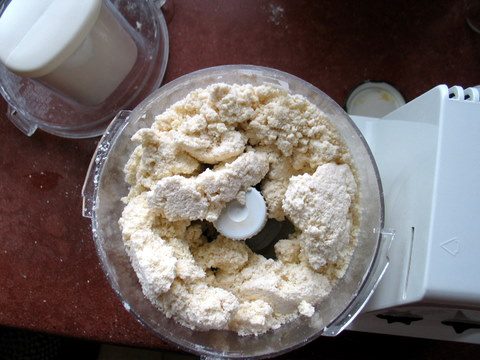

    The rhubarb filling seems scant in contrast to the abundance of crust but it turns out perfect, in part because the crust is so good, but also because the fruit is so tangy-tart—the buttery crisp crust is a perfect foil for the sharp fruit. Whipped cream puts it over the top.


    The pie is best served the day it is made—that’s when the crust is crispest—but the second day the fruit mellows and the crust softens, making the pie delicious in a whole new way.

    Cream Cheese Pastry
    Adapted from The Pie and Pastry Bible by Rose Levy Beranbaum

    I’m giving you the recipe for a nine-inch double crust because you will want pastry leftovers. I’ll tell you why later, but for now save any leftover scraps—simply press them together into a ball, flatten the ball into a disk, wrap the disk in plastic wrap, put the wrapped disk in a plastic bag, and put the bag in the freezer. Trust me.

    Updated on March 16, 2011: do not blind-bake this pastry. It shrivels up and makes holes, like a piece of lace.

    12 tablespoons butter
    2 cups, plus 2 tablespoons, all-purpose flour
    1/4 teaspoon salt
    1/4 teaspoon baking powder
    4 ½ ounces cream cheese
    2 tablespoons cold water
    1 tablespoon cider vinegar

    Chop up the butter and put it in the freezer about half an hour before making the pastry.

    Using a food processor:
    Measure in your flour, salt, and baking powder and give it a couple whirls. Add the cream cheese and pulse briefly (till crumbly). Add the frozen butter and pulse—again, till crumbly. Add the water and vinegar and process till the mixture starts to come together (this takes about thirty seconds in my processor).

    Dump the mixture (it will still be quite sandy) onto the counter, knead briefly (just enough to pull it together—don’t overwork it) and then divide it into two parts, one being a bit larger than the other. Press each part into five-inch disks, more or less, wrap each one in plastic wrap, and set them in the refrigerator to chill for about an hour. (Or, you can double-wrap them and freeze them for several months.)

    Using the hand method:
    Measure the flour, salt, and baking powder into a mixing bowl and stir briefly. Add the cream cheese and use your fingers to mix it in. Add the butter and, working quickly since your hands are warm and you don’t want to soften the butter too much, work it in till you have a pebbly/sandy mixture. Knead in the water and vinegar. Shape into disks, wrap them in plastic, and refrigerate.

    Classy Rhubarb Pie
    Adapted from The Pie and Pastry Bible by Rose Levy Beranbaum

    4 cups rhubarb, cleaned, trimmed, and cut into ½-inch pieces
    5 teaspoons cornstarch
    2/3 cup sugar
    1 teaspoon lemon zest
    pinch of salt

    Toss together all the ingredients and macerate for about fifteen minutes.

    To shape the crust and assemble the pie:
    Place a baking stone on the bottom oven rack and preheat the oven to 425 degrees. This is one of the things I learned from Rose: placing the pie plate directly on the hot baking stone gives the pastry crust a crispy golden brown bottom and does wonders in eliminating the Soggy Pie Bottom Problem.

    Remove the disks from the refrigerator and let them rest on the counter for about ten minutes. Unwrap the larger of the two disks, situate it in the middle of a piece of plastic wrap and place a fresh piece of plastic over top. Using a rolling pin, roll the pastry into a large circle, to about an eighth-inch thickness. This step requires a lot of elbow grease and much umphing and oofing, and maybe even a few gentle curses, but it will eventually do what you want it to. I often peel off the top piece of plastic, lay it back down, flip the whole thing over, loosen the bottom-now-top piece of plastic, lay it back down, and then roll from that side. When you’re ready to fit the crust into the pie plate, do the whole peely-flippy routine that I just described, except that instead of laying the bottom-now-top piece of plastic back on, you leave it off, slip your hand under the bottom plastic and invert the whole thing into the pie plate.

    Have I totally lost you? Am I making any sense at all? Is anyone still even reading this???

    Gently press the pastry into the pie plate, smoothing out the air bubbles. Peel the piece of plastic wrap away from the pastry (the one that was on the bottom but is now on the top, of course), and trim off the excess pastry.

    Relax your shoulders. Take a deep breath. Think about weeping willow trees by a rippling brook. You’re doing great.

    Put the rhubarb in the pie shell.

    Roll out the second crust into a rectangle. Cut it into long skinny strips. Weave the strips over the rhubarb. I’m not even going to try to explain how—just do it.

    Bake the pie for about thirty minutes, or until the juices are bubbling thickly. (Mine never bubbled thickly thickly, so I increased the original four teaspoons of cornstarch to five teaspoons.) You may need to cover the edges of pie crust with some aluminum foil after the first fifteen minutes of baking—take a square of foil, cut a hole out of the center (the width of your pie top) and then bend the outside edges of the foil square so that they curl loosely down over the pie crust when arranged on top of the pie.

    Serve with whipped cream.
  • A more important matter

    I have quite a number of recipes I want to share with you. This could be either a boon or a problem, depending on how I look at it. I feel like it’s a problem (I want to write and I don’t have time!), but I’m choosing to see it as a boon (I have lots of writing material for whenever I do get a chance to park my rear and wiggle my phalanges).

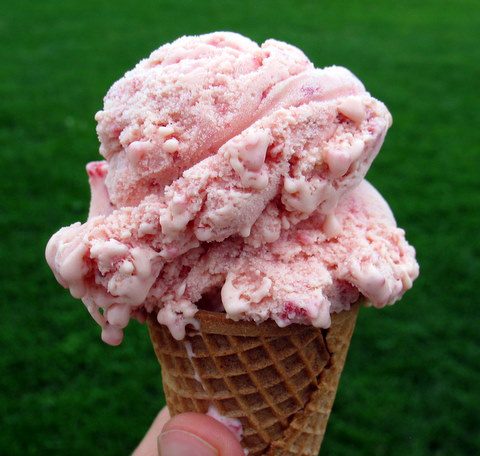
    I know I promised you a rhubarb pie recipe, but I’m going to have to put that on hold, I’m afraid, in order to tell you about the ice cream we made last night.


    I’m hoping you’ll forgive me the change in plans. Rhubarb is really the more important matter, considering that it is in season now and you need ways to use it up now, but come on, folks, it’s strawberry cheesecake ice cream. Priorities, schmiorities, right?

    Besides, maybe you’re in the same situation I am and it is your priority to use up all the strawberries you still have in the freezer from last year (making jam, ASAP). Either way, strawberries will soon be in season and before you know it you’ll be inundated with the ruby fruits. Consider this a friendly service announcement: make this ice cream when you get strawberries! Or, if you don’t have time in the heat of The Berry Moment, crush up some of the berries and freeze them in two cup portions—then you’ll have them on hand when you do have a little more breathing space.


    Strawberry Cheesecake Ice Cream
    Adapted from Jude’s blog Apple Pie, Patis, and Pâté

    When eaten fresh, this is a very soft ice cream. We churned it before supper and then kept it in the freezer for the next hour or two till we got around to eating it. (I make it sound as if we were dreading the proposition—oh darn, I made ice cream and now I have to eat it—which wasn’t the case at all. We had company and were busy enjoying them). At that point it was still really soft, but a couple hours later (after the company left and the kids were in bed and the dishes were mostly washed) when I transferred the leftover ice cream from the canister to freezer containers, the ice cream was nice and firm. It tasted really good, too. (Why is it that ice cream tastes better at ten at night, eaten directly from the container?) My point is: make this ice cream ahead of time to give it time to set up.

    Also, this recipe makes a lot of ice cream—small ice cream makers will overflow. If you do have a small maker, churn the cream cheese base and then dump it into a large bowl to stir in the strawberries.

    Oh yeah, in keeping with my cream-loving nature, I changed the recipe to include more cream. The original recipe called for 2 ½ cups whole milk and ½ cup cream and I reversed that. You can flip it back to the lean version (ho-ho-ho), if you wish, or, if you’re even more cream-infatuated than I am, omit the milk entirely (and then tell me—I’d like to meet you).

    1 pound fresh strawberries, crushed (or two cups crushed frozen berries)
    1 3/4 cups sugar, divided
    3 egg yolks
    2 ½ cups cream
    ½ cup milk
    1 teaspoon vanilla
    1/8 teaspoon salt
    1 pound cream cheese, softened
    1 teaspoon lemon zest
    1 ½ tablespoons lemon juice

    Stir ½ cup sugar into the crushed berries and refrigerate till ready to use (the berries need at least half an hour to macerate, so don’t do this step at the last minute).

    Pour the cream into a saucepan, add the salt and 3/4 cup sugar, and heat over medium-high heat. While the cream is heating, beat the egg yolks. Temper the yolks by whisking in a half-cup of the hot cream a little at a time. Pour the tempered yolks into the saucepan, whisking furiously. When the cream has thickened slightly (do not boil), remove it from the heat and whisk in the half cup of milk to stop the cooking. Add the vanilla. Pour the mixture through a fine-mesh sieve, cool to room temperature, and chill thoroughly.

    In a large mixing bowl, beat together the cream cheese, remaining ½ cup sugar, zest, and lemon juice. Gradually beat in the chilled cream mixture. (I added my cream while it was still quite hot and had no problems). Chill the ice cream base in the refrigerator, or, if you’re like me, you can speed-chill it in the freezer for a little while.

    Churn the ice cream. When it’s done, add the strawberries and churn for another couple minutes. For (very) soft serve ice cream, eat immediately. For hand-dipped ice cream, freeze for at least four hours.

    Update, August 17, 2009
    Variation: Use mashed peaches in place of the strawberries for some delightful Peaches-and-Cream Ice Cream.

  • Jam with a punch

    It’s rhubarb season! So far I’ve made a rhubarb pie (with strawberry juice), a rhubarb crisp (but I don’t think it counts since it was made from last year’s frozen rhubarb), another rhubarb pie (which I will write about shortly), and rhubarb jam. It is the jam I want to talk about now.


    This jam is oh-so-simple to make—just toss four ingredients together, simmer them for twenty minutes and ta-da!—you have yourself some tangy, punchy jam. (Because this jam doesn’t call for any of the traditional jam thickeners such as Sure-jell, the end result is less gelatinous and more like thick, blob-y fruit preserves.)

    While the original recipe calls for rhubarb, sugar, candied ginger, and lemon zest, I did a little research and have come to the conclusion that you can make any number of variations on the theme and the recipe will be none the worse for it: when I was digging around in my cupboard for the candied ginger, I found some candied orange peel which I then decided to add in place of the called-for lemon zest. The chewy chunks of fruit gave the jam a marmalade-like flair—a good thing, in my book.


    Some variation suggestions: Add fresh, powdered, or candied ginger, lemon or orange zest, candied lemon or orange peel. You may want to add other fresh or frozen fruits, too, though you might need to adjust the sugar and cooking times accordingly. I read one recipe that paired red raspberries with rhubarb, and that got me to thinking about fresh cranberries… And now that I wrote the words “fresh cranberries” I’m wondering about dried—I bet craisins (golden raisins? sour cherries?) would be quite tasty and in keeping with the marmalade theme.

    Anyway, as my rhubarb comes in I plan to cook up little batches of this jam. Each recipe yields a pint of jam, so I think I’ll hot-pack it in half-pint jars as I go along. That is, if we don’t eat it all up first.


    Rhubarb Jam
    Adapted from Epicurious, a recipe from the July 1997 issue of Bon Appétit.

    The original recipe called for 1 1/4 cups of sugar, but I cut it back to one cup. Depending on your preferences, you may want increase the amount, or even decrease it some more.

    The recipe doesn’t call for any water, but I added a couple tablespoons because the mixture seemed impossibly dry and I was afraid it would scorch. I needn’t have worried though, because as soon as the rhubarb started heating up, it wept copious amounts of water. If you, like me, want to add a little liquid to appease your qualms, I suggest using only a couple tablespoons of water or fruit juice (orange, grape, or apple would all be delicious, I think).

    (See the body of the post for the other recipe variations.)

    4 cups rhubarb, cleaned and chopped into ½ inch pieces
    1 cup sugar
    3 tablespoons candied ginger, chopped
    1 teaspoon lemon zest

    Mix the ingredients together in a heavy-bottomed saucepan and bring to a boil. Once it is boiling steadily, turn the heat down to a high medium so that it still bubbles pleasantly, but not at break-neck speed. Once the mixture has thickened (it will mound up on a spoon and briefly separate when you cut through it with the stirring spoon) it is done. Note: Stir the mixture quite a bit at the beginning and end of the cooking time to prevent scorching, but in the middle you can relax a little, checking on it once every two or three minutes.

    Either hot pack the jam in jars, or cool it to room temperature before transferring it to the fridge or freezer.

    Serve the rhubarb jam on toast, muffins, scones, add it to yogurt, serve warm on top of vanilla or strawberry ice cream, use as a fruit filling for shortbread cookies and coffee cakes, or drizzle over cheesecake.

    Updated, May 8, 2009
    The second time I made this jam, I added about a third cup of frozen cranberries and they turned the jam nice and red (the variety of rhubarb I have in my garden tends to be mostly green with a few red stalks, resulting in a pinkish jam).


    For that batch of jam I used lemon zest and for the next one I used orange zest. Both were delicious.