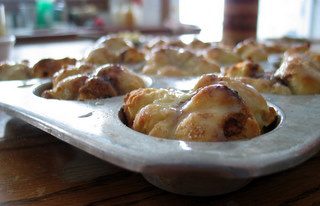
• To monkey with

    Over the past couple weeks each of my kids has taken their turn visiting my parents for several days at a time, and this past Monday when my mother returned the last child, she stayed for a day and a night so she could do some rugging. When she left yesterday afternoon, I gave her a little assortment of goodies for her to take home to share with my father. Later that evening I received the following email:

    JJ– The monkey bread was exquisite. I believe I find it preferable to sweet rolls. The fruity chocolate candies were also wonderful. What chocolate do you use? The raisin-filled cookies will wait for tomorrow. If we don’t have school (not likely) I’ll sit and eat mine in the morning with coffee. JJ and John, Thanks for letting your children visit us. They are delightful. –Love, Dad

    Well, shiver me timbers, if that didn’t make me feel all warm and snuggy inside I don’t know what will. For some strange reason, people who appreciate my cooking strike me as being above-average. You know, more intelligent and debonaire. Obviously, they know a good thing when they see it, and they’re confident enough to say so. It’s refreshing.

    I’m pretty sure I’m not biased or anything.

    After further thought, I suppose it could be that complimentary folks are kindred spirits because they view their food the same way I do—i.e. we like the same things.

    Or maybe they’re just crafty; they know that if they play their cards right, they’ll never have to do any baking ever again.

    Hmmmm. Now that’s a very real possibility because giving me a compliment is like opening the floodgates: once I know that a particular person appreciates the fruits of my labors, I direct all my extra culinary creations in their general direction. THUNK—Take that bread! PHWAP—Eat cranberry sauce, three different kinds while you’re at it! SHAZAAM—Chocolates, cookies, cake coming your way, Sugar Pie! With that in mind I think it would be wise to only dish out honest compliments; otherwise you might drown under a deluge of food that you said you liked but didn’t really. And that might make you feel kind of sick.

    Not that my father would do something like that. He is sincere and intelligent, of that I am certain. He doesn’t monkey around when it comes to compliments.
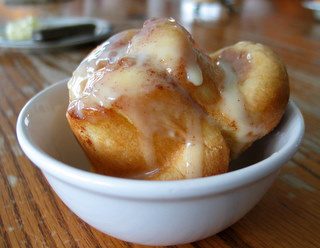

    Ree’s Monkey Bread
    Adapted from her blog The Pioneer Woman

    Ree says you can use any leftover bread dough you happen to have loafing around your refrigerator (ooo, I crack myself up!), but I made a batch of sweet dough specifically for the purpose of turning it into monkey bread. I’ll include the recipe, but do what suits you. The recipe for monkey bread is more of a process anyway, one you can monkey with.

    (After all those bad puns, I’m beginning to wonder where the title “Monkey Bread” originated from. Because you’re playing around with the dough? Because you’re pulling the bread apart with you fingers? I grew up with something similar—balls of dough that were rolled first in melted butter and then in cinnamon-sugar before being piled on top of each other in a greased tube pan—but we called it “Pluck-its” because you pluck off the pieces one-by-one. Clarity, anyone?)

    One other thought: I bet this would be really good with dulce de leche in place of the condensed milk.

    1 recipe sweet bread dough (recipe follows)
    cold butter, cut into little pats, about 1 teaspoon each
    lots of cinnamon
    sugar
    1-2 cans sweetened condensed milk

    Grease the muffin tins. Put a pat of butter in the bottom of each tin. Add ½ teaspoon (or so) of sugar and a generous dash of cinnamon.

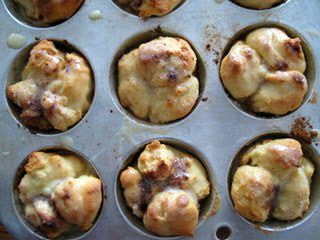
    Pull off ragged little chunks of dough and, without even bothering to roll them into nice little balls, plop three of four of them in each muffin tin. (It’s important to not put too much dough in the tins—like I did in that last picture—because you need to have room to add the condensed milk after the bread has baked and gotten all poofy, so err on the side of too little dough.)

    Top each cluster of dough balls with another pat of butter, sprinkling of sugar, and dash of cinnamon. Let the dough rise for 30-45 minutes, or bake them right away. Either method works fine.

    Bake the muffins at 350 degrees for about fifteen minutes. Upon taking the pans out of the oven, scoop a generous spoonful (a tablespoon, maybe?) of the condensed milk on top of each muffin. Let the muffins cool in their cups for about ten minutes before scooping them out and scarfing them down.

    I am not sure how well the baked monkey bread keeps. I’m assuming that after 6-12 hours it needs to be refrigerated because of the milky coating, but I’m no authority on this matter. I recommend only making enough for immediate consumption and sharing and saving the rest of the dough for another baking. Goodness knows it’s easy enough.

    Sweet Dough
    Adapted from the Mennonite Community Cookbook by Mary Emma Showalter

    1 cup milk
    ½ cup butter
    ½ cup sugar
    1 ½ teaspoons salt
    2 eggs, lightly beaten
    7 cups flour
    ½ teaspoon nutmeg
    2 tablespoons yeast
    1 cup warm water

    Put the warm water in a small bowl. Stir in the yeast and set the bowl aside for ten minutes, or until the yeast has puffed.

    Scald the milk. Remove the saucepan from the heat and add the butter. Let the butter melt.
    In a large mixing bowl, stir together the milk-butter mixture and the sugar and salt. Add a couple cups of flour and the nutmeg and stir till combined. Stick your finger in the dough to make sure it is no longer hot and then add the yeast, a couple more cups of flour, and the eggs. Stir well. Add the remaining flour.

    Knead the dough till it’s supple and elastic (don’t add too much flour or the resulting bread will be tough) and set it to rise in a floured (or greased) bowl.

    When the dough has doubled in size, it is ready to be turned into monkey bread, sweet rolls, sticky buns, regular loaves of bread, dinner rolls, or anything else your little heart desires. Or you can punch it down, put it in a large (it will rise), tightly-lidded container and store in the refrigerator till you are ready to shape and bake.

    I am submitting this post to YeastSpottings. Lots of other wonderful recipes can be found there, so go check it out.

    About One Year Ago: Cashew Brittle. You really need to make this.

  • Christmas corn

    This past week I cooked supper for a homeless shelter. I had never done anything like this before and it semi-freaked me out. Cooking a meal for company gets me in a tizzy, but to cook a meal for 20-30 people, transport it into town, and then serve it and clean up afterwards? Whew! It about threatened to put me over the edge. (Well, okay, not really. I managed fine. But I was anxious. I’ll admit that much.)

    Several years ago our town started a shelter for homeless people. This program differs from other, more common, programs in that it is the downtown churches that host the homeless, usually for a week at a time. The host church is in charge of providing the space, volunteers, and food for the guests, and last week it was our church’s turn to host. Usually people will work together to prepare different parts of the meal and then serve it. But me? Ho-ho-NO. I decided I could handle it all by myself with just—get this!—Yo-Yo Boy and Miss Beccaboo to help me out.

    No wonder I get in a dither over these things; I’m forever totally over-estimating my capabilities.


    But I had my reasons for being so stoic, my precious little reasons. The first was that I didn’t want to coordinate food with a whole bunch of people; many times it’s just easier to do things in my own crazy way, sink or swim, and I like being in charge. My other reason was slightly more noble: I wanted Yo-Yo and Miss Beccaboo to be central to the evening’s events because this little supper making/serving deal was to be a big part of our Christmas festivities … because in our house we don’t do Christmas gifts.

    Our decision to scrap the gifts came about when Yo-Yo was two years old. He had a huge pile of gifts that year, generously given to us by different family members, and I watched, fascinated, as my little blond-haired-though-still-mostly-bald baby grabbed and tore and shrieked and grabbed for more. There was a glint in his eyes that I hadn’t seen before, and, quite honestly, it alarmed me.

    Around the same time one of my friends, a woman with children much older than mine, told me about how her youngest son turned into a greedy little brat come Christmas morning. No matter how much they emphasized that Christmas was not about getting gifts, they couldn’t seem to get the point through the kid’s tough skull.

    Those two incidents (and probably some others that I don’t recall) clinched the deal for me: Christmas gifts would not be a part of our holiday tradition. We would focus on other things like playing games (a huge sacrifice for me since I hate playing games), buying chickens and pigs for needy families in underdeveloped nations (via MCC or Heifer International), decorating the tree, visiting with friends and family, reading good books, and, of course, baking lots and lots of Christmas cookies.

    Naturally, my nice little decision to nix gifts hasn’t been as clear-cut as I make it sound. Life never really is. Friends and family members give us Christmas gifts and we’re not so hardcore that we tear off the red and green paper and rewrap them in pastel flower prints and make the kids wait till May to open them—no, no, no, we savor each gift that comes our way.

    Then there was the whole issue of Santa Claus. No matter how many times I told my kids there was no Santa Claus (come ON kids, use your heads! do you REALLY think a fat old man could squeeze down our chimney? and even if he did, how would he get out of the stove, huh? he would TOTALLY burn to a crisp if he ever tried to pull such a stunt!), they insisted he was real. Finally we just gave up and played along.

    On Christmas eve the kids hang up (thumbtack, really) stockings (they have morphed from Mr. Handsome’s white tube socks to old cloth bags to the official-looking decorative stockings that I scavenged from a thrift store) on the wall by the wood stove, set out a plate of cookies for Santa, and write him a letter before going to bed. Then Mr. Handsome and I eat the cookies, write a reply letter, and fill the stockings with candy and doo-dads. Come the twenty-fifth, we blast Christmas music, gorge on candy, eat a huge platter of cookies for breakfast, play games, and read seasonally-appropriate stories. Joy and sugar highs abound.


    However, now that the kids are older it was time to illustrate the second part of our no-gifts equation: that we don’t only forgo our gifts, we give gifts to others. (I don’t count choosing geese and goats from a catalogue in my category of “felt” giving; it is way too far removed for the kids to truly grasp the concept.) So one morning last week I played some of these videos for them, and then I explained that this meal I had been working on was one of our Christmas gifts and that they were going to be a part of it by coming along to help serve the food and wash the mounds of dirty dishes. They were dubiously agreeable.

    Earlier Miss Beccaboo had helped me to cobble together the menu:

    Me: I know I want to take baked corn. What else do you think I ought to make?
    Miss B, almost without thinking: Sloppy joes, and green beans.
    Me: Yes, that would be good. And I could make something with potatoes.
    Miss B: And applesauce.
    Me: And some sort of dessert.


    But then the day before The Day, Harold, the coordinator from our church, told me that kids weren’t supposed to be present at the shelter because a number of the guests were sex offenders. “But I don’t think it would be a big deal if the older two came as long as they stayed in the kitchen and didn’t mingle with the guests,” he said.

    Oh dear. Was I being foolish if I took my children? I mentioned to the kids that there was a rule that I hadn’t known about (I did not explain the reason for the rule—couldn’t quite figure that one out), and they were upset—apparently they did want to do this project. After more thought I decided it would be okay to take the kids as long as Mr. Handsome was there to be their bodyguard and ensure that they felt needed and useful (in other words, were doing their work). Then Harold called back to say that he had rounded up a couple more volunteers and that it really would be okay if the kids came, so all was set. We were still on.

    Thursday morning came. I panicked that I wouldn’t have enough food (I always do this—it’s par for the course), so I turned two more pounds of burger into sloppy joes. I thawed and iced the cakes. In the afternoon I baked the potatoes and then smooshed them into a large crock pot. I heated up the sloppy joe meat and smooshed it into another large crock pot. I cooked the green beans, put them in yet another large crock pot, and drizzled browned butter over top. I made three large pans of baked corn. The kids brought jars of applesauce up from the basement. When Mr. Handsome came home, he loaded the crock pots and foil-covered pans into wash baskets; the kids cradled the cakes in their laps.

    Harold met us at the door and gave us a tour of the makeshift shelter: three rooms had been filled with cots and blankets. While it felt right to see our Sunday school rooms transformed into something so basic and useful, it was also deeply disturbing. The people who would be sleeping in those beds did not have homes.


    Then the guests came in and it was time to eat. I stationed myself behind the serving table and slapped burger meat into buns as fast as I could. Nelly, Harold’s wife, stood beside me dishing up the potatoes and green beans. The guests hesitated when they got to the corn, bending over to peer at it more closely and inquiring as to what in the world it was.

    “That is baked corn,” I said, my bossy-mother instincts taking over. “It’s good. You’ll like it. You must try it.” I must have been pretty convincing because almost everyone obediently scooped a bit of corn onto their plates.

    One man asked, “Is that an old Mennonite recipe?”

    “Why, yes!” I exclaimed, totally surprised. He went on to tell me that back during the Civil War the Mennonites ate a lot of what they called corn pudding, something similar to my baked corn recipe.


    Almost everyone came back for seconds, and some came back for thirds and fourths. They loved the potatoes and meat, but the thing they commented about the most was the corn. “That corn is good,” they said, mystified. I crowed triumphantly, “I told you you’d like it! Eat more, there’s still another pan back.” And they did. One woman even requested a bowl so she could fill it with corn for a snack later on.

    And that, my dears, is what I call the ultimate compliment: when people, total strangers, mind you, taste the food just to be polite (or to get me off their backs) and then actually hoard it for later. How gratifying.

    Baked corn, anyone? And, Merry Christmas.


    Baked Corn
    Adapted from the Mennonite Community Cookbook by Mary Emma Showalter

    2 tablespoons butter
    1 ½ tablespoons flour
    1 tablespoon sugar
    1 teaspoon salt
    black pepper
    1 cup milk
    2 cups corn (frozen, fresh, or canned)
    2 eggs, lightly beaten

    Melt the butter in a heavy bottomed saucepan over medium-high heat, add the flour and stir well. Immediately (the pan is still on the burner and you don’t want the roux to scorch) whisk in the milk and stir till it bubbles and has thickened a bit. Add the salt, sugar, and corn and heat through. Remove the pan from the heat and quickly whisk in the beaten eggs (the corn is hot and can cook the eggs if you’re not careful—no one wants bits of scrambled eggs in their baked corn).

    Pour the corn into a greased, square (8 x 8) glass pan. Grind a bit of black pepper over the top. Bake the corn in a 350 degree oven for 30 minutes, or until set, the top is puffy in spots and has a couple (little) cracks, and the edges are lightly browned. Serve immediately.

    Yield: 4-6 side servings

    About One Year Ago: Company Tizz, and other matters.

  • Full circle

    As soon as I realize that we would be eating supper in the dark if it weren’t for the wondrous invention of the electric light, I get hit with the urge to make Christmas cookies. I chomp at the bit until Thanksgiving passes (according to my personal laws and regulations, Christmas is not allowed to swerve out into the passing lane and cut off Thanksgiving) and then, only then, do I set free my inner child and start tossing flour and sugar all around the kitchen like nobody’s business. I have no limits, I exercise no restraint, I have no shame, and it is marvelous. (The grocery bills don’t exactly make Mr. Handsome sing for joy, but he doesn’t do much complaining when his mouth is full.)


    The first cookie I made this season was one that I haven’t made for a couple years because I could always count on my mother to bake them and then share with us—raisin-filled cookies. But this year I didn’t want to wait around for my mother to start baking. I wanted those cookies all for myself, and right away, please. So on Tuesday afternoon, in the middle of a long day of solid rain, I stuck Handel’s Messiah in the CD player and took the rolling pin in my own two hands.


    These old-fashioned raisin-filled cookies (a little spoonful of ground nuts and raisins tucked between two rounds of sugar cookie dough, the edges pressed gently together, and then the final touch—the only bit of adornment allowed—one little raisin poked into their caps when they are still hot from the oven) are plain yet comforting, honest in their unassuming modesty. In fact, they are so simple that many an unknowing person unwittingly bypasses them for the more glitzy sugar bombs—the gooey lemon cookies, the chocolate-nut toffees, the iced gingerbread men. Therefore, we don’t usually share these cookies with complete strangers because we’ve learned it takes a certain kind of person, mainly one of Pennsylvania Dutch heritage, to fully appreciate these labor intensive sweet cakes. But for those of us who grew up with them? Oh my, do we ever love our raisin cookies!


    From the way I’m going on about these cookies, it’s probably pretty obvious that they played a central role in our Christmas celebrations. I remember my father helping my mother set up the old metal meat grinder that she used to mash up the raisins and then watching, entranced, as the ground raisins, dark, moist, and richly fragrant, slowly snaked their way out of the side of the machine and softly plopped into the waiting bowl. My brothers and I would sometimes help to roll and cut the dough (with my mother in the background forever warning us against over-working it), and we’d wait impatiently by the oven for the cookies to finish baking so we could perform the raisin-poking honors.


    Nowadays I use a screaming food processor to chop up my raisins and walnuts (my mother left out the nuts), so for a few very loud moments the atmosphere in my kitchen is not quite as romantic as it was back in the good old, food processor-less days (which, by the way, still persist in my mother’s house). But then I’m done with the obnoxious (but oh-so-marvelous) machine and peace is restored and goodwill reigneth (until the Baby Nickel starts smashing his fists into my freshly cut circles of dough, but I’m ignoring that part for the sake of the romanticized Christmas cookie baking ideal that I’m forever striving after).


    Regardless of the method used, these cookies still produce the same results: my kids delight in these Christmas treats in the same way that my brothers and I did when we were little. And in this way, via raisin-filled cookies, I am completing one of my life’s (hopefully many) full circles. If only all traditions could be so delicious.


    Now it’s your turn. What’s one (or two or three) of your Christmas baking traditions?

    Raisin-Filled Cookies
    Adapted from the Mennonite Community Cookbook by Mary Emma Showalter

    These cookies are plain enough to be a part of the main meal (and they are probably much healthier than what many people call muffins), so as well as eating them for dessert, afternoon snacks, and with a glass of milk before bedtime, we sometimes also enjoy them for breakfast along with our cereal.

    There is always a little raisin filling left over after assembling the cookies (this time I had about half a cup extra), and it’s very yummy stirred into a bowl of warm breakfast oatmeal. As a matter of fact, you may find that you like the raisin-walnut puree topping so much that you decide to make a batch of filling for the sole purpose of globbing it atop your hot cereal.

    A note about rolling out cookies: Remember that less flour makes a more tender cookie. You want your dough to be floured enough that you can handle it, but still sticky enough that you get mad at it every now and then for gumming up the rolling pin, your fingers, the tabletop, etc.

    1 cup butter
    2 cups sugar
    2 eggs
    5 ½ cups flour
    1 teaspoon salt
    4 teaspoons baking powder
    1 teaspoon baking soda
    1 cup milk
    2 teaspoons vanilla
    1 recipe raisin filling (recipe follows)

    Cream together the butter and sugar. Add the eggs and vanilla and beat some more. In a separate bowl, stir together the dry ingredients and then add them to the creamed butter alternately with the milk.

    Cover the bowl of dough with plastic wrap and chill it in the refrigerator for about four hours or overnight. (It freezes well, too.)

    On a well-floured counter, roll out the dough till it’s about 1/4-inch thick. Use a round cookie cutter (I used a drinking glass) that is about two inches in diameter to cut out cookie rounds. Place the rounds on greased cookie sheets, leaving about two inches between cookies (they will spread quite a bit as they bake).

    Put a teaspoon of filling in the center of each cookie and then top with another circle of dough. Gently press down on the edges of the top cookie so that it sticks to the bottom cookie. (There is no need to use a liquid to stick the cookies together because the dough softens as soon as it hits the heat and the two cookies quickly melt together.)

    Bake the cookies in a 350 degree oven for 10-13 minutes, or until the edges are lightly browned (a little bit of brown gives the cookies good flavor), and the tops look dry.

    Let the cookies cool on the cookie sheets for two minutes before transferring them to a cooling rack. While the cookies are still quite warm, poke a single, solitary raisin in the top of each cookie, pushing it down far enough so that it won’t easily fall off, but not in so far that it disappears from sight. (This is a good job for the impatiently lurking kiddies.)

    Yield: About four to five dozen cookies.

    Raisin Filling

    2 cups raisins
    ½ cup walnuts
    1 tablespoon thermflo
    3/4 cup sugar
    1 cup water

    Put the raisins and walnuts into the food processor and pulse till they are finally chopped. (Or put them through a food mill or finely chop them with a knife.)

    Put the sugar, thermflo, and water in a heavy bottomed sauce pan. Add the chopped nuts and fruit. Cook over medium-high heat, stirring constantly, till the mixture has thickened — about 5-8 minutes at a gentle simmer. Remove it from the burner and cool to room temperature. At this point you can use it to fill the cookies, or you can store it in a covered container in the refrigerator (or freezer) till a later date.

    About One Year Ago: The Selfish Game