Whenever I’ve gone through a cheesemaking phase, I always think longingly of cuajada, the salty, fresh cheese made from raw, unheated milk that we learned to love when we lived in Nicaragua (back at the end of the last century).
Doña Paula, our neighbor, had a cow and made the best cuajada. The process was equal parts fascinating and horrifying. The container of rennet hung from a hook on the adobe wall — a piece of calf stomach soaking in some whey (or milk or whatever) — or sometimes she used a cuajo pill from the little venta down the road. (Cuajar means “to set” or “to coagulate;” cuajada means “curd.”) Expats often called the cheese “amoeba cheese” because, well … let’s just say that our internal workings sometimes struggled a bit.
Elias and my older daughter.
Many times, I sat on a wooden stool in her kitchen watching asDoña Paula scooped out some rennet and stirred it into a big bowl of milk. Then she’d let it rest on the counter while she lumbered about, patting out tortillas or prepping a twiggy bouquet of chicken feet for a stew.
When the milk had sufficiently solidified, she’d shoo away the flies that had gathered about the bowl and, gently and slowly, oh so slowly, press the curds with her hands, coaxing out the whey. The solids she’d place on the molino — a stone, similar to this one (though I know for sure it didn’t cost 189 dollars!), for grinding corn into masa — and begin mashing and pressing on the curds until all the whey had been pushed out: a bit of the whey went back into the container on the wall to replenish the rennet, if I remember correctly, and the rest she’d divide between the chickens and dogs. Once she’d kneaded the cheese into a smooth mass, she mixed in an ungodly amount of salt, form the cheese into large, palm-sized ovals, and press her thumb into the very top to leave her mark.
In our community, the cuajada was stored at room temperature in a plastic container and mostly served alongside a plate of boiled red beans. Simple food, yes, but there’s nothing quite like a freshly toasted corn tortilla, smokey from the cooking fire, with a thick slice of cuajada on top. I’d palm the plate-sized tortilla in my left hand and, with my right, tear off bits of warm tortilla to scoop up bits of the creamy, almost unbearably salty, cheese. Add a sugary cup of black coffee and that, my friends, is what Nicaragua tastes like.
So anyway. Back to my kitchen.
My double-boiler method for heating milk, though I often just heat it directly over the flame, too.
I’ve always wanted to learn to make cuajada but I couldn’t, for the life of me, find a recipe. Considering the lack of refrigeration, running water, sanitation, money, and materialDoña Paula was working with (or not), I figured it shouldn’t be that complicated, so I started messing around: Rennet. Room temp milk. Mashed curd. Salt.
Checking for a clean break, which shows that the milk has set.
It kinda worked, but not really. The cheese didn’t have the right texture, the same depth of flavor. And then I found the blog of a woman living in Nicaragua and she, bless her heart, did a post about learning to make cuajada. Her instructions said to break up the curd with my fingers (did Doña Paula do that? I don’t remember) and then add water and let it sit.
l-r: yogurt cheese, cuajada, gloves from making mozzarella
I’m still not a hundred percent solid on my methods — I know they didn’t hang the curd, and maybe I really shouldn’t heat the milk? and Wah! I missDoña Paula! — but it’s getting close. Each time, I improve a little. I’ve changed things, like slightly heating the milk to get it to set, and, in lieu of a molino, I use a food processor to mash the curd.
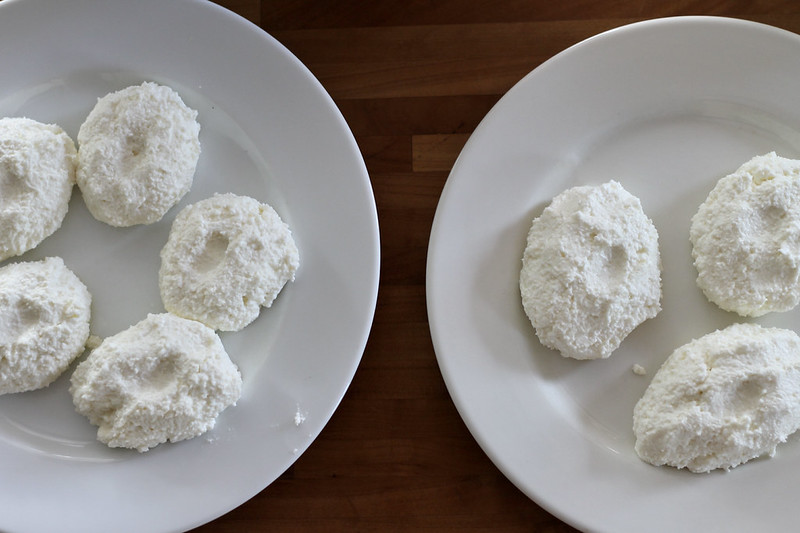
Baby cuajadas: normally I shape them bigger, about the size of oval softballs.
For now I’m confident enough in the recipe to share it here, though I’ll probably pop back in to to tweak and adjust, so stay tuned!
When I leave the milk at room temperature, as per the traditional method, it doesn’t set. Heating it just a little seems to give it the necessary kick in the pants. Also, my use of the food processor is not authentic (obviously), but it’s what gets the most authentic final product.
1 gallon milk ¼ teaspoon rennet in ¼ cup cool water 3 cups cool water salt, non-iodized
Heat the milk to about 90 degrees. Remove from heat and gently stir in the rennet. Let sit, undisturbed for 45 minutes, at which point the milk should be set. To test, stick your finger or a knife into the curd at an angle and lift up; the curd above your finger should split cleanly apart. If it’s still mushy soft, let it sit another 15 minutes or so.
Using your hands, gently stir the curd to break it into pieces. Add three cups of cool water, stir, and then let the curds sit, undisturbed, for 10 minutes, during which time the curds will sink below the surface of the whey.
Pour the curds and whey into a cheesecloth lined colander. Discard the whey. Hang the cheese cloth for 30 minutes or so, or if you’re impatient, you can twist and squeeze the bag to remove the whey. Or squeeze the curds gently with your hands. Whatever! Just get the whey out.
Dump the curds into a food processor and pulse until creamy. Or, if you have a molino, knead and mash them by hand. Add salt to taste, making it saltier than you think it should be. The salt will dissipate a bit, but remember: this cheese is meant to go with bland food so it’s supposed to pack a punch.
Form the cheese into plump ovals, pressing your thumb into the top to leave your mark. Place the cheese, uncovered, on a plate in the fridge. More whey may come out, or not… After a few hours, wrap the cheese in plastic and store in a plastic container in the fridge where it should last for about two weeks.
To serve: place thick slices of cheese atop boiled red beans, bowls of chili, steaming corn tortillas, scrambled eggs, etc.
The cold weather — such a glorious reprieve — makes me itchy in my skin. I want to do EVERYTHING. At the SAME TIME. Right NOW.
But then I end up doing just one small thing, like watering the plants or hosting a writing group, and then I collapse on the couch, tired and out-of-sorts because I can’t decide whether or not to make the peach pie filling for the bakery pies or make another batch of cottage cheese or bake a cake. So I do none of that and instead scroll facebook and check Instagram (on my computer only) and then get pissy at myself for being so undisciplined and pathetic.
Pull yourself together, I say to myself, though not in those words, exactly. My get-with-it pep talk is more like a long, drawn-out internal moan: angsty and self-pitying and supremely uninspired.
Sorry. This is boring.
About Instagram: I hate it. I’ve recently been introduced to some fabulous cheesemaking instagrammers but I keep getting mad because the platform is so dang impossible to navigate. There’s no way to quick find the recipe/information I want, and then, once I do, there’s no time to dwell on it because the damn slides zip by faster than I can read them and I have to keep pausing and unpausing. And if there’s sound to contend with? Oh good lord!
To make things worse, IF YOU CAN IMAGINE, everything is video which takes a crazy amount of time to work through, and don’t even get me started on the disappearing stories which only heightens the gotta-click-on-this-before-it’s-gone addiction factor. (Unless the person saves them but I can’t know that at the time if they’ll be saved, gr.) And then there’s the whole “subscribe to be an insider” thing, and I know people gotta make a living but I HATE specials and deals and sign-up-here-now-or-else stuff. Just give me the information or stop talking, please.
At first I thought me struggling with the Insta was just a result of me being too inflexible and uncool to catch on to the media platform’s wiley ways but then I asked my older son to please enlighten me and he was like, “You’re not doing anything wrong. Instagram sucks.” HA.
So why do I persist if I hate it so much? Because, in spite of myself, it’s kinda fun (wiley social media sorcerers, indeed!), but mostly because there’s some good stuff out there that’s helping me up my cheesemaking game AND because it’s how certain people/businesses I know and care about communicate and, well, here I am.
On the couch.
Fussing.
But hey! I bought a new cheesemaking book the other day. It holds really still and doesn’t make noise and the pages only turn when I make them.
I like it.
P.S. My older son and his friend went to a medieval-themed party. They asked me to take photos. We had fun.