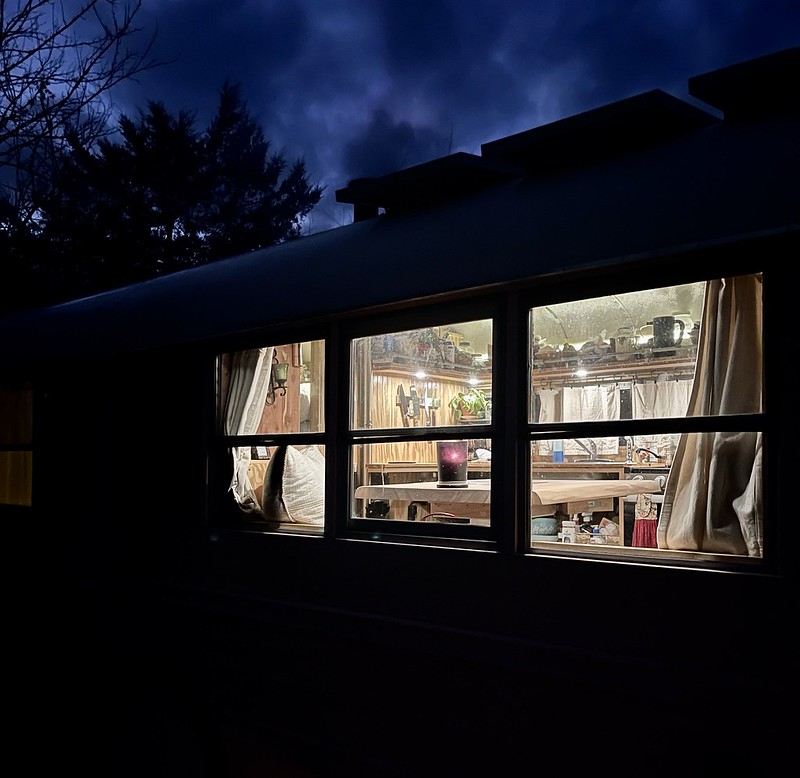
Since getting married last December, my older son and daughter-in-law bought a small school bus that they then converted into their home. Now that they’ve had a few months to live in it, I asked if I might interview them about the experience, and they said yes. Enjoy!
***
Where did you get the idea to live in a bus?
Jonathan: Several years ago I worked with someone who had converted a school bus into a motorhome, or “skoolie.” He showed me pictures of his build and immediately I was hooked. I loved the idea of living in a space that had the luxury of being mobile and having everything I needed in a space hardly larger than a walk-in closet. When I met Hannah in 2021, even though she had heard of skoolies, she had never considered building one, but little by little my enthusiasm rubbed off on her. A few months later when we got married, our main wedding gift request was for money to buy our own bus.
Hannah: During our first meeting, Jonathan spontaneously called a friend to ask if they would paint his bus — that of which he did not have. His impulsiveness left me curious. Was he actually going to make this idea a reality? But then a few weeks after our wedding, a friend told us about a short, six-window bus that had been already built out. Two weeks later, after some deliberation and a thorough inspection by a diesel mechanic, the bus was sitting in our driveway. Fast forward many months and here we are! Living out a dream.

At what point did you decide to actually live in the bus?
Jonathan: Full-time living in the bus wasn’t on my radar in the beginning. I assumed Hannah couldn’t possibly love me enough to want to live together in exactly 105 square feet, and I would have been happy enough just using it as a fancy camper van. However, it was Hannah who first broached the idea of living in it fulltime. That was about two months after we got married, and the lease for our apartment would be up in August, about seven months later. We started renovations immediately.

In the past when I tackled projects like building a clubhouse, I’d charge forward with no plan, no money, few resources, and intermittent determination. The end result was usually half-assed and held no resemblance at all to what I’d had in mind. The difference with this project was that I had money to draw from and a distinct deadline with the prospect of temporary homelessness . . . and I had Hannah.
How did you come up with the design?
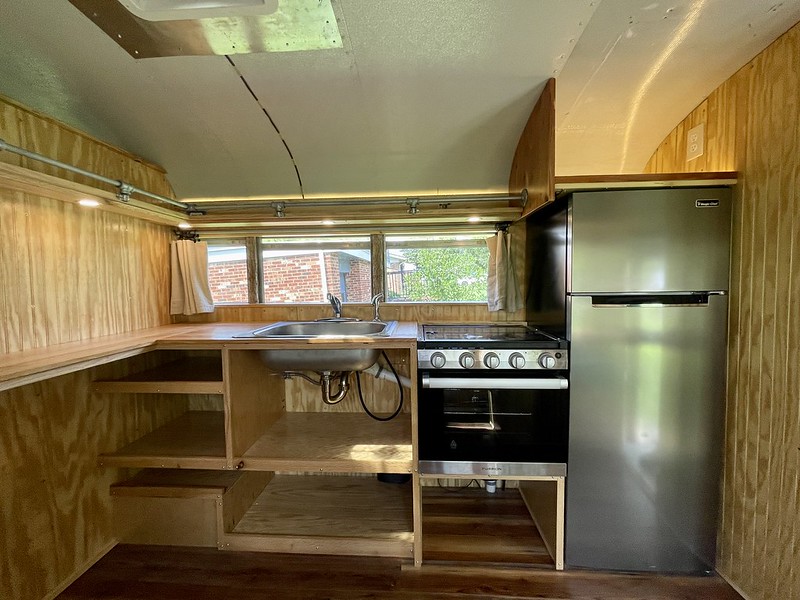
Hannah: We spent countless hours sketching and dreaming. (I may have requested a full washroom with a mini tub, tiled kitchen walls, a guest bed for two, and a greenhouse, ha!) Having the previous owner’s appliances allowed us to experiment with different arrangements. From the get-go, we knew we’d need a spacious kitchen since it would host nearly all our indoor routines.

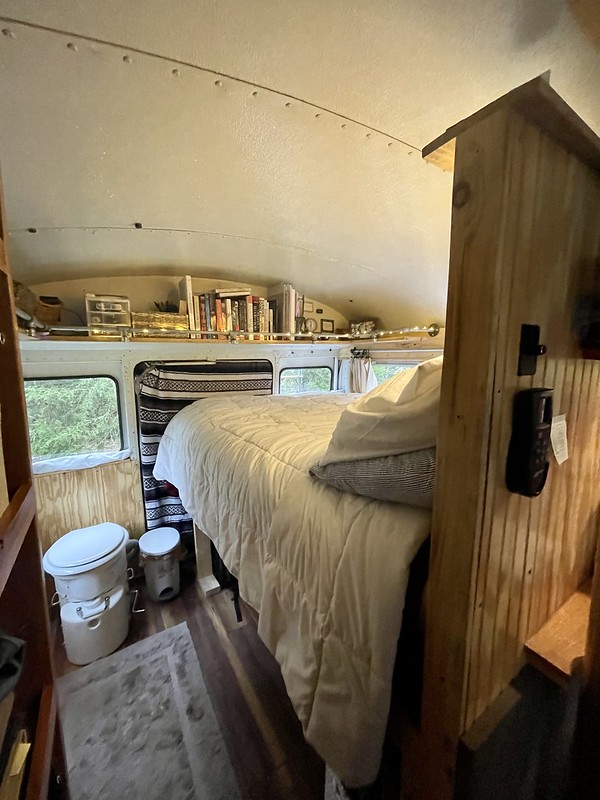
We wanted an open floor plan with two distinct living spaces. It took a lot of internet browsing, a roll of tape to mark things out, and several arguments, but we finally settled on a layout: the bed in the back of the bus, the kitchen/dining area towards the front, and a wall between the two. Once we’d established those two main sections, we created the rest of the build — the L-shaped counter, the shelving for clothing, the fridge nook — as we went along.
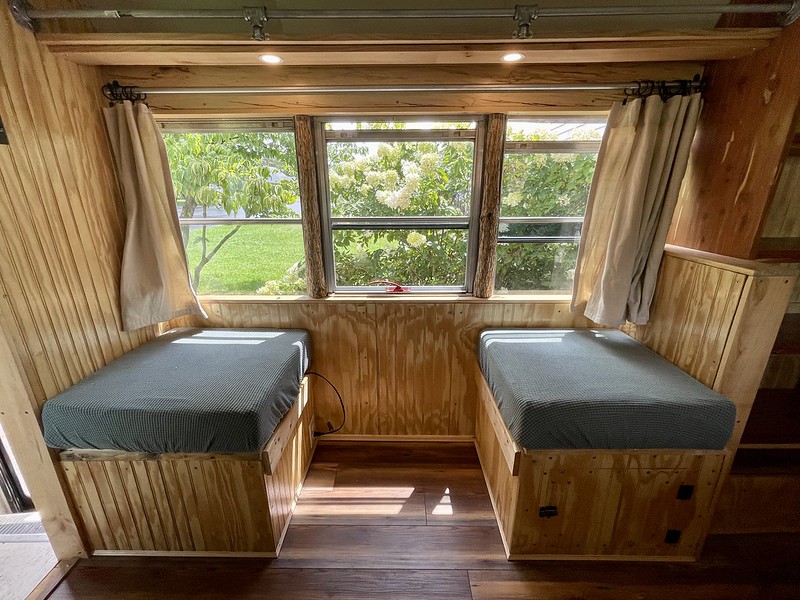
under the seats: inverter, transfer switch, charge controller, etc (left)
and batteries, toaster, Bananagrams, etc (right)
Why did you choose to buy a bus that had already been converted instead of a bus that hadn’t had anything done to it?
Primarily circumstance. Since we learned about the bus through a mutual friend, we felt like we were buying from people we could trust. The previous owners had driven it across the country a couple times and were confident in its mechanical condition. (The mechanic said the bus was in pristine condition and estimated its value to be at least 10K — their asking price.) Also, we thought we’d be able to reuse a lot of the previous owners’ appliances and furniture, which would save costs.

So you didn’t reuse their things after all?
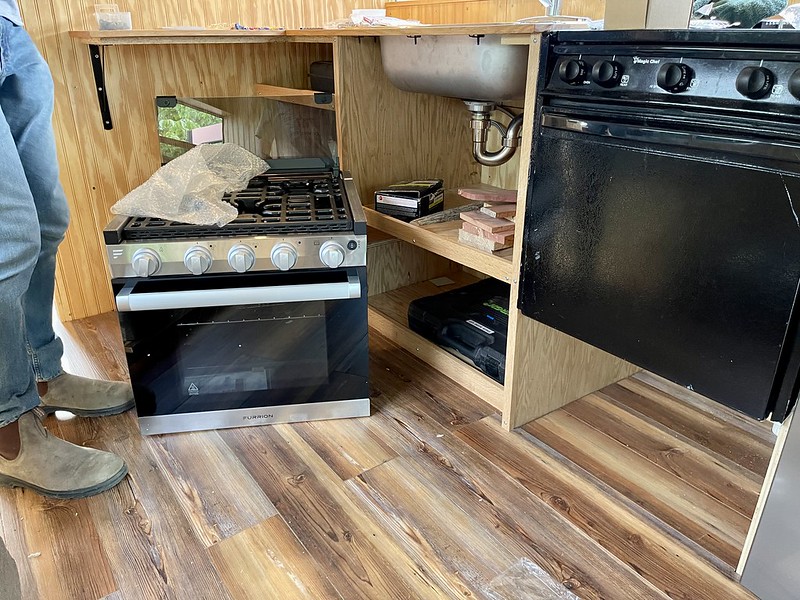
Since we’d be living in the bus, we needed appliances that would hold up to daily use, and their water heater, water tank, mini kitchen sink, etc, didn’t quite meet our needs. The stove, for example, was a basic camper stove without much insulation, and we wanted a full-size sink. (We are still using the previous owners’ bed, gray water system, propane tank, ceiling insulation, and pink bus color.) It would have been cheaper and saved us a ton of time if we had just gone ahead and purchased the appliances we wanted in the first place instead of trying to reuse everything, because we essentially ended up installing things two or three times.
What are some things that you’re most proud of, or that were most challenging?
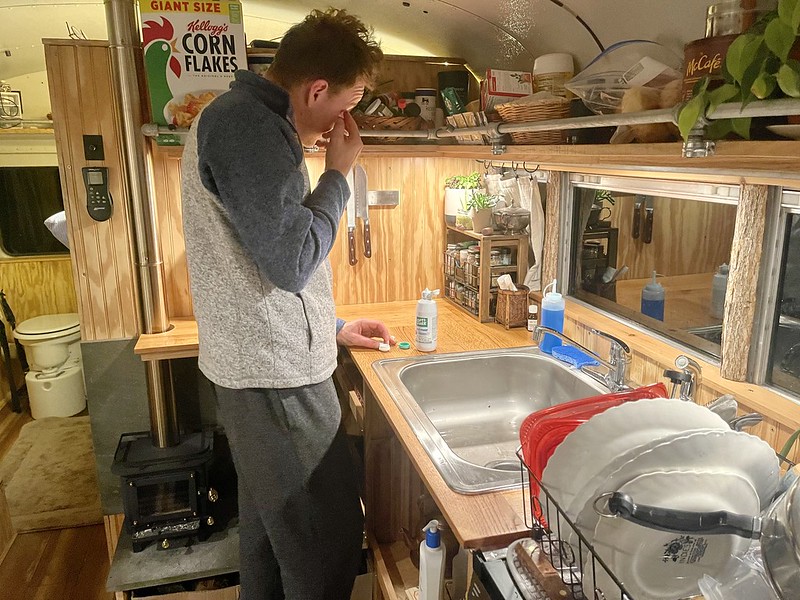
Jonathan: For such a small space, the bus feels quite large. This is primarily due to the many windows, but also because we divided the bus into the two distinct spaces.
On the outside, we added steel strips above the windows as a sort of makeshift gutter. I was skeptical about how well they were going to work — it was one of those ideas I had where I was like . . . maybe? — but they work great. We can even keep the windows halfway open in heavy downpours!

We made all of our shelves open, partially because that made them easier to build, but also because we didn’t know where we’d store things and we wanted flexibility. (My grandparents gifted us many beautiful pieces of wood, including the cedar for our clothing shelves and the oak for the kitchen shelves. All the wood was harvested from their property, so it means a lot to have it in our home.)
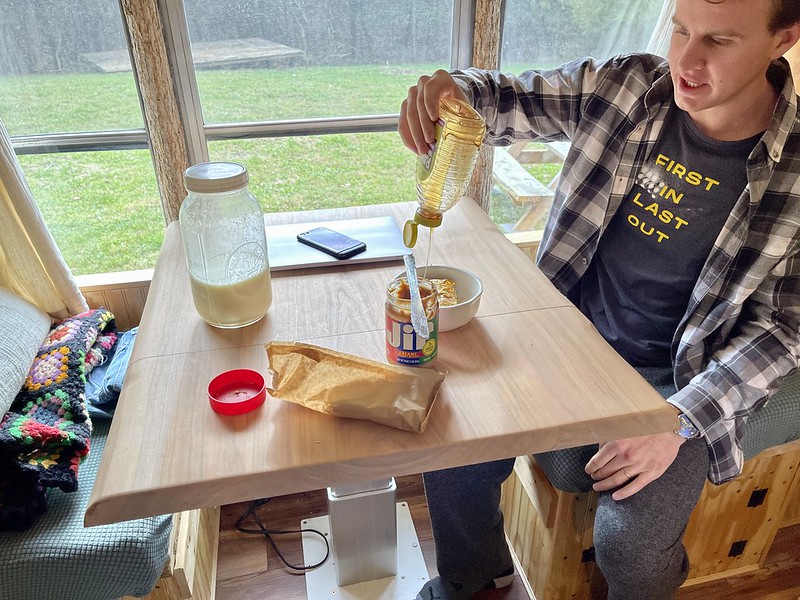
The cherry table top took me quite some time to finish. We have an electric stand for the table’s pedestal that can go from 12 to 32 inches with the press of a button. When it’s up, we have a table with booth seating; when it’s down, we have a couch. We wanted the table to be deeper than the couch when in “table mode” so I built an extra-deep table top, cutting off one end and then reattaching it with a piano hinge on the underside. To make it foldable, I fashioned two gate hinges that, when extended, support the end flap. When folded, the flap is flush with the booth seating. The result is a beautiful, sturdy table, or a comfortable couch — whichever we like!
How much has this project cost?
Jonathan: So far, we’ve spent just under $24,000. The bus itself cost $10,000, and we’ve spent about $1500 in tools, $4000 in materials, and $7000 on the appliances, such as the kitchen stove, wood stove, and solar. While we were actively building out the bus, we were able to set set aside $800-1800 each month (the max we could afford), but now that we’ve purchased and installed most of the necessary components, that monthly amount has dropped. We hope we won’t have to invest more than $25,000 or $26,000 in total. My grandparents graciously loaned us some money so we could buy our solar kit and stove, but other than that, we haven’t had to borrow anything, other than a few of my dad’s tools.

So the appliances in the bus are powered on solar?
Yes! We purchased the Renogy 800-Watt Solar Kit which came with solar panels, a charge controller, wire and connectors, and a bluetooth solar monitor that monitors in real time the amount of electricity we are gaining. We also purchased a 3000 watt inverter, a battery monitor, two lithium batteries (for a total of 500 amp hours), and reused the former owners’ 30 amp transfer switch, a nifty little gadget that automatically switches the power to an electrical hookup when we plug in the bus. When the days are long, we are easily able to power our water heater and pump, lights, fans, phones and laptops, and any appliances such as a toaster, coffee pot, and instapot. Recently, given the position of the bus, the trees around us, and the angle of the sun, we only get about two hours of direct sunlight a day, so we end up plugging in for a day or two each week.

You’ve been living in the bus for over four months now. How do you like it?
Hannah: Lil Peach is definitely the coziest place I have ever lived. A year ago I would have never thought that living in 100 sq ft would be so fulfilling. Jonathan and I are still waking up with smiles on our faces, grateful to one another for making this bus a home. However, we have struggled to find a rhythm for laundry. Because our space is so limited, soaking my reusable pads is a nightmare. We bounce around our social circles for washer and dryer access, yet during that special time of the month, our weekly laundry haul just isn’t enough.

before the wood stove was installed, trying to stay warm
Jonathan: I still find myself amazed at how comfortable this place is. The bus is pretty much a glammed-up clubhouse. It’s so, so small, but small doesn’t mean uncomfortable or claustrophobic. Everything we use on a daily basis fits inside the bus quite nicely; and we have little need for a space any larger than this. However, we aren’t a special couple: we do have times where we can hardly stand to look at one another. On those days, our bus only has room for one, and the other usually goes outside for a while.
Where do you store your extra stuff?
The bus is parked next to a woodshed. The owners let us store some of our things there.
How do you shower?
Hannah: We never built the full washroom with a mini bathtub that I dreamed of! Instead, when we first started living in the bus, we used the kitchen sink hose which made showering a messy, two-person ordeal: one person held the hose out the bus window and sprayed the showering person standing outside. Recently, however, we installed a proper outdoor shower-rig that is supposedly freeze-proof (fingers crossed). When people ask us how we’ll shower in winter, we have no answer, except: quickly!

Jonathan: The freeze-proof shower was a challenge. After a few hours of pacing around Home Depot’s plumbing department, I pieced together a plan: two frost-free outdoor faucets (they shut off about ten inches inside the bus), a bunch of fittings, and a standard shower head. With this set-up, we have a normal shower and we can drain the pipes during freezing weather. It works better than I hoped!
What about going to the bathroom?
We have an Airhead composting toilet.

This model has a seal on the toilet seat and lid which creates a vacuum. The toilet’s venting system pulls air from the inside of the bus into the toilet and then out of the bus, which helps keep moisture down in the toilet and removes any odors. It is so efficient that even to Hannah’s extraordinarily sensitive nose — a nose that can smell food going bad inside a sealed container inside a sealed fridge from five feet away — there is no odor while using the toilet.

melting butter
Does the itty-bitty wood stove keep you warm enough?
Our cubic mini wood burning stove is our newest addition and is much better than our original plan of a propane heater. Some days when we run the stove, we have to open the bus windows to cool the bus down, so even though it hasn’t been too cold here yet, we expect that this stove will keep us comfortable.

What projects still need to be completed?
*Finishing the door. (At the moment, a flimsy curtain between the entry way and the living space is all that protects us from the artic blasts.)
*Installing removable drawers under the bed to make that space more efficient.
*Completing the built-in spice rack.
*Building an outdoor countertop.
*Rigging a shower curtain.
*Creating rooftop storage.
*Painting the bus a more neutral color, such as gray.
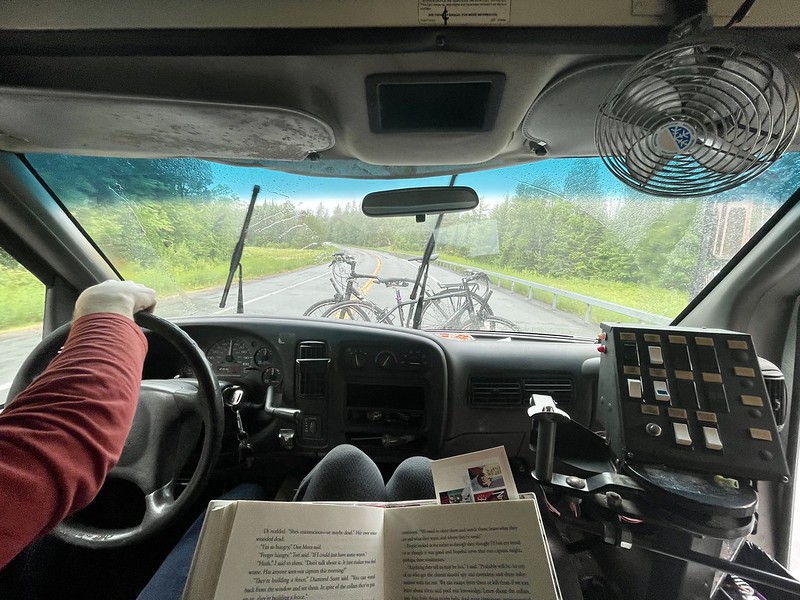
What’s it like to travel with the bus?
Exhausting. Planning is everything, both for the route and for securing things in the bus. This past summer when we took a trial trip to the Adirondacks and Canada, the most upsetting moment was when we failed to remove our loaded dishrack from the countertop before getting on the road, and the whole thing crashed to the floor. Now when we move the bus for anything, we do a walk-through of the space and secure anything that might move. We have a stockpile of bungee cords, baskets, and towels for cushioning breakables.

Looking ahead, what are your plans for the bus?
We plan to mostly live in the bus (and occasionally housesit for friends) through the fall of 2024. At that point, we hope to take a year-long road trip across the US and into Canada. Between now and then, we’ll take a few weekend trips to Dolly Sods, or to visit extended family, but mostly we’re settling down and saving up!
***
Thanks so much, Hannah and Jonathan! (If you want to see more of their bus life, check out Lil Peach’s Instagram here.)
This same time, years previous: the quotidian (12.6.21), how we homeschool: Rebecca, Clymer and Kurtz, my sweet beast, the quotidian (12.4.17), the quotidian (12.5.16), oatmeal sandwich bread, in my kitchen: 6:44 p.m., cinnamon raisin bread, holding, iced ginger shortbread.