I was going to make a fun list for this Friday, and then I realized I only had two fun things, only one of which was new to me, so then I wondered if it was worth it to share, and is two things even a list anyway?, but: to heck with it. Fun is fun is fun. So there.
***
Season three of Ted Lasso is here!
New episodes are released Wednesday, so after we get home from pick-up Ultimate, shower, and eat supper, my husband and I plop down on the couch to watch the latest episode. It’s not anything that amazing, really — just familiar and homey and sweet, and the perfect end-of-day, bone-weary, tummy-full, couch-cuddle with my best bud.
In other viewing news, we finished season one of Shrinking, which we loved. What are you watching?
The other night I opened YouTube, just to see what the algorithm would recommend, and one of their videos popped up. Within minutes, my husband and I were sitting side-by-side (because I hollered at him to come watch), watching video after video.
The channel is about an inter-abled couple’s relationship and watching their videos challenges my assumptions about bodies and relationships in ways I didn’t realize needed to be challenged, which makes the videos all the more fascinating. Two other bonuses: the videos 1) help me feel more grounded and matter-of-fact about my own body, and 2) make me feel more happy and hopeful, and not in a superficial way, either.
(One caveat: their thumbnails and titles are often misleading, veering towards sensationalism, which bugs me, but aside from that, the videos and couple themselves are delightfully earthy.)
***
Oh, wait! I’ve got another fun thing, after all. (But for locals only — sorry, all you faraway readers.)
raspberry ricotta cake, minus 1/3 of the flour, oops (and thus the reason for test bakes)
At a bakery meeting a few weeks ago, we were wishing outloud that we could do more for Easter weekend (which is the third biggest holiday in the bakery world), and I suggested that a couple of us show up at 3 am on Saturday morning and bake out little buttsies off. A couple hours later one of the other bakers texted me, “Were you serious? Let’s do it!”
One thing led to another and now three of us are gonna have a rocking middle-of-the-night bake party, which means I have to get up at 2:00 tomorrow morning to mix up bread and bake off aaaaaall the goodies: apricot couronnes, challah, cookies, hot cross buns, scones, pastries, bread, etc, etc. Also, there’s gonna be flowers!
I bet 95% of you read that title and your eyes immediately glazed over, am I right? (That’s okay. I still love you! Please love me back.) But for the 5% of you (and that number might be generous) who immediately did an internal happy dance, this is for you.
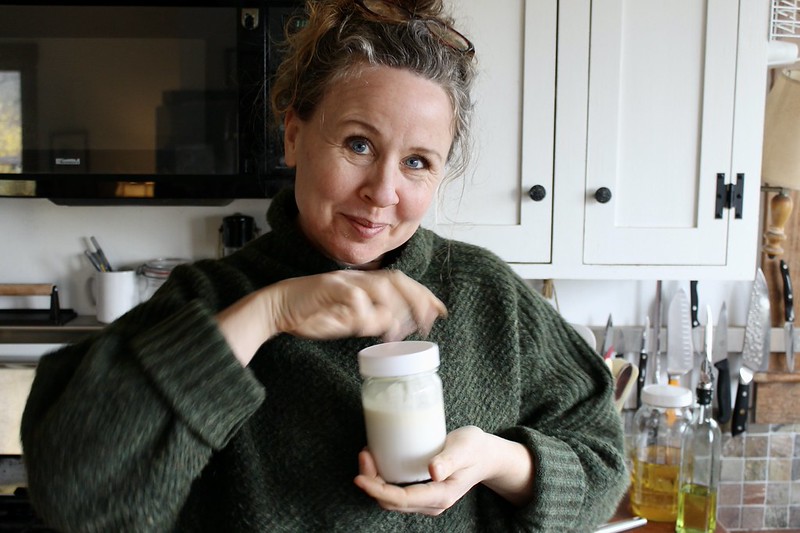
I’ve been doing a ton with clabber in my kitchen and on YouTube, but I haven’t much mentioned it here, so it’s high time I get some of the main points down in writing. (I find written instructions to be a more accessible resource than video, though video is stellar for actual teaching purposes. But I digress.)
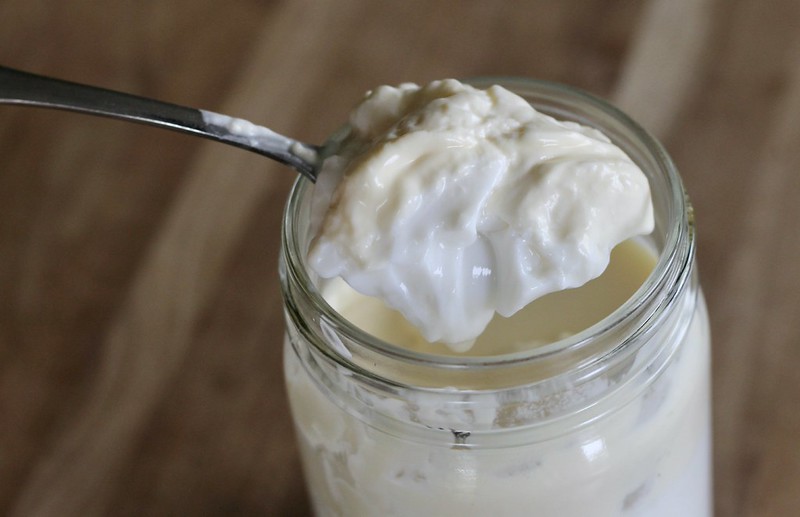
Some facts: *Clabber is milk that has been left to sit out at room temperature until it thickens. *To start out, you gotta use raw milk. *Once thick, clabber is like a sourdough starter: shake a bit of clabber into a new jar of milk, wait a day or two until it thickens, and then repeat to infinity and beyond.
The Big Questions… What does clabber smell like? Freaking amazeballs. Like nutty-sweet, buttery cream.
What does clabber taste like? A little tangy-tart. Needle-y bright.
What is the texture of clabber like? Watery jello, as opposed to thick and creamy like yogurt. Cut into it and it holds its shape. Shake it up and it reverts to liquid, like a thin lassi. In some places, like South Africa, clabber is a standard beverage that’s more easily digestible for the lactose intolerant.
What’s the point of clabber? For the regular home cook, it’s like buttermilk: use it in baking or salad dressings or smoothies, or drink it straight. For the cheesemaker, it’s pure magic. A one-size-fits-all culture for cheesemaking, clabber can be used to culture any cheese — mesophilic and thermophilic — removing entirely the need for freeze-dried cultures which means that each cheese is completely unique to the cheesemaker’s location and cows. In other words, cheese cultured with clabber is ALL about the terroir.
Months ago, I made my first clabber-cultured cheese and it turned out to be one of my best yet. Nutty, sweet, and uniquely flavored, I went absolutely gah-gah over it. Since then, I’ve experimented with making and maintaining various clabbers, posted a video on it, and I’ve made a bunch more clabber-cultured cheeses (most of which I have yet to taste* but all of which are behaving and smelling most marvelously). I have been maintaining the same clabber for the last month and a half and it’s still going strong.
Actually, that’s not totally true. The other day I noticed it was smelling a little less-sweet than normal, and then I realized it was setting up in only 12 hours (because of the extra-hot weather, I think), so I started refreshing it every 12-18 hours and now it’s smelling like insanely delicious butter once again.
I’ve heard that you can keep clabber in the fridge and then take it out and get it going again — like sourdough starter — but when I tried it, the revitalized clabber never returned to its former rich, creamy state so I decided it’s better to just let it live on the counter permanently and refresh it daily. I save the discard in a jar (in the fridge) and make pancakes every few days, or else feed it to the pigs. Considering we’re drowning in milk, it’s not a big loss.
How to Make and Maintain Clabber
First, some tips…
Use a permanent marker to write the date on the clabber jars.
Always use a clean jar and lid.
Don’t screw the lid on tight — a little airflow is good.
Shake in the clabber culture and then don’t disturb (though I did take my clabber along with me on a family trip and all the jiggling in the car didn’t seem to faze it).
Take notes so you can see how much time it takes for the milk to set up between feedings.
Important!You must start clabber with raw milk. Once it’s set up the first time, you can switch to pasteurized milk, they say, though I’ve only ever used raw milk.
The Process…
Step 1: Put a half cup of raw milk in a clean jar, top with a lid (but don’t screw it on tight), and set the jar on the counter at room temperature. Check morning and evening by gently tipping the jar to one side. When you tip the jar and the milk stays solid, it’s set. (For a full set, you should be able to hold the jar upside down for a couple seconds before gravity pulls it down.) It will take between 2-5 days for the first set.
Step 2: Take a scoop of the clabber and plop it into a clean jar. (Toss the discard — you could probably drink it, or use it in baking, but first-set clabber has a stronger flavor.) Add some fresh milk, either raw or pasteurized. Shake. Set on the counter, with the lid loose. This time, it should set up in 24-48 hours.
Steps 3-5: Repeat step two. (In other words, use the clabber to culture fresh milk three more times.) At this point, the milk should be setting up into clabber every 24 hours. If it’s really cold/hot in your house, it may go slower/faster accordingly. The discard can be used in baking and cooking.
After Step 5(ish), the clabber will be established enough to be used in cheesemaking. To scale up for a batch of cheese, just put a small scoop of clabber in a larger jar and add as much milk as you need. There’s no need to use extra clabber to culture the larger amount of milk; one small scoop of clabber will culture a cup of milk as well as a quart (or more) of milk.
Steps 6 to Infinity and Beyond: Each day, culture a bit of fresh milk with the clabber from yesterday’s milk.
To use clabber as a culture for cheese:
Use ¼ cup of clabber per gallon of milk. For example, if you’re making a 6-gallon cheese, you’ll need 1½ cups of clabber, so the day before, culture about a pint (2 cups) of milk.
Shake up the clabber, and add a little milk from the pot, if you want to thin it. Where the recipe says to add your fancy, freeze-dried cultures, just pour in the thinned-down clabber and stir.
You can use refrigerated (discard) clabber for cheesemaking, but only use clabber that’s 1-3 days old. Much older than that and it starts getting risky (though some people say 4-5 day-old clabber is fine — you decide).
If the clabber doesn’t smell good, don’t use it!
***
*Correction! I opened one of the Camemberts today and HOLY HECK FLAVOR FIREWORKS. Clabber is The Bomb.