• street food

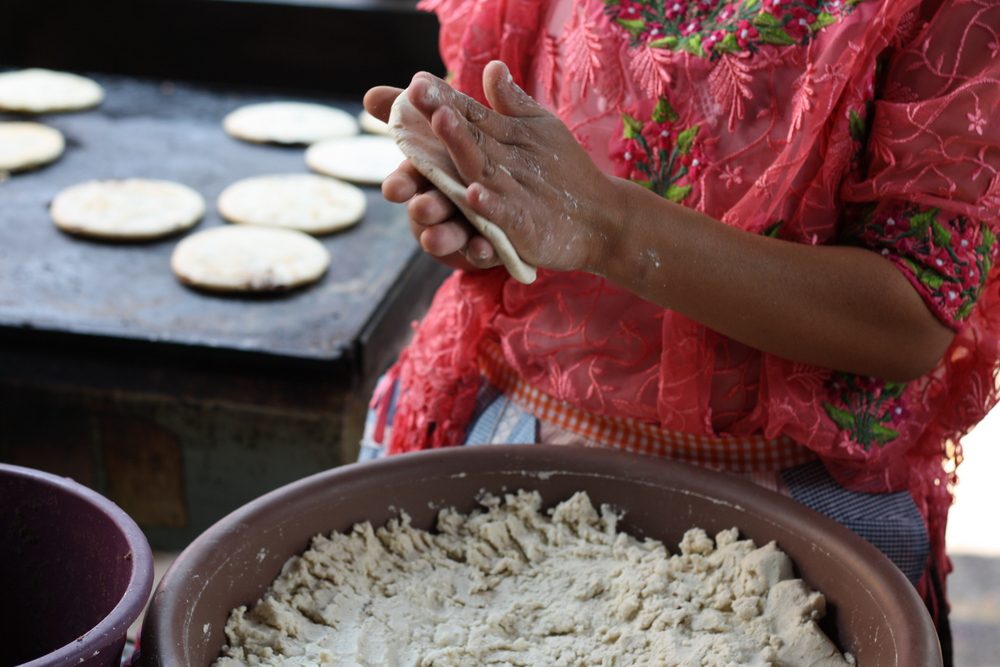
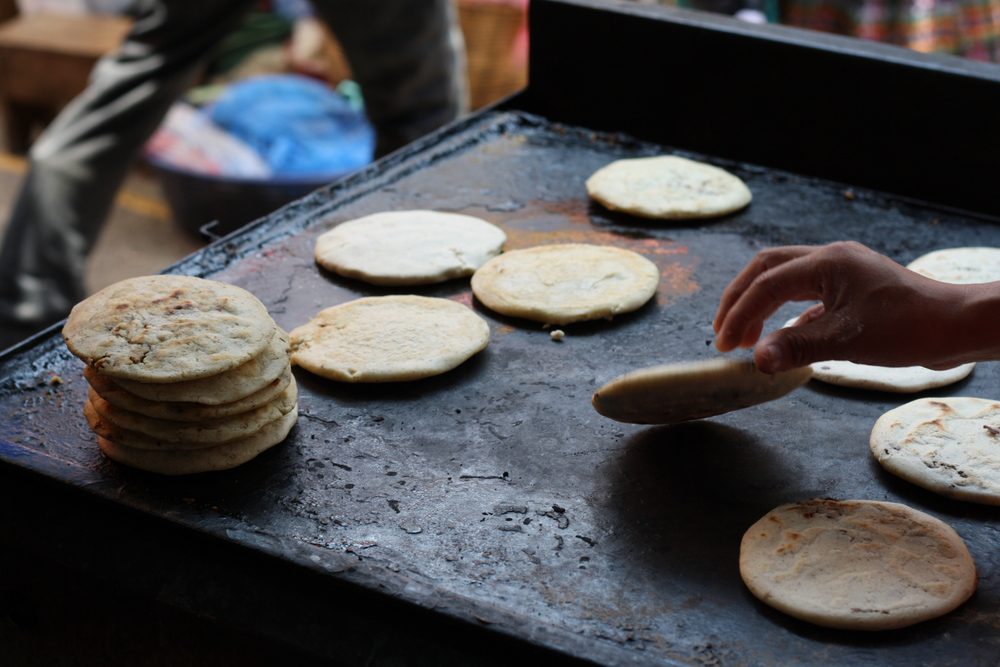
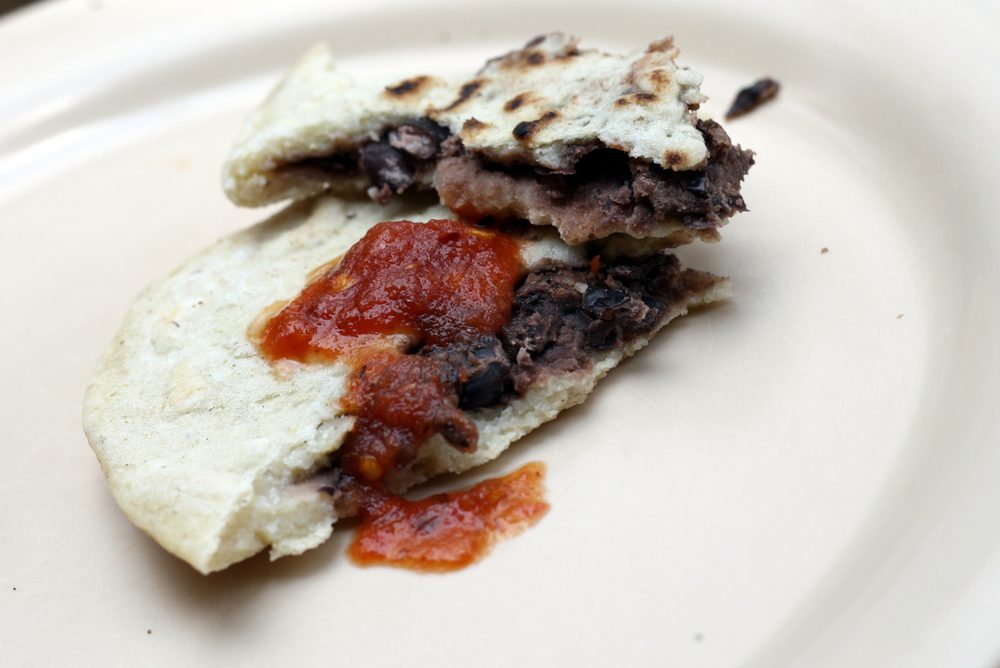
    Tayuyos: stuffed tortillas

    This is the Guatemalan version of the Big Mac. In fact, people call them MacTayuyos.

    In the Chamelco market, there is a woman who makes fresh tayuyos. She’s there every day (except Sunday, maybe?) patting stuffing the masa with cheese, potatoes, pork, or refried beans and then patting them into tortillas. They cost one quetzal each, except for the pork ones which cost a little more. She puts the hot tayuyos into a plastic bag and then ladles chili sauce directly onto them. I like mine a little less soggy and spicy, so I always ask for my chili in a separate bag. A bit of sour cream with the potato tayuyos is absolutely divine.

    Churrascos: grilled beef
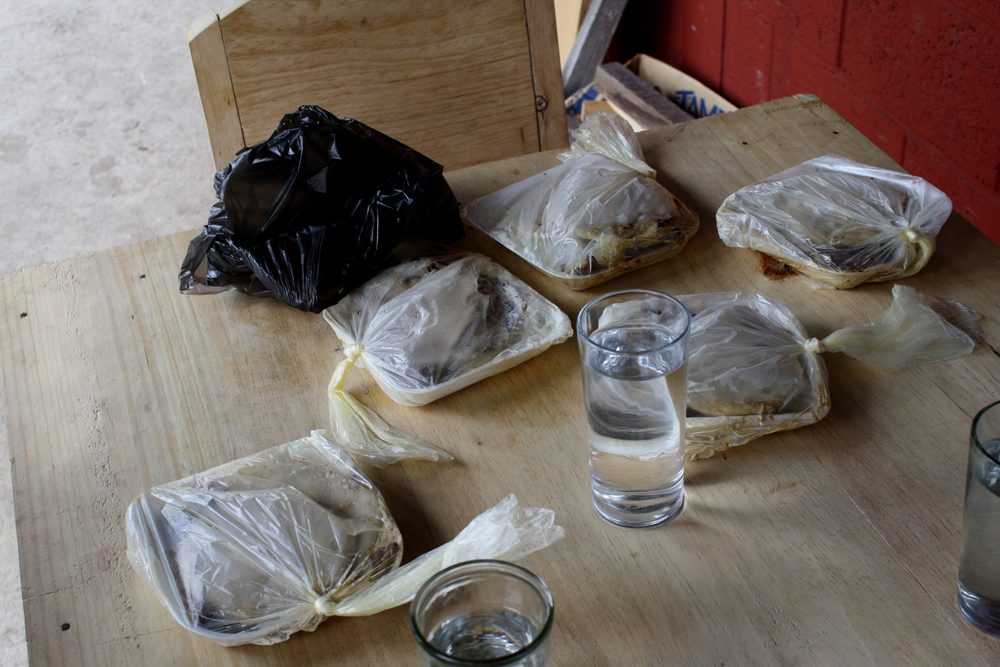
    One Sunday on our way home from church, we stopped at a food cart in Chamelco. The guy was selling grilled liver and onions. Because no one but me likes liver, I ordered one meal, just to try it. Back home, we opened the bag and promptly devoured every last morsel. The next Sunday I was all eager to buy six liver and onion lunches, but the guy wasn’t there. So we bought churrascos instead.
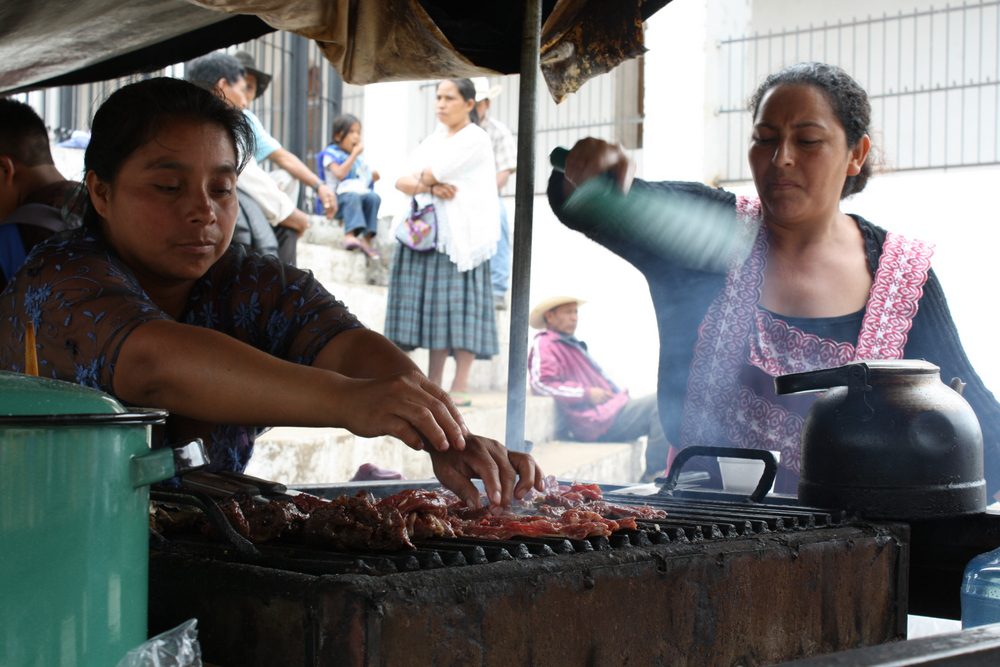
    For ten quetzales, less than a dollar and a half, we get a styrofoam plate of grilled beef (marinated in a parsley-garlic-oil type sauce) with slaw, refried beans, lots of onions (the best part), and three tortillas layered across the top in lid-like fashion, hot sauce on the side.
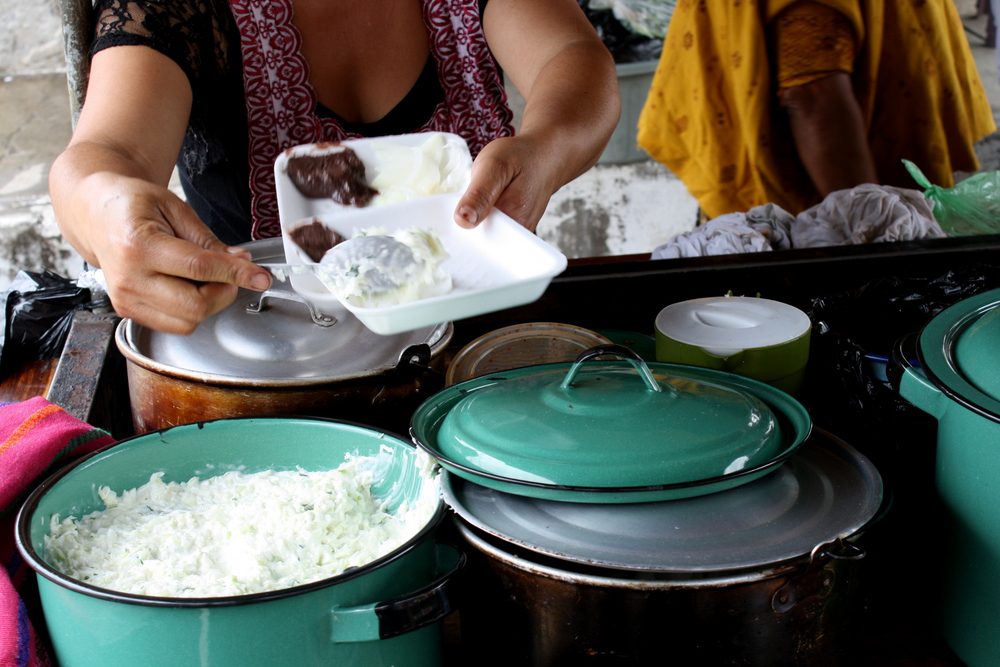
    While I wait for our order, I sit on one of the little stools by the cart. The women are in constant motion, cutting more onions, scooping mounds of raw meat out of a kettle and slapping it on the grill, basting, filling plates, fanning the coals, adding another bag of charcoal to the fire (literally: they burn the plastic, too), turning the meat, etc. The raw meat touches the cooked meat and they never wash their hands. The food is delicious.
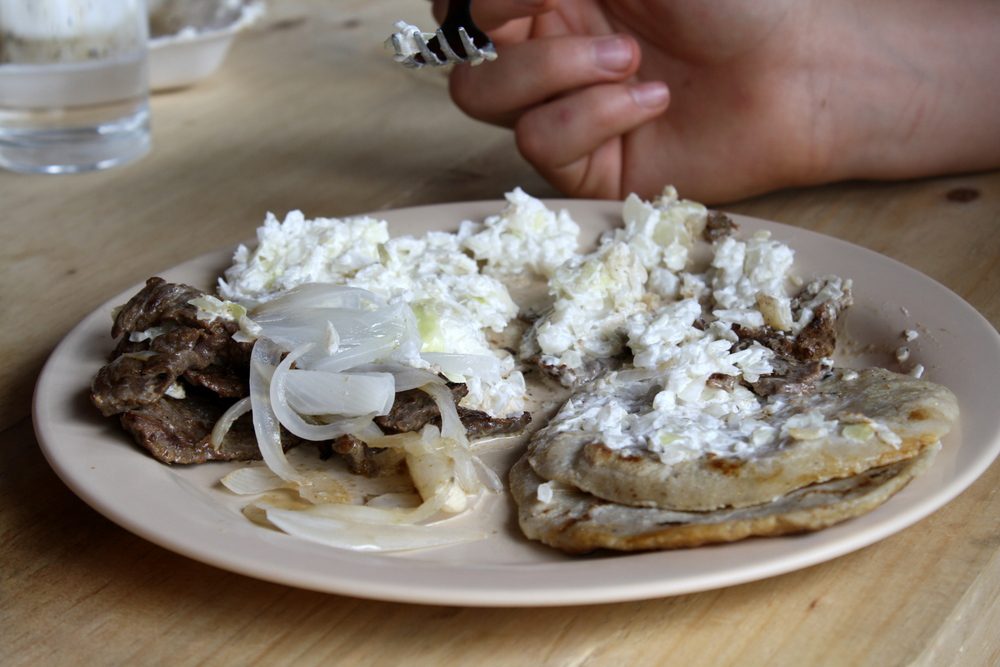
    The liver-and-onion guy has yet to reappear, but we’re pretty content with our Sunday churrascos. They’ve become such an integral part of our weekend that last Sunday when we didn’t go to church, I hiked into town for the sole purpose of fetching lunch.

    Elote Loco: crazy corn (i.e. field corn on a stick)

    ‘Tis the season for fresh corn, and this delicacy is everywhere. My kids have been begging me to buy them some, so the morning of the race, I did.

    It’s simply (field) corn-on-the-cob, smeared with mayonnaise, squirted with red ketchup and green hot sauce (which my kids said no thank you to), and then sprinkled with salty cheese. It’s surprisingly good, and very filling.
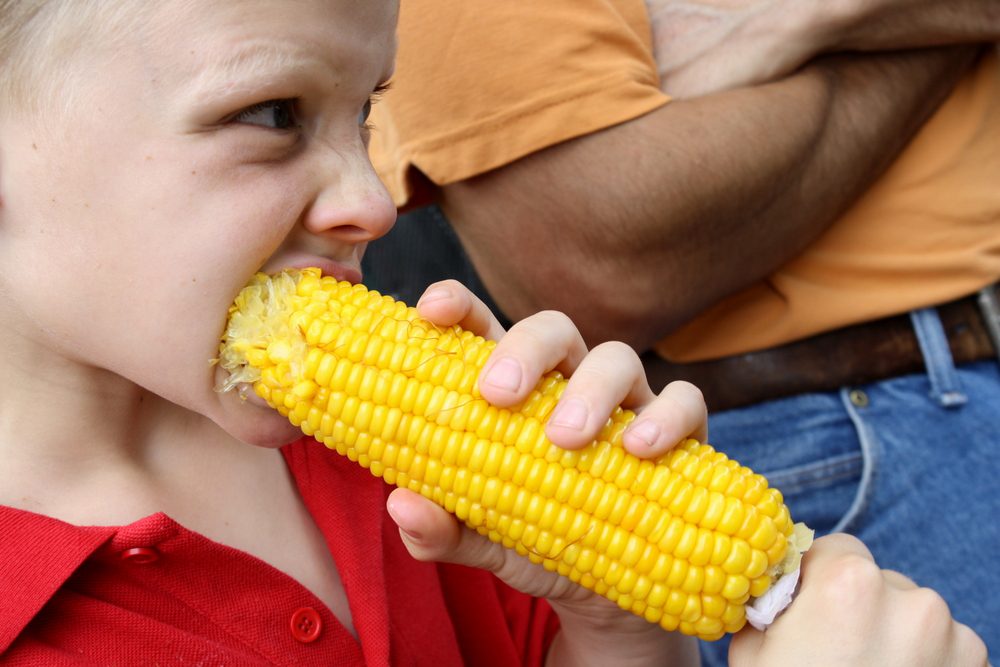
    He wanted his plain. 
    This next week is the Chamelco fair. The next week it’s the Carchá fair. The following is the Cobán fair. Something tells me there is a lot of street food in our future. 
  • the business of belonging

    “Fifteen more weeks!” my daughter shouted from her bedroom. “We go home in 15 weeks!”

    The rest of the kids started yipping and hollering and doing out loud (everything is out LOUD in this house) calculations about what fifteen weeks means exactly. As I listened to them jittering away, I found myself growing increasingly irritated and annoyed. My children haven’t transformed into the cultural chameleons I want them to be, dagnabbit. Why can’t they relax into the experience and savor this special time that we have away from It All, together, in an exotic, foreign land? Why must they always be hankering after our same old boring routines? Aren’t they enjoying this at all? I
    mean, come on kids! Be bold, be brave, be strong, CONQUER!

    But mostly, I’m irritated at myself because I feel exactly the same way. More and more, my mind is occupied with thoughts of home and all the things I miss. It’s not classy to wallow and whine, and I’m aware that doing so only highlights my inability to adapt well, but whatever. I’m not classy.

    Things I Miss: my kitchen, netflix, my bed, dress boots, a real haircut, the van, fresh strawberries, the public library, phone conversations, amazon, sourdough bread, a spacious house, two bathrooms, a toilet that doesn’t plug up with just one small poo, soft chairs and sofas, the fireplace, the yellow-green of new spring, not wearing a backpack, bagels, sausage, salads, homeschooling, knowing what’s going on, church, the five-o’clock glass of wine, screened windows, central vac, etc, etc, etc (for pages). But most of all I miss ease, convenience, freedom, connection, belonging, friends and family, and Being With My People.

    Sundays are hardest. It’s the day when everyone hangs out with their friends and family and since we don’t have friends and family to hang out with, it kind of stinks. Plus, there’s nothing to do. Schools are closed, market is mostly shut down, nobody’s online, and there is nowhere to go. It’s the perfect opportunity to fall into the pit of despair and splash about, and I’m not one to pass up a perfect opportunity, no matter how depressing, woe is me.

    Of course, no one excepts anyone to go to a foreign country for a few short months and develop life-long friendships and a profound love and acceptance of a place that’s so wildly different from home, least of all me.

    Except, I kind of expect that of myself. Or at least I wish it for myself. I wish I was the type of traveler who made instant connections and wrote home glowing reports about making tamales while  having life-altering conversations with the locals. Because the people who can bridge the cultural gap with such ease are the ones who are really good at their work, obviously. Anyone less than that is just an imposter. An overseas worker wannabe.

    The thing is, thanks to personality, skills, temperament, something, fitting into Central American culture is, for me, clumsy and awkward. I knew this about myself after living in Nicaragua for three years, and I’m grappling with the boring reality that I haven’t changed one whit since then. One part of me knew this all along and is genuinely okay with the fact that I do my deepest connecting on home territory, but another part can’t shake this crazy hope that I’ll somehow, someway, someday start to feel like I belong here (or in any Spanish-speaking country, for that matter).

    One of my friends—a woman I’ve looked up to ever since the very first chapel of my college career in which she seared into my brain the importance of keeping the Sabbath—has spent a fair bit of her life in Central America. She and her husband met while working in Nicaragua. They raised their family in both Central America and the States. They host study tours to Central America. They sing their mealtime prayers in Spanish and eat lots of beans and rice. Heck, they even adopted a child from Central America! By all appearances, they are The Real Deal Workers. The ones who fit in, make connections, belong. They have successfully bridged the gap.

    At the beginning of our term, in a delightful turn of events, they were able to visit us in our home. We were lingering at the table (after the pancake breakfast, maybe?) when I admitted my insecurities, my sneaking suspicion that I’m not cut out for this type of work. My proof: I have never made deep friendships. I’ve never felt like I belong.

    Her swift response sent me reeling: AND YOU THINK I DO?

    Ever since that conversation, I’ve been gentler with myself. I still wish being overseas felt more natural. But just because I don’t want to call Guatemala my home until I’m a shriveled up prune doesn’t mean I don’t have an ability to work here. If my friend can rock the international living thing and feel the same way I do, then guess what: I can (try to) rock this business, too.

    The only problem is, most days it doesn’t feel like I’m rocking any business, least of all mine.

    But maybe that’s beside the point? I sure am hoping so.

  • the smartest thing I did

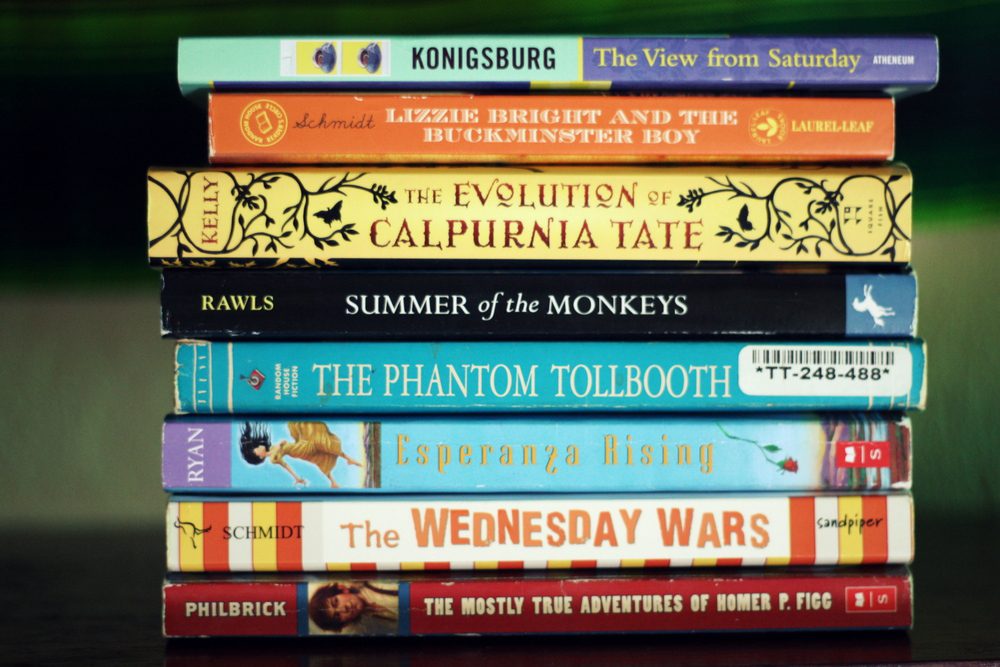
    Last November and December, I spent hours poring over reading lists and Amazon reviews, and then I slapped down a hundred bucks in exchange for a small stack of brand new books. Thanks to that planning, we have had a whole string of top-quality books to keep alive our bedtime tradition of reading aloud.

    In retrospect, it was the smartest thing I did.

    Esperanza Rising was the first book we read, and we couldn’t have picked a more fitting one to start with. It’s all about a rich Mexican girl who ends up, due to tragic circumstances, immigrating North and becoming a migrant worker. Her distaste for her lower standard of living closely mirrored what my children were going through. It was perfect.

    The Phantom Tollbooth was a bit deep for the youngers, but my older son thought it was hysterical. Also, it gave us The Island of Conclusions (a place we jump to it on a daily basis). Summer of the Monkeys was a fun, light read. The Mostly True Adventures of Homer P. Figg made us laugh. Shakespeare and the 7th grade came together in The Wednesday Wars.

    Beautifully written, informative, and entertaining, The Evolution of Calpurnia Tate hit home on a deeper level for my children. In the book, Calpurnia has a science-loving grandfather called “Granddaddy.” In real life, my children have a science-loving grandfather called Granddaddy. The connection was so startling, so real, that my younger daughter begged me in tears not to say the word Granddaddy while reading—it made her too homesick. But I persisted and she acclimated.

    A couple nights ago we started Lizzie Bright and the Buckminster Boy. Next up is The View from Saturday.

    I brought other books, too. For me, I brought This Rough Magic, Blood, Bones, and Butter, My Berlin Kitchen, Dignity, and An Everlasting Meal. For my son, I brought All Quiet on the Western Front, Roll of Thunder, Hear My Cry, and Touching Spirit Bear. Other books have found their way onto our shelves via generous neighbors and blog readers.

    My son is branching out from the popular teen books on his Kindle to some of the classics like Twenty Thousand Leagues Under the Sea and some of our more adult reads such as The Story of Edgar Sawtelle and The Boy Who Harnessed The Wind. That last book, plus Foreign to Familiar, a book I read to the older two children, so impressed him that he wrote to his friends suggesting they, too, read the books. And just this very morning, he copied down the name of the boy who harnessed the wind so he could watch his TED talk during his computer class at school.

    In conclusion, three thoughts:
    1. The books I brought, along with a few that
    some friends have shared, will be enough to get us through our time
    here.  I wish we had more books, of course. I miss having ridiculous quantities of
    literary entertainment at our fingertips. But you know what? It’s been enough. I don’t know what to make of it. It’s proof, I guess, that I really do come from a culture of excess.

    2. If traveling, take books. 

    3. The high quality of the reads and the great fun we have gotten
    from them make me wonder if it is worth spending a hundred bucks each
    year on some brand new, carefully selected books even if I don’t plan to go anywhere. It’d be like menu
    planning, but with a literary twist. What do you think? Do you have a tried and true method for selecting your reading material?