When Sarah and her family lived in our area (they moved to Florida a couple years ago, and then to Ohio), she was our homeschool evaluator. Each spring she’d come to our house and listen to me prattle on about my kids, and then she’d go home and write up a professional-looking statement certifying that they were, indeed, learning. I never felt like I had to prove myself to her. Her trust — of me and of my children, and of the learning process as a whole — allowed me to relax, trust myself, and, most importantly, try to do a better job of trusting my kids.
Hello, Sarah! Tell us about your family! We’re a family of four: Ben (43), Sarah (42), Sam (11), and Asher (3). We live in Northwest Ohio. Ben works in the information technology department of a local home store, and I’m home doing the gardening, cooking, and kid-watching.
Why did you decide to homeschool? I was unschooled (though it wasn’t called that back then) 1st-12th grade, and it was a great experience for me. Ben was homeschooled as well. So it was always sort of our default option. When Sam was five we visited a kindergarten open house, and after looking over their objectives and talking with some of the teachers we concluded that there wasn’t much for Sam there, academically or socially. We’ve always kind of taken it year by year. I’ve looked at some various options along the way, but none have been as good a fit as unschooling. Sam has never wanted to go to school, either.
What do you mean by “there wasn’t much for Sam there, academically or socially”? The kindergarten teachers gave us a list of objectives for the year that they would be teaching: things like learning letter sounds and a few sight words, counting to 100, following two step directions, etc. Sam was already reading on his own and doing multiplication. I think I found two things on the list that he didn’t already know: recite the Pledge of Allegiance and listen without interrupting during conversations.
Sam’s piano teacher that year was also an assistant in the preschool class at the elementary school. When she heard we were considering sending Sam there to kindergarten she told me that the incoming class she was working with was the absolute most challenging she had ever had—disruptive and needy to the point that she couldn’t recommend that we send Sam. Given all that and the fact that we had another option, we decided to give it a pass.
What does homeschooling actually look like for your family? We identify as unschoolers or life learners, which means Sam is largely in charge of his learning. He has some chores and responsibilities around the house, but other than that his days are his own. Before the pandemic he took part in a number of outside activities: choir, summer camps, homeschool classes at co-ops and homeschool centers, library activities, church stuff, and so on. Now all of that is on hold for us, just like everyone else.
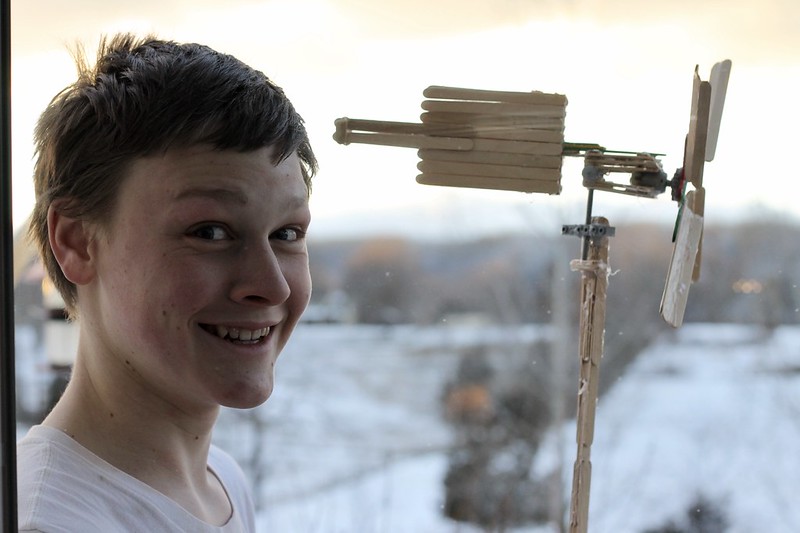
I’m at home with him and Asher, so he does things with us or on his own: lots of reading, playing with Legos, programming things in Python, composing and playing music, playing outside, chatting online with friends, cooking things, etc. He also writes a weekly newspaper, a completely self-chosen activity that he’s maintained for a year and a half. He cleans up breakfast every weekday, makes supper on Tuesdays, and does other chores when I ask (usually without too much grumping!)
Tell us more about Sam’s newspaper! Sam writes about weekly happenings in our household. Some of the stories are about real-world events and some take place in one of his many fantasy worlds — he’ll write about his stuffed toys or similar. He takes photos, makes ads, thinks up jokes, and sometime interviews family members. He usually doesn’t seem to enjoy the actual writing very much, but he does it every week, nevertheless. Once in a while he’ll ask me to type while he dictates or give him advice on some part, but usually he does it on his own. It’s been interesting to me to see not only how his writing has developed, but how he’s handled having a weekly deadline. Sometimes he’ll spread out the work and do a few pages each day and sometimes he’ll put it all off until the end of the week and spend several hours working on it on Friday or Saturday. If he knows we’re going on vacation or something he’ll work ahead. Every once in a while the paper is very short, but there’s been one every week for about 18 months.
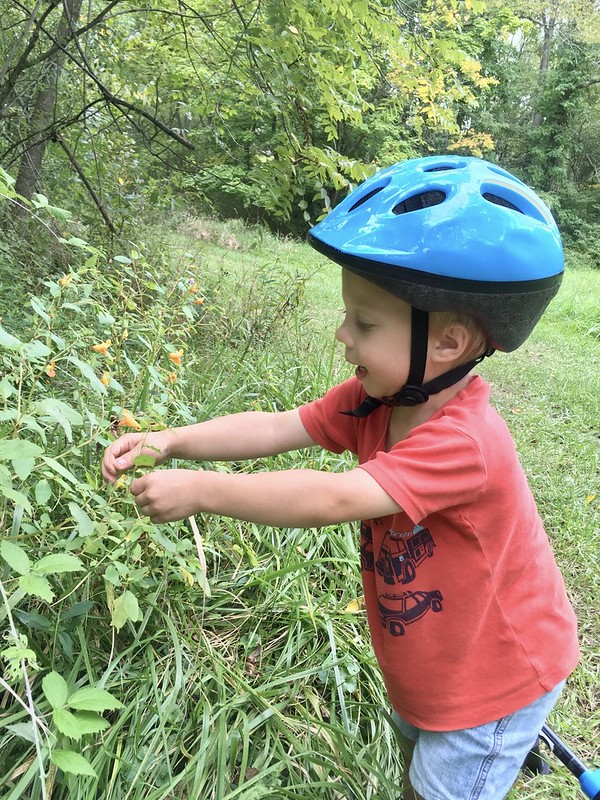
Has your homeschooling changed as the boys have gotten older? The truth is that with unschooling nothing really changes when your kid turns five or is ready for first grade or middle school or whatever. I get wound up when people talk about “homeschooling” their preschool age kids (I imagine kids in high chairs with worksheets in front of them), so most of this is focused on Sam, but Asher’s learning all day too: playing with toy vehicles, riding his bike, listening to books, singing songs, alternately playing with and fighting with Sam…all you’d expect from someone who is three.
Does it every drive you crazy, being at home with the kids all the time? It’s gotten easier as they’ve gotten older. I’ve been very fortunate in a lot of ways: the first child was the one who most intensely needed my presence when he was little, and that was okay because he was the only child for eight years. I’m also fortunate to not need to have a job, and to find watching people learn fascinating. So usually we’re pretty content at home together.
But how do you ever get anything done? The kids play outside while I garden and hang out with me while I cook. I write while Asher naps. I try to enjoy or at least respect their interests and chosen activities (I’ve learned more about trains and cars since I’ve been a parent than I ever wanted to know). Now that we’re out of the baby stage I get grouchy if one of them needs me after 8:30PM or so when I want to be “off duty” for the night, but Ben is usually very kind about being the active parent at that point.
What’s most challenging about homeschooling? The most challenging things I can think of aren’t specific to homeschooling: the screamy times; so many interruptions to what I want to do; no childcare because it’s the pandemic. I think all parents are dealing with those things.
What have you learned through homeschooling your children? I’m often surprised by the things my kids know that I’m sure I never taught them. Sam identified iambic pentameter the other day, which, while I had heard of, would have no idea how to identify. When Asher was two he started spelling his last name and reciting my phone number, no prompting or coaching. (I finally caught on that it was from listening to me talk on the phone!)
I’m learning and re-learning how to model what I want to see. That’s a never-ending process. I love watching the different ways my two kids learn: Sam likes lists, explanations, and wants to know the right way; Asher likes to practice on his own, again and again. I’ve seen, especially from Sam (since he’s been around longer) how learning isn’t necessarily a linear process. He’ll work on something—music, math—intensely for several weeks, and then largely ignore it for months or even years. When he comes back to it he’s ready for the next level.
Do you ever get worried that Sam might ignore something for too long and then have trouble later? Not too often — having been unschooled myself I’ve experienced a lot of “learning it when I need it.” I did very little formal writing or math until I applied to college, and that was fine — when I decided I wanted to go to college I was extremely motivated to do whatever I needed to do to go.
Every year or so I’ll check grade-level objectives to see what Sam would be doing if he were in school, partly out of curiosity and partly to make sure he’d have the option to join if he wanted to. If there are things that I don’t think Sam knows already I’ll show him the list and ask him about it. Often that’s sparked an interest for him in learning about whatever it is. But generally if he doesn’t know the principal rivers of the US or what system of government was used in ancient China I’m not too concerned about it. He’s always been interested in learning pretty much everything and I can’t imagine that that will ever change.
There have been, and continue to be, certain social and self-care skills that I insist he learn, because I have to live with him and he’ll be interacting with people all his life. Everyone needs to know how to handle their anger and clean the bathroom!
You’ve moved a lot recently. How have you managed to get the support you need (assuming you’re getting it, of course)? I have a few friends with homeschooled kids who are older than mine. It’s always inspiring to see what that next stage might look like, especially on those days when I feel a little mired. Often I’m inspired just by observing what my kids are doing and learning. I have some favorite authors I turn to when I need words for what I’m seeing or feel like I need a course correction; Alfie Kohn’s Unconditional Parenting and Peter Gray’s Free to Learn are two favorites.
Do you have a homeschool philosophy? I sometimes describe my unschooling method as what you’d do with a toddler or preschooler: Let them participate in your activities, don’t disturb them if they’re happily occupied, answer their questions, and show them things you think are cool. The rest is just (“just,” hah!) parenting. If you can teach your child things like washing their hands and table manners and treating other people decently, academics will likely be the easy part.
I used to be a lot more of the opinion “Just leave them alone and they’ll learn.” There’s still a lot of that in my philosophy, but I’ve grown to place a lot more emphasis on relationships. Kids don’t need someone to tell them what to do, but they certainly need people in deep relationships with them, setting healthy boundaries, modeling respect, and reflecting together.
Any advice for someone who’s considering homeschooling? Know yourself and know your kids. Be flexible. Be okay with trying something and making a change if it’s not working. Let your relationship with your kids take top priority. Do some reading on how people learn — you might be surprised at how little it matches what happens in school.
Let’s bake something comforting, yes? But first, a new cookbook.
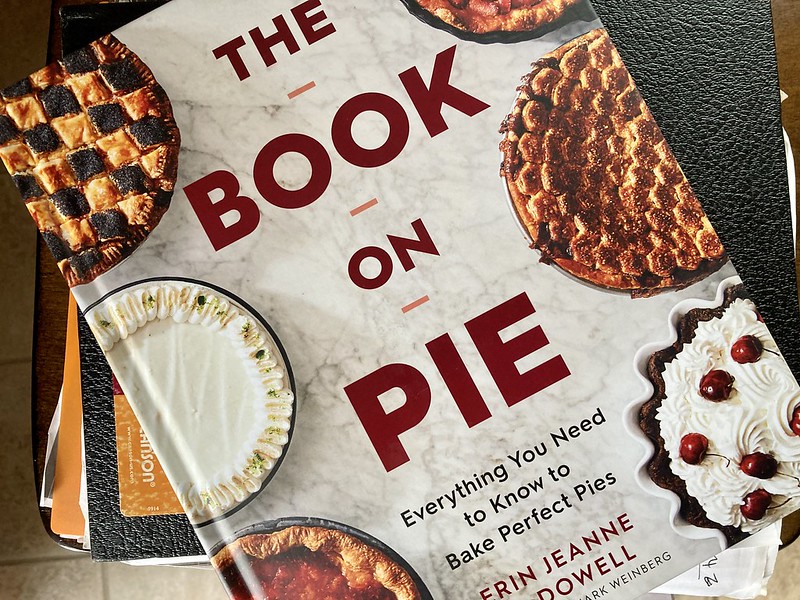
I’ve been holding back telling you about this one, mostly because I’m not sure what I think. I mean, I watched all four of her video lectures before buying the book, and I appreciated her techniques: draining the fruit and reducing the juice to get a consistently saucy-yet-sliceable filling, parbaking the crust, admitting that the first slice of pie always looks like crap and is thus called “The Sacrificial Slice,” etc. Her clear instructions and contagious enthusiam encouraged me to make the switch to eyeballing the water when making pie dough (I KNOW), and now I roll the pastry out directly on a lightly-floured counter using my French rolling pin (which is a lot fancier sounding than it is) and it’s so, so easy.
Plus, I could see that all the pies in her videos had crisp, well-browned bottoms. Which is HUGE. All too many fancy pies made by so-called experts showcase pies with limp, pallid bottoms which is a dead giveaway that they haven’t a clue.
Since the lady, judging from her (pie) bottoms, clearly knew her way around a pie, I bought the book and straightaway read it from cover to cover. (And when I saw that her pretzel dough pie called for honest-to-goodness lye, I whooped out loud. This woman was serious.) But then I plunged in and promptly turned out a handful of truly dreadful pies: too sweet, too gummy, too salty. Were my tastebuds off? Were hers?
But I kept going and gradually I landed on some winners, including this crostata.
Which isn’t actually a pie pie — it’s more of a layered fruit crumble — but it’s still sliceable and baked in a round pan so: pie. (Never mind that cake is also sliceable and round. Whatever.)
Red raspberry and rhubarb, I think.
Freshly baked, the crumb topping is crunchy and the fruit sharp and saucy. But Day Two is where things get good. The oaty layers soften and the fruit looses a bit of its bite, and the whole things feels almost cakey. Actually, it reminds me of these blueberry bars that my aunt makes. I love these bars, but I rarely make them because the rolling feels finicky. This crostata, on the other hand, just gets wacked into the pan, free-form, and the fruit — you can use whatever you want: odd ends cluttering up the kitchen counter or bits of berries gathering freezer burn down cellar — is left raw. The whole thing is satisfying to make, and it ends up tasting almost nourishing.
In fact, it feels more like a fruit-packed coffee cake than a dessert. I eat it for breakfast, and if I’m not saving it for anything in particular, I let it sit out on the kitchen counter so the kids can cut off thick wedges to accompany their tall glasses of milk whenever they get hungry.
Of course, if you want it to be fancy, be my guest: served warm, with a big scoop of vanilla ice cream and a cup of strong coffee, and everyone will be wowed.
When I made a red raspberry rhubarb version, I thought the filling was too tart at first, but by day two it had mellowed and sweetened and felt just right. Just something to consider….
Some of my plans for future crostatas incude: *stone fruit medley (plum, apricot, peach) *triple reds (strawberry, sour cherry, red raspberry) *rhubarb, straight up (with orange) *apple cranberry
for the crumbs: 1½ cups rolled oats 1½ cups flour ⅓ cup whole wheat flour ¾ cup brown sugar, packed ¾ teaspoon baking powder ¾ teaspoon salt ¾ teaspoon cinnamon 170 grams (1½ sticks) butter, chopped ½ cup chopped pecans, reserved
Toss together the oats, flours, sugar, baking powder, salt, and cinnamon. Using your fingers, cut in the butter until crumbly. Press two-thirds of the crumbs into the bottom and up the sides of a greased 9-(or 10)-inch springform pan. The crumbs should make half inch-high border. Add the pecans to the remaining crumbs and set aside.
for the fruit: 900 grams mixed berries (strawberry, red raspberry, blackberry, cranberry, blueberry, etc) juice of ½ lemon 2 teaspoons vanilla ½ cup sugar 3 tablespoons cornstarch ½ teaspoon salt
Add the lemon juice and vanilla to the berries. In a separate bowl, stir together the dry ingredients (so the cornstarch doesn’t get lumpy when it hits the fruit) and then toss with the berries.
Tumble the berries into the crust-lined pan. Top with the remaining pecan crumbs. Bake the crostata at 375 degrees for 45-60 minutes, or until golden brown all over and the fruit is bubbly. Note: I usually end up baking it another thirty minutes or so, reducing the heat to 350 and slipping a tray under the pan (and covering the top with some foil) to protect the crostata from burning; I like the middle to be bubbling and the whole thing to be quite toasty.
Cool completely (or mostly completely) before slicing and serving. Store any leftovers at room temp, covered with plastic.