The day after the CDC announced that kids ages 12-15 could get vaccines, I signed up my younger son for his shot. Once again, I had that same nervous feeling, and, once again, it was totally fine. The clinic was teeming with parent-child duos, and there was even a place for walk-ups.

The next day, my son had a wee bit of stomach upset, but his arm hardly even hurt. He gets his second shot later this week which means that, when we head north on our family vacation, he’ll be nearly fully vaxxed, hip-hip!
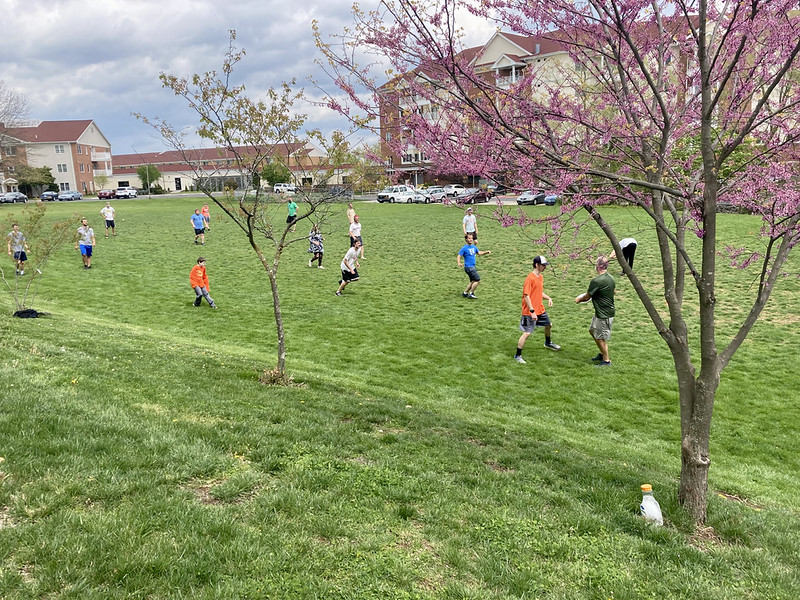
Ultimate games (until I pulled my hamstring).
The day after the CDC’s sudden (and extremely clumsy) mask mandate reversal, I was itching to put on lipstick and go shopping without a mask. Better yet, I wanted to burn the masks. (Not really, but you know what I mean.)
But then I got to Old Navy and everyone was still masked, the “just virtual hugs for now” announcement still playing over the sound speaker every ten minutes, and I was like, Oh yeah, national chains can’t just turn on a dime. Darn. Guess this means Costco’s probably not putting out the samples just yet.

Indoor meals! With (lots of) friends!
Back in the beginning, in an attempt to get everyone on board with mask wearing, a moral case was made for them: people who wore masks were thoughtful and caring; those who didn’t were selfish and rude.
There was good reason for this because, apparently, a whole bunch of people in our country no longer believed in science [cue the rumbling of a falling civilization]; how else were we to convince people to put the damn things on their faces if not through shame and blame?
But now that science has proven that fully-vaxxed people have a very low risk of transmitting and contracting the virus, mask-wearing advocates find themselves in a bind: if we give up masks, then how will anyone be able to tell us thoughtful folk apart from the careless maskless ones we so itched to challenge in the grocery store? Now I find myself feeling pressured to continue wearing a mask, not because it will protect me against the virus (thank you, vaccine) or because the people I’m with are compromised (they aren’t), but because if I don’t, then people might think I’m a bad person.
It’s ironic, no? We make a moral case to shame people into wearing masks and now we’re embarrassed to take them off. Oops.
Of course, it still totally makes sense for vaccinated people to want to continue wearing masks. From an article in the Atlantic (What Happens When Americans Can Finally Exhale by Ed Yong):
But it is also reasonable for people to want to continue wearing masks, to feel anxious that others might now decide not to, or to be dubious that strangers will be honest about their vaccination status. People don’t make decisions about the present in a temporal vacuum. They integrate across their past experiences. They learn. Some have learned that the CDC can be slow in its assessment of evidence, or confusing in its proclamations. They watched their fellow citizens rail against steps that would protect one another from infections at a time when the U.S. had already weathered decades of eroding social trust. They internalized the lessons of a year in which they had to fend for themselves, absent support from a government that repeatedly downplayed a crisis that was evidently unfolding. “We had no other protections all year,” Gold said. “We had masks. No one else protected us. It’s understandable that people would be hesitant about taking them off.”

From my writing nook at the coffee shop.
Now, (semi-)post Covid, I keep hearing people ask, What’s it going to be like to be in a group of people without a mask? Will I be able to relax? Will I remember how to be behave? The emotional fragility has felt familiar to me, and then I realized why: it reminds me of how it feels to come home after living in another country.
Reentry is tough. The whole world seems shrouded and otherworldly and, unsure of myself, I move gingerly. Each new thing — writing a check, driving a car, running the washing machine — evokes anxiety. Can I do it? Will I remember how? But as soon as I do the “new” thing I’m so worried about, like buy groceries with a credit card or check books out of the library, my confidence comes flooding back and I relax.
That’s how this stage of Covid feels to me. Each new thing — standing close to someone, waltzing into someone’s house, walking into a populated room without the “putting a mask on” motion, sitting outdoors with a crowd of people — is a little weird. I feel clumsy. I marvel. I get emotional. But I’ve also noticed that I’m acclimating. Quite quickly, actually.
Thing is, with Covid, people are re-entering at different times and at different speeds. It’ll probably take weeks, if not months, for us to work our way through this stage of the pandemic. But then, I imagine, we’ll reach the tipping point where we look around and suddenly realize that more people than not are in society, doing more or less the same things they used to pre-pandemic.
That’s my theory, anyway. We’ll see what actually happens.

At my kids’ concert, we sat physically distanced but, once seated, almost everyone removed their masks. At one point, we were even instructed to sing along. I settled for crying.
This same time, years previous: simple lasagna, brown sugar rhubarb muffins, the quotidian (6.1.15), a bunch of stuff, small pasta with spinach and bacon, three reds fruit crumble.