• four fun things

    Saturday afternoon, we threw a spontaneous corn party.

    My brother’s family was here for the week, so that morning we’d all gathered at my parents’ house for breakfast. When lunchtime rolled around, everyone (minus my parents who opted to stay home and snatch a breather) transitioned to our place for lunch. 

    On the drive home, I checked my phone. A local farmer had left a message: they had seconds of fresh corn — did we want it? I followed up with her for details — 25 dozen ears, picked that morning, $2.50 a dozen (!!!) — and then phoned the rest of the family. Anybody up for doing corn? I asked.

    Sure, why not, they said.

    So that afternoon, we hauled out the big cook pots and the knives and a gazillion bowls and threw ourselves a rolicking three-hour corn party. 

    There was even live music! Here’s a snatch of a song that I filmed and sent to my older daughter, the only person missing from the festivities, as a passive aggressive ploy to make her come see us.

    Hope I didn’t make you too homesick, hon (wink-wink). We love you!

    ***


    A few weeks ago, out on an early morning walk with a friend, I noticed she was wearing soft, slip-on shoes. Hold up, I said, stopping in my tracks. Your shoes. Are they even comfortable?

    Oh, yeah, she said. They’re great. More like slippers than shoes, actually. And since they’re made from washable wool, I just throw them in the machine every few weeks to clean them. 

    Wool? I was aghast. Don’t your feet sweat? 

    Nope, she said.

    So I bought a pair!

    Now, they are pricey (mine cost nearly $80, and that was with a discount) but they are even better — way better — than I imagined. Even in this hot weather, I wear them constantly. (UPDATE: Today, in 93 degree heat and sky-high humidity, I did notice that my feet were sweating a bit. So yes, feet will sweat in them, but in normal weather they’re peachy.)

    They’re more comfortable than going barefoot, I raved to my husband.

    And then one of the Merino ads popped up on social media: Better than bare feet, it declared, and I was like, See? I told you.

    ***

    Have you seen Julia Sweeney’s talk about loosing her faith?

    My mother sent the link to me, and then my husband and I watched the two-plus hour live performance over the course of several days. Both of us loved it, probably because we appreciated Julia’s persistant questions and identified with many of her observations about religion and faith.

    Only problem: it left me wishing I was part of a book (or video) group so I’d have more people to discuss it with! 

    ***

    My brother and sister-in-law recently released this music video along with their new CD Coffee & Cake.

    Each time I watch it, I can’t help but get a little emotional. Something about the beauty of the mundane: kids running around outside, grating carrots, conversation with a spouse.

    Precious stuff, the ordinary is. 

    xo!

    This same time, years previous: sixteen miles, the quotidian (8.27.18), the quotidian (8.28.17), peach crisp, bezaleel scenes, the quotidian (8.27.12), fresh tomato salad.

  • no-hands mozzarella

    Y’all, I can’t stop. This cheese, it consumes me (and I it, hehe).

    Up today: No-Hands Mozzarella!

    I’ve made mozzarella before, and it’s fast (only 30 minutes), but it involves several steps, lots of dirty dishes, whey splashes galore, and — this is the worst part — plunging your hands in painfully hot liquid. Add in this crazy hot humid weather, and making homemade mozzarella is like installing a sauna in the main part of your house: stupid.

    But homemade mozzarella is easy to make! It freezes well! It’s cheap! It goes with everything! I need my mozzarellaaaaaaaa!

    milk “jello”— right around the 100-degree mark
    (though that thick band of whey means I probably heated it a bit higher than I should have)

    So when I happened upon a video of an Italian dude making mozzarella by stirring the curd with a long wooden paddle, not his hands, I got excited. Just lots of stirring, extra hot water, and then — BAM — mozzarella, could it be?

    I tried it, but nope. It just didn’t stretch properly. 

    But THEN I saw that Kate (the quark lady) had recently done a post updating her mozzarella method and, lo and behold, she’d switched from hand-stretching to spoon-stretching (à la the Italian cheesemaker in the video)! To stretch the cheese, she just lifted it out of the whey with the spoon and let gravity do the work. The part I’d been missing, I surmised, was that I hadn’t heated the whey enough.

    So I made it again and . . . IT WORKS.

    Kate’s new method is so relaxing and easy and efficient and — most importantly — painless. No more scorched hands!

    my niece wanted a lesson

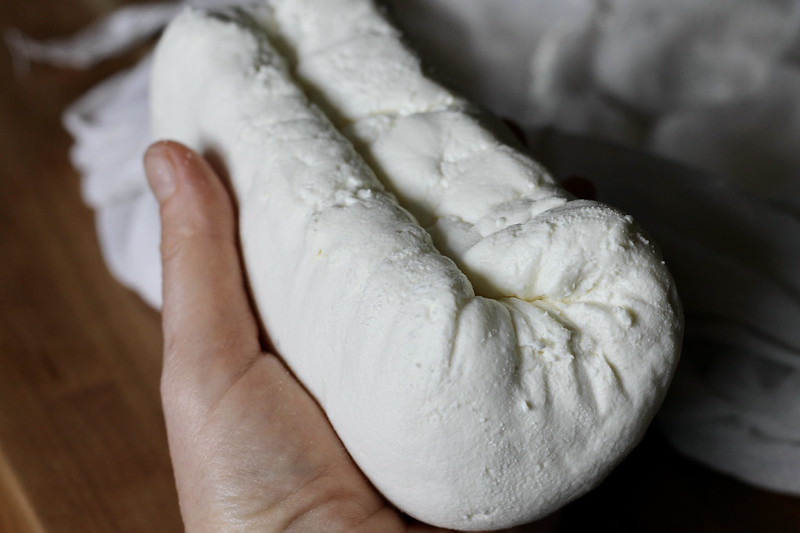
    Once the cheese is sufficiently smooth (we’re aiming for “good enough,” Kate says), she just dumps the squishy soft mass into a square container (the easier to grate it, my dears!) and pops it into the fridge. Or freezer, since it only holds a few days in the fridge.

    Have I mentioned how well it freezes?

    I’ve been trying to make a batch of mozzarella each week. Sometimes I grate it prior to freezing, other times I wrap a whole chunk in plastic and then bag it, and yet other times I vacuum seal it. 

    Course, if you want to shape the cheese into ropes and then drop them in ice water to set (though they will, once removed from the water, slump a bit), feel free!

    Mozzarella is short on flavor (but long on stretch, pun intended) so always make sure to salt it prior to eating it fresh, or while cooking with it. Most recently, I’ve been putting it on pizza (of course), tossing it into stirfries, eating fresh with slices of tomato, and sticking it in grilled cheese. 

    Speaking of grilled cheese, yesterday I made a grilled cheese using fresh mozzarella and quark and I about fell out of my seat it was so delicious.

    The quark added a gentle creamy tang and the mozzarella the incredible stretchy gooiness, and goodness gracious, oh boy, WOW.

    Talk about fireworks!

    No-Hands Mozzarella
    Adapted from Kate’s blog, Venison for Dinner.

    Since I find it easier to spoon-stretch a larger amount of curd, I usually make my mozzarella with at least 2 gallons of milk.  

    (Update: I just rewatched the video of that Italian guy making mozzarella. Maybe next time I should try hanging the curd to drain, crumbling it, stirring in salt, and then adding it back into the pot of hot, reserved whey? Might make a more flavorful cheese….)

    2 gallons milk
    3 teaspoons citric acid dissolved in ½ cup cool water
    ½ teaspoon rennet in ¼ cup cool water
    ½ cup non-iodized salt

    Heat the milk to 55 degree and gently stir in the citric acid. Continue heating the milk until it’s about 85 degrees, and then gently stir in the diluted rennet. Continue heating on low for another couple minutes — no stirring — until it’s about 95 – 100 degrees. 

    Remove from heat and let sit for 10 minutes. At this point, the milk should be a solid block of curd — think milk jello — with a thin ring of whey around the edge. Make sure the curd is sufficiently set by sticking a table knife (or your finger) in at a 45-degree angle and then lifting up; the curd should split cleanly. 

    Stir the curds to break them up into small pieces. Let sit for several minutes — the curds should sink. Remove 2-3 quarts of whey.

    Place over medium-high heat, add the salt, and heat to 130-140 degrees, stirring every couple minutes. Right around 120 degrees, the curds should start clumping together. Once they’ve pulled together, you can start the stretching process. (The hotter the whey, the easier this is, so feel free to wait until 135 degrees or so.) 

    Using a sturdy spoon (I use one that my brother hand-carved), lift the curd out of the whey and hold, watching as the curd slowly stretches/falls back into the pot. Repeat this lifting and stretching process 10-20 times. At first, the curd will look dry and clumpy, but as it heats, it will soften and stretch. Once it’s satiny and smooth, lift it into a plastic container and pop it in the fridge. 

    Use fresh within a few days (don’t forget to salt it!), or (grate and) freeze it for later. 

    This same time, years previous: perks, the quotidian (8.26.19), a big deal, on love and leftovers, don’t even get me started, atop the ruins, on not rushing it.

  • quark

    Welp, it looks like it’s time for my weekly dairy post! How about we tackle . . . quark?

    QUARK!

    (Note: “quark” is best vocalized loud and fast, like a cross between a goat’s bleat, a duck’s quack, and a dog’s bark: QUARK! Go on, try it. See? Wasn’t that fun?)

    I didn’t know anything about quark — QUARK! — until a few weeks ago. Turns out, it’s a German soft cheese, sibling to the French fromage blanc (or frais, or whatever), and similar to cream cheese but made with milk instead of cream. It’s actually a lot like the yogurt cheese I make but without the yogurty tang (and the extra step of making the yogurt). 

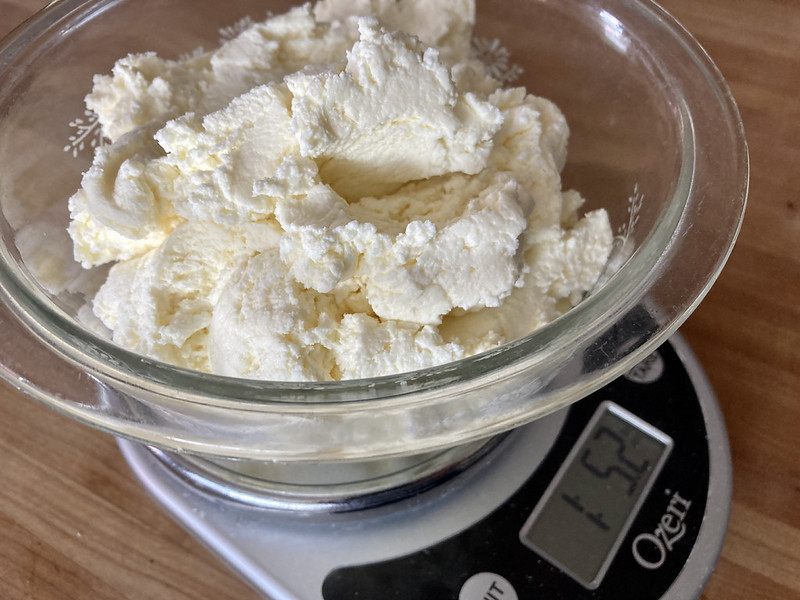
    Quark yields a gratifyingly large amount: nearly two pouds per gallon of milk if you have high-fat milk (our Daisy milk only yields 1 pound 5 ounces). Also, it’s extremely simple: culture plus time, that’s it. If you plan things right, you’ll actually be asleep for the majority of the process.

    Quark requires mesophilic starter which is expensive BUT I’ve learned that I can save the whey from the quark and use that as my mesophilic starter for futures quark, cottage cheese, monterey jack, etc. It’s brilliant! (Locals, I’ve got plenty and am willing to share.)

    Since quark differs enough from cream cheese that we don’t use it as a substitute, at least not for fresh eating, figuring out how to use the quark has been a little challenging.

    So far, I’ve used quark…
    *in place of ricotta for lasagna-type dishes: fabulous.
    *baked French toast: since I can detect a slight different flavor, I thought the kids might fuss, but they gobbled it up, syrup is magic. Also, since quark crumbles kinda like feta, it was way easier to layer with the bread — no sticky cream cheese to swear at!
    *quiche: perfect.
    *cheesecake: lovely.

    baked fresh toast

    leek and sausage, with a few fistfuls of quark and some leftover cuajada

    I was skeptical about the cheesecake. I mean, I do already have the recipe for the perfect classic cheesecake in my files, and there was no way, I thought, a milk-based cheese with a slight texture could possibly compete, right? Right. EXCEPT, cheesecake made with quark is altogether different. More dense, and with a slight tang, it’s less like a dessert and more like a nutritious food. Like if we’re comparing cheesecakes to breads, a classic cheesecake would be a brioche while cheesecake made with quark would be a rustic wholegrain sourdough. Both are delicious.

    Eating the cheesecake, one of my girlfriends actually got emotional — Oh, Jennifer, she whispered, her eyes welling up (or did I imagine that?), this is incredible! — and another declared she liked it even better than regular cheesecake. Cheesecake of the traditional sort, she said, is so rich she can only handle a couple bites, but this? This now, she could do.

    My husband and I agree that this cheese requires a tart fruit sauce, and lots of it. For our small group supper the other night, I served the cake with sugared peach slices and they just didn’t pack the right punch. However, the leftover berry drizzle that I brought home from the diner (that they used on their weekend waffles) was perfect, as would be this red raspberry sauce. Saucy and bright, that’s the goal.

    Quark
    Adapted from Kate’s recipe at Venison for Dinner.

    Save a quart of the quark’s whey to use in other cheesemaking recipes that call for mesophilic starter, like cottage cheese and monterey jack. (I generally substitute about ¼ cup whey for every ⅛ teaspoon of dry culture.) The whey should hold in the fridge for at least three weeks, and maybe longer. 

    1 gallon milk
    ¼ cup whey saved from making cheese with mesophilic culture 
    (OR ⅛ teaspoon dry mesophilic culture)
    2 drops rennet mixed with 2 tablespoons cool water
    1 teaspoon salt, non-iodized

    In the evening before bed: 
    Heat the milk to 85 degrees. Gently stir in the whey, and then the diluted rennet. Pour the mixture into a gallon jar (or keep it in the kettle), lid, and let sit at room temperature overnight, approximately 12-14 hours. 

    In the morning:
    Using a long serrated bread knife, roughly cut the curd into squares. Let sit for 5 minutes. Pour the curd into a cheesecloth-lined strainer (don’t forget to save some of the whey for your next batch!), tie up the ends, and hang for about six hours. 

    Dump the cheese — QUARK! — into a bowl and stir in the salt (I’ve used as little as a half teaspoon and as much as two). Transfer to the fridge — it should hold for about three weeks — and use it in recipes that call for cream cheese or ricotta.

    One gallon of milk should yield about 1½ to 2 pounds of quark, depending on the fat content of your milk.  

    German Cheesecake 
    (because “Quark Cheesecake” just sounds wrong)

    Use this recipe, but substitute quark for the cream cheese, and double up on the fruit sauce.

    This same time, years previous: full circle, fresh nectarine galette, the quotidian (8.24.15), that special date, 16, coming up for air, fourteen years, the mater question.