Sunday, we celebrated my younger daughter’s 18th birthday (though her real birthday isn’t for another couple years — she’ll be five!). For her gift, we all went together and got her a camera, and I got her this book on photography, which I’m looking forward to reading.
Her meal requests were specific: Captain Crunch for breakfast, chef salads for lunch, and honey-baked chicken for supper. The birthday cake, though, was entirely up to me. I could make whatever I wanted, she said.
I tossed around a bunch of ideas before finally settling on a red velvet cake. It felt a little risky, though. I’ve never found a red velvet cake that I like — they usually seem dry and/or flavorless, and the bright red feels garish — but then I happened on a post in which the writer had tested a whole bunch of red velvet cakes and then shared her favorite. If she said this cake was the best, then I’d trust her — she’d done her homework, after all — and then I proceeded to knock out two batches of cake in one afternoon.
Turns out, it’s the best red velvet cake I’ve had. In fact, I think it might be my new go-to recipe for festive occasions. Something about it — the deep red color, perhaps, or maybe the kiss of chocolate — feels special. Lush, even. Seductive. Just thinking about it makes me happy.
For the filling, I went with my copycat Costco-esque cream filling — sooooo good. I worried the cream filling would sploosh out the sides of the cake — two recipes of cake, a whole heck-of-a-bunch of layers high — but I kept popping the cake in the refrigerator whenever I wasn’t working on it, and it held its shape just fine.
For the icing, I made a double batch of cream cheese frosting with a little extra butter to help it set up firmer. The frosting was too sweet: an Italian Meringue Buttercream would’ve been better, I think, but I didn’t make it because my daughter isn’t a fan.
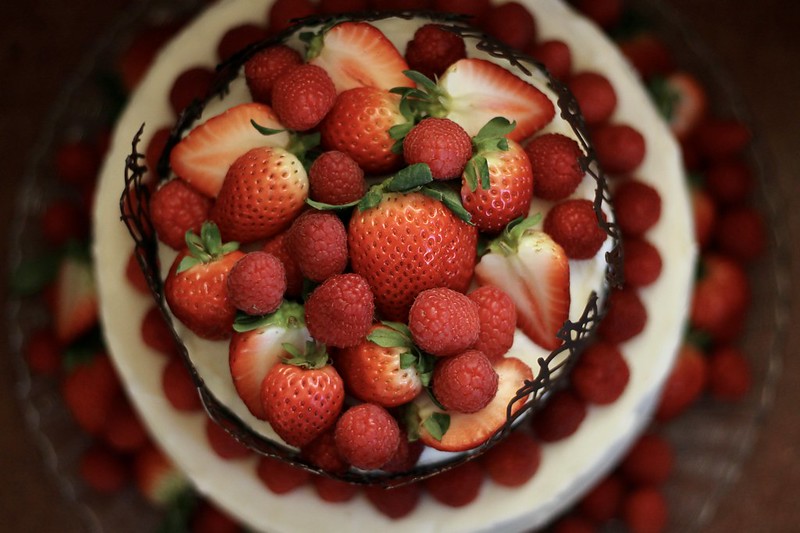
For the decorations, just fresh strawberries and red raspberries, and I wrapped the top tier in a chocolate cage. It was my first time making one — I used this tutorial — and it was shockingly simple: minimal effort, big impact.
The cake-and-cream filling combo was my favorite part. Add in a fresh berry — heaven.
My mom asked why I don’t just ice the whole cake with the Costco filling; she might be on to something.
The recipe calls for one to two ounces red food coloring. I used one and it was perfect.
2 cups flour 2 cups sugar 2 tablespoons cocoa powder 1 teaspoons baking powder 1 teaspoon baking soda 1 teaspoon salt 1 cup buttermilk 1 cup oil ½ cup coffee 2 eggs 2 teaspoons vanilla 1 ounce red food coloring 1 teaspoon white vinegar
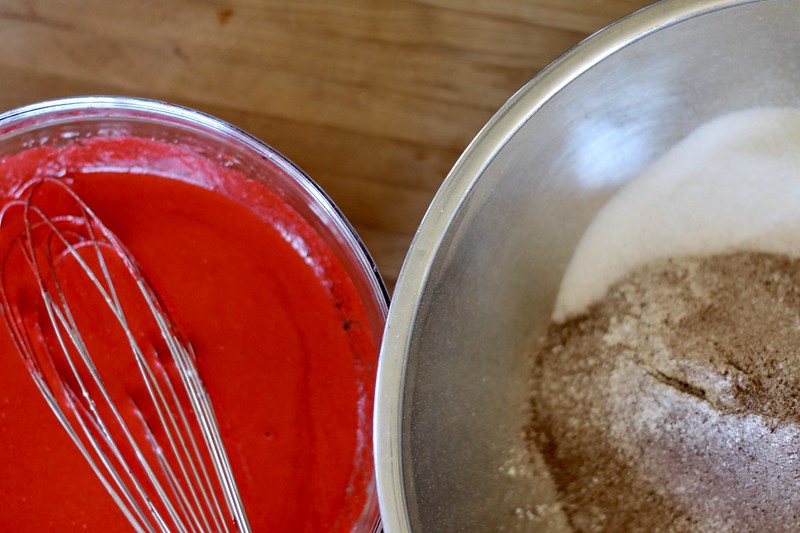
Sift together the dry ingredients in one bowl. In another bowl, whisk together the wet ingredients. Combine the two and whisk well.
Divide the batter between two greased, parchment-lined cake pans. Bake at 325 for about half an hour. Watch closely — do not overbake! Cool in the pans for 10 minutes before inverting onto a cooling rack and removing the parchment paper.
Once the cakes are completely cool, ice and serve, or wrap the cakes in plastic and freeze for later.
There’s a rectangular patch of woods a little ways down the road from our house. It’s not big, maybe 15 acres or so, but because it’s edged by two roads that I frequently run, I notice it a lot. Deer lurk in the shadows, and squirrels rustle in the leaves so aggressively — they sound more like large mammals than harmless, furry-tailed rodents — that I get heart palpitations.
Christmas Day 2019: the forest at my back
Anyway. Over the last week or two, they’ve been logging that forest. In the early morning, we hear the chainsaws start up and then all day long, the screaming crashes and thunder-booms as one massive tree after another hits the ground. I keep checking the tree line. Did we used to be able to see the mountain ridge through the trees, or is that new? How much wood are they taking? Do they plan to leveling the entire forest, or are they clearing just a small area?
“How many trees are they going to cut?” my younger son says to no one in particular.
This morning when I ran by in the icy drizzle, chainsaws were already roaring and a small crane was loading trees onto a truck. I thought about stopping and asking about their plans, but then I didn’t.
The steady thud of falling trees gives me a bit of a cosmic doomsday vibe: the world’s heating up, the trees are disappearing, crash-boom.
“It seems wrong,” I said to my husband the other night. “They’re destroying a forest.”
“Where do you think the wood that I build with comes from?” he asked.
He has a point, I suppose. Perhaps it’s fitting that we — a family who lives on a builder’s income — hear the trees fall. If we all lived right next to the garbage dumps and slaughter houses and the water treatment plants — the unsightly inner workings that fuel our daily lifestyle choices — we might be less inclined to take things for granted, more thoughtful about the choices we make.
November 2021: in my parents’ woods
The first time our Puerto Rican friends joined our family at my parents’ for a wood-cutting party, they were taken aback. “You’re allowed to do this?” they asked, incredulous, gesturing at the downed trees, the piles of firewood, the axes and chainsaws.
“Yes, it’s their land,” we said. “But not only are we allowed to take out firewood, removing the dead trees and clearing certain areas allows for new growth that actually makes the forest stronger.”
right now
Maybe the guys down the road are just cleaning up the woods? You know, thinning out some of the trees. Tidying up a bit.
When did you start to notice that things were changing? I began noticing changes when I was about 42. The first difference was night sweats that would come on for about a week before my period. A few years later I noticed anxiety and tightness in my chest; this would happen not only during the day but also at night, and would wake me up. I often felt overwhelmed, too — which could just be from regular life stresses, or it could be related to my period.
My periods were regular until about age 48 — I guess they had probably been getting shorter and lighter before that, but I hadn’t paid much attention — but then at about age 49 I skipped my first period. Actually, I skipped two cycles, but then when it came, it was heavy. Since then, my period has been erratic — sometimes I skip it for months, and sometimes it’s so frequent that there’s only a week or two between cycles. The periods can also last a long time (one this summer was 6 weeks long!) and are very heavy. I was recently diagnosed with fibroids, which is likely one of the reasons for the heavier bleeding.
How did they figure out that you have fibroids? When I went to the midwife for my annual exam, I mentioned that my periods were increasingly heavy. She didn’t seem too concerned; she said it could be fibroids and ordered ultrasounds and a uterine biopsy (just to rule out other possibilities). A grapefruit-sized fibroid was discovered during the ultrasound, which surprised me because that’s so big! I don’t have any other symptoms that are common with fibroids, like pain or discomfort during sex, so I feel fortunate. The doctor who saw me after my diagnosis suggested either a hysterectomy or taking progesterone to balance out the estrogen, since that’s what’s causing the heavy bleeding. However, fibroids usually shrink after menopause when there is less estrogen, so I decided to wait it out and take progesterone instead of getting a hysterectomy.
What other symptoms have you had? For a few years from about age 42 to 48, I noticed that about a week before my period was due I’d feel more anxious and sad, my breasts would hurt, and I’d have headaches and night sweats. I never had PMS and my periods had always been no big deal, so this was the first time that I was bothered by my cycle. I would have to remind myself that I was just feeling that way because my period was due and to not take things too seriously: This is really hard, I’d tell myself, but peaceful feelings are on the way. Then I’d get my period; I’d feel calmer that day and remain calmer for about 3 weeks — and then everything would get worse again the week before my next period. That roller coaster eased up about two years ago, right around the time I started skipping periods.
So the brunt of the emotional upheaval happened earlier in perimenopause? Yes, I still feel occasional brain fog and anxiety (or is that because of the pandemic?), but the night sweats and breast tenderness are gone and the hormonal headaches have lessened. I feel great when I don’t have my period and love skipping months. Now the main problem is how heavy my flow is, which can be stressful — sometimes I worry about leaving the house.
How heavy are we talking? By heavy, I mean filling a large-sized menstrual cup in one gush. And that can happen repeatedly in an hour. It comes in waves, so it can be gushing for a couple hours and then settle down for several hours. This is the first time in my life that I’ve had to worry about heavy periods, and it’s definitely taught me compassion for teenage girls and women who have to deal with this every month! Last winter I started using a menstrual cup because it can hold large amounts of blood, and I also wear period pants or heavy flow pads at the same time in case a gush overflows the menstrual cup. Because of my heavy periods I’ve started taking iron and progesterone (under medical guidance). My periods are still heavier than before, but they’re much more manageable.
Can you give us a quick summary of what you’ve learned about hormones? Estrogen promotes the build up of the uterine lining with blood, and progesterone, which is usually produced during the second half of the cycle beginning at ovulation, serves as a brake to the estrogen. During perimenopause we have vastly fluctuating levels of estrogen and we ovulate less and less frequently, so there can be too much estrogen and build-up of blood in the uterine lining, and therefore heavy bleeding. I take progesterone 10 days a month to help balance the unchecked estrogen. Theoretically, the progesterone is taken during the last 10 days of my cycle and my period will start after I finish the 10-dose round. That has happened for a few cycles, but I’ve also skipped several cycles. I’m not sure if that’s because I’m closer to menopause or because of the progesterone. Either way, less bleeding is better for me!
Regarding the menstrual cup, period pants, and heavy-flow pads, do you have recommendations? For the menstrual cup, I use the Super Jennie. I have five pairs of period pants (I use these): two pairs of the light/moderate, two pairs of the moderate/heavy, and one pair of the Maxi 24-hour pants. I wear the Maxi ones when I know that I’ll be gushing and won’t be able to empty my menstrual cup if it overflows. The period pants work, keeping the blood away from my clothes, and I’ve been pleased with all of them. When searching for the most absorbent pads recommended by other heavy bleeders, I discovered these. I find them comfortable and very absorbent, but since they are expensive, and certainly not good for the environment, I feel a little guilty using them, especially because I can go through several in an hour, even with the menstrual cup. For these reasons, I use them only when I need something portable and disposable, like when I’m traveling.
Any other resources to recommend? Menopause Confidential was the first book I read on the subject. It was helpful, but didn’t go deep enough since I was hoping to learn more about lifestyle and diet recommendations. I’ve learned a lot from the book Fibriods: The Complete Guide to Taking Charge of Your Physical, Emotional and Sexual Well-Being”, although it only touches on perimenopause. I just found The Menopause Manifesto by Jen Gunter. Based on what I’ve heard from Dr. Gunter, I think it will be wonderful; she shares the facts with an emphasis on empowering women to take charge of their health.
How has your self image been impacted by all these changes? As an adult I’ve had a fairly positive view of my body, and perimenopause hasn’t really changed that. Overall, I feel appreciation for my body, and I’m taking good care of it by daily walking and doing yoga, and by eating a low-sugar and mostly vegetarian and dairy-free diet. (I’ve read that this diet may help balance my hormones, but whether or not that’s true I don’t know. Regardless, I feel better when I eat this way.)
Emotionally, I feel weaker and more susceptible to mood swings. Some days I feel strong but the next I feel confused and overwhelmed. Before my 40s, my moods were definitely more even keeled. Thankfully, my husband has been super supportive. He’s willing to help anytime I need it, like if I’m stuck on the couch because I’m bleeding heavily. I’m resistant to asking, though; I don’t like feeling weak and I don’t like my body preventing me from doing things.
What about sex? The heavy bleeding has affected our sex life, but we’ve been together for almost 30 years so we know how to roll with it and be resourceful. I use the nixit disc during sex; it’s similar to a diaphram (which I used for decades) but it’s sturdier and holds more blood. It works well enough to prevent a big mess during sex, and doesn’t make it more difficult to orgasm. Everything else feels the same, as good as it always has. Lubricant is a must, though!!
Is there anything you wish someone would’ve told you? I wish I had known how hard perimenopause would be, emotionally. It’s like being a teenager again — my body is doing things it didn’t do before, and I feel raw and worried. I like understanding what’s going on with my body, so I wish I had understood more about hormones, how they fluctuate during the month and what each of them do. I wish women talked about perimenopause with the same openness we do regarding pregnancy. I’d love to have access to a women’s perimenopause circle, like a pregnancy circle, so we could find camaraderie and support each other.
Any big takeaways from this experience? I may be physically weaker than I want to be at times, but I’m also stronger and more resilient than I think. Since I hadn’t thought much about my period before, perimenopause has helped me feel more connected to all women, even if we don’t talk about it much. I didn’t get a chance to talk to my mother or grandmother about their perimenopause experiences, but thinking about hormones and menstrual cycles so much these past couple years has reminded me of the women who have been in my life and how we’re connected by this common experience.