• both ends

    The play has thrown a little wrench in my “wake up early to write all morning and then run before lunch” routine. Even though rehearsing three or four evenings a week doesn’t sound — or even feel — very taxing, it does wear on me. It’s such a drag, leaving the house immediately upon waking and then returning from rehearsal and jumping straight into bed. Makes me feel like I’m burning the candle at both ends.

    To make matters worse, the play sometimes infiltrates my dreams, and I spend the night dreaming about packing, hiding, and being chased. They’re not nightmares, exactly, but they are exhausting.

    Since I have no evenings in which to unwind, I often let myself rest in the afternoon. Sometimes I read a novel. Other times I sleep. A couple times I’ve even allowed myself to watch an episode or two of Catastrophe or Schitt’s Creek or Workin’ Moms (though even with all my mad justification skills, I still felt guilty).

    A couple weeks ago I decided something had to give, so I shifted things around, allowing myself to sleep a little later, then running, then writing. I don’t get home from writing until early afternoon now, which makes me feel like I don’t have as much time (because I don’t), but at least the schedule is a little less grueling.

    I recently read Michelle’s book (and then entertained the rest of the family by reading great swaths of it outloud to them at the supper table), and it made me feel like such a wimp. That woman does so much! For example, in the course of single day, Michelle might fly to a speaking engagement for thousands and then back again, work out, cut a ribbon at a local nonprofit, change clothes multiple times, host a tea for a couple hundred high-profile people, and dig in the dirt with a bunch of school kids. I, on the other hand, drink coffee and write, make my kids scrub the toilets, go for leisurely, country-quiet runs, and crash into bed at ten o’clock, exhausted. Reading about her go-go-go life, it made me feel like I could — or maybe should — do more.

    Not that I want to, really. But it would be nice to add in an activity or two (like a play) and not feel so zonked, you know?

    Get your tickets here!

    This same time, years previous: it takes a village, the quotidian (4.17.17), the quotidian (4.18.16), cheesy popcorn, take two: Omri, nutmeg coffee cake, and then he shot me through the heart, ground pork and white bean chili.

  • the quotidian (4.15.19)

    Quotidian: daily, usual or customary; 
    everyday; ordinary; commonplace

    No ganache, no problem. Hot fudge sauce makes a fine substitute.
    How much energy’s in a peanut?
    One of the dogs  we’re not sure which  killed Teacup.

    And now the remaining lamb  Fleetfoot  thinks she’s a dog.

    See? 
    Big baby.

    I like my washing machine.

    Coming to blows (not really) over taxes. 

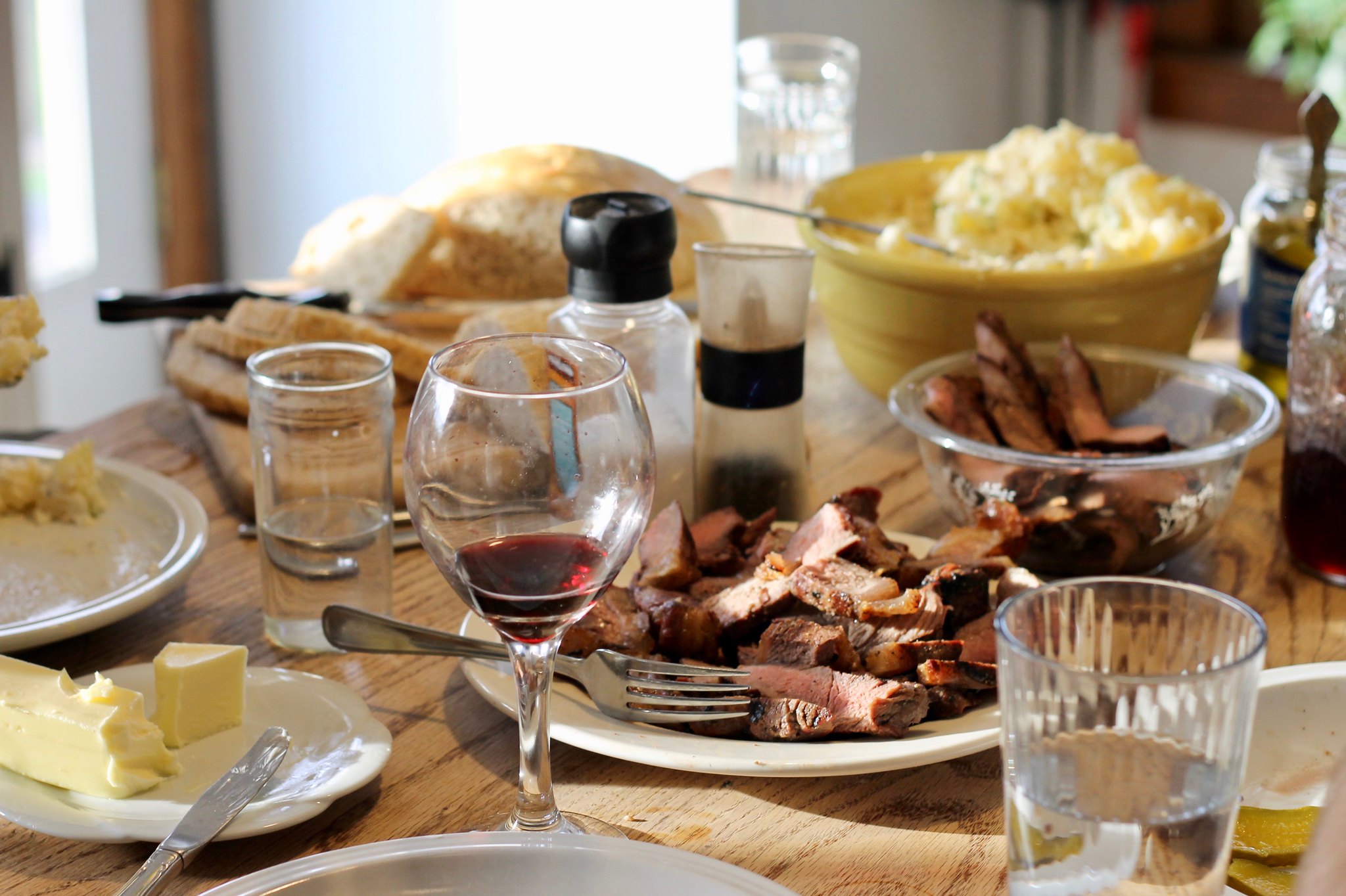
    Steak night.

    This same time, years previous: while we were gone, wrangling sheep, crispy almonds, mint wedding cake.

  • feeding my family

    So far this month, I’ve already spent over four hundred dollars on groceries (we budget $750 per month) yet, since most of my purchases are in raw form (bottles of coconut oil, sacks of rice, bread flour, butter, lentils, cheese, coffee, honey), it still feels like we have no food — no ready-made food — in the house. This has made a number of my family members rather anxious. And upset. I know this because they have told me so, again and again and again.

    So yesterday morning, I neither went to work nor went running. Instead, I made a cup of coffee and sat down at the kitchen table to do some menu planning, and then, there I sat, pen in hand, lost.

    “I have no idea what to make,” I announced to no one in particular.

    My older daughter’s eyes bugged. “Are you serious? Have you looked in the freezer?”

    And then she grabbed my arm and marched me down to the basement where she yanked open the chest freezer, dove in headfirst, and started rooting around.

    “How about this?” she crowed, uncovering a box of filet mignon and ribeyes. “Or this?” — holding up packs of flank and cube steaks that I’d forgotten about — “Or this?” and she brandished a brisket the size of a small toddler in my face.

    “Okay, okay,” I laughed. “You’ve made your point.” Before heading back upstairs, I selected a small chocolate cake — the last leftover layer from my younger son’s birthday cake — a whole chicken, and a box of sweet cherries.

    As soon as my younger son and his friend finished cleaning up their breakfast mess (they’d made, and gorged on, a double batch of Russian pancakes), I set to work. I began slow, starting with a batch of pancake syrup and scrubbing a few potatoes. Then, gradually, I picked up speed.

    I made two pie crusts (in the shell, crimped, and frozen for later), a pan and a half of hash brown potatoes, a pot of black lentils (to make this, later) and a pot of quinoa (to mix with sausage and kale, later), a sausage-egg bake, a double batch of granola bars, and a batch of ciabatta dough.

    In the afternoon, I made a sticky toffee pudding and whipped cream with my niece for her cooking lesson and roasted the chicken for supper, and, that evening, my older daughter mixed up a batch of Dutch puff for the next morning’s breakfast and I made a vanilla pudding to go with it.

    Even with all that cooking, I still feel like I’m running a little short. We go through the food fast, and if I’m going to use what we have, then I need to keep at it: thinking, planning, thawing, cooking, and, perhaps the hardest part, making sure we actually eat the food I make.

    Finishing off the leftovers, especially when they aren’t anyone’s favorite, means I have to actually pull them out of the fridge and physically serve them.

    If I don’t, no one will ever think to eat them.


    This same time, years previous: right now, the quotidian (4.13.15), the quotidian (4.14.14), deviled eggs, on fire, I went to church with a hole in my skirt.