• on slaying boredom

    On Sunday evening the girls and I (mostly me) made two banana cakes. Monday morning (they didn’t have school), we stacked the pieces of cake between layers of wax paper and covered the pan with a towel. The girls dressed in their K’ekchi’ skirts and blouses (my younger son begged to wear a skirt, too), and Jovita showed them how to carry the container on their heads. The children took turns carrying the cake all the way to town.


    As we walked up the street to the market, my older daughter said, “I’m starting to feel nervous. Everyone is looking at me!”
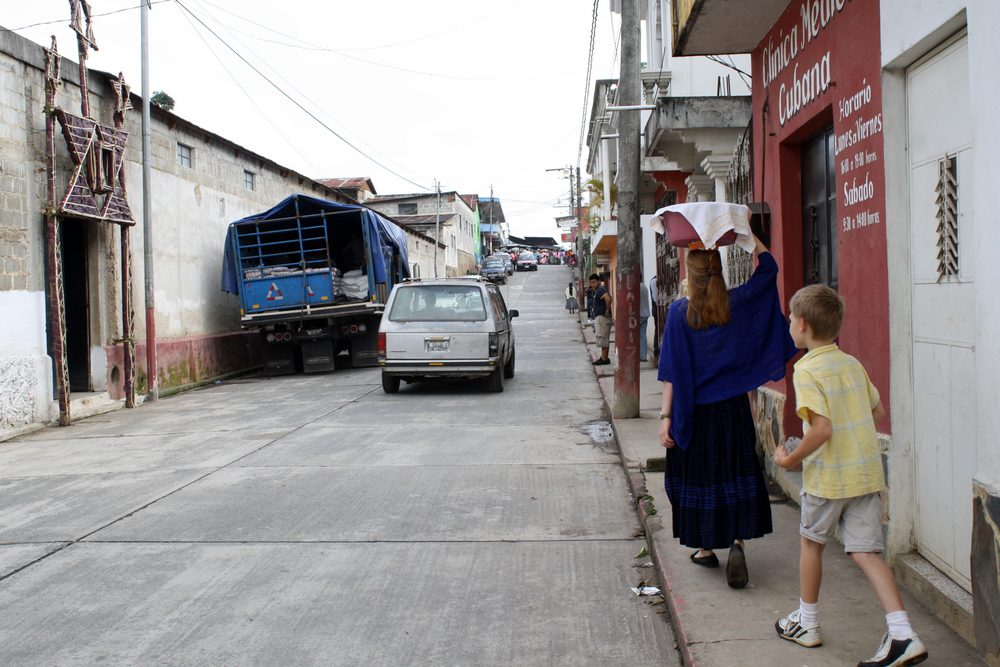
    We waded into the market and I snatched up the first empty spot I came to.
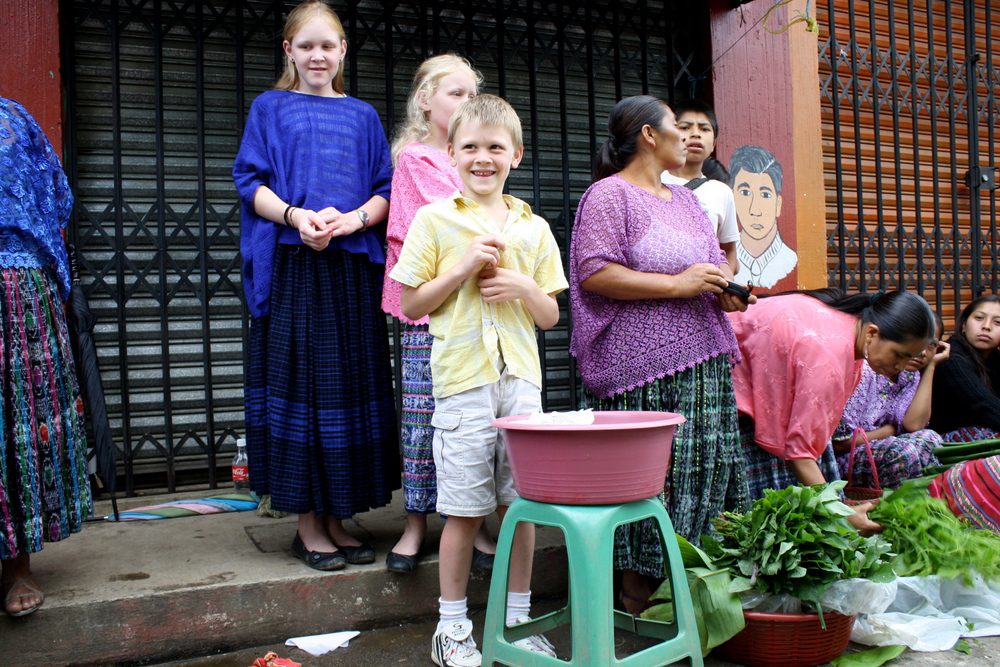
    Suddenly stricken with bashfulness, the girls hung back, but my youngest stationed himself behind the cake and gamely called out, “Torta de banano! A dos quetzales!”

    It took a minute, but as soon as the surrounding vendors realized what was going on, they started grinning from ear to ear (except for the ones who were staring, their chins scraping the ground).

    And then a bit of magic happened: the locals took charge of my children and their cake-selling project.
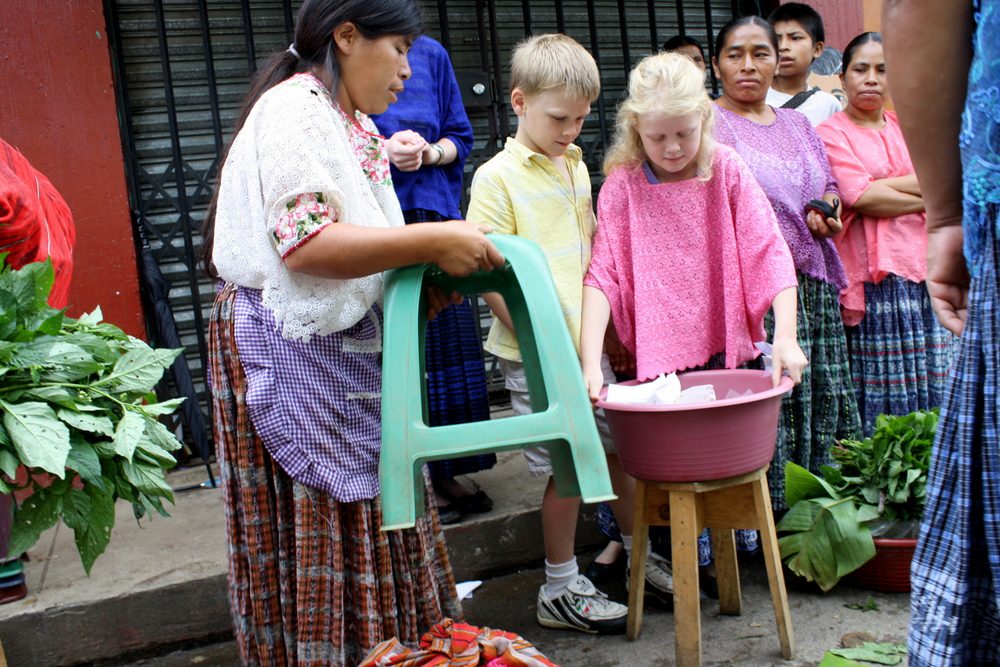
    One woman brought the children a stool to set the cake on, and then a few minutes later she switched it for a sturdier, wooden one.

    Someone handed us plastic bags for packaging the bread. (We had brought napkins, but they were too awkward. When I asked, they pointed me in the direction of a store that sold bags—I bought a hundred.)

    The first customer approached. He wanted five pieces of cake. He handed the kids the money, and then explained, his eyes twinkling, that the person managing the money should not be the person touching the cake.

    For the next ten minutes, the children ran a brisk business.

    After the initial setting up and some basic pointers, I faded into the background and snapped pictures. Besides, I couldn’t have gotten close to them if I had wanted to—they were completely surrounded by their customers.
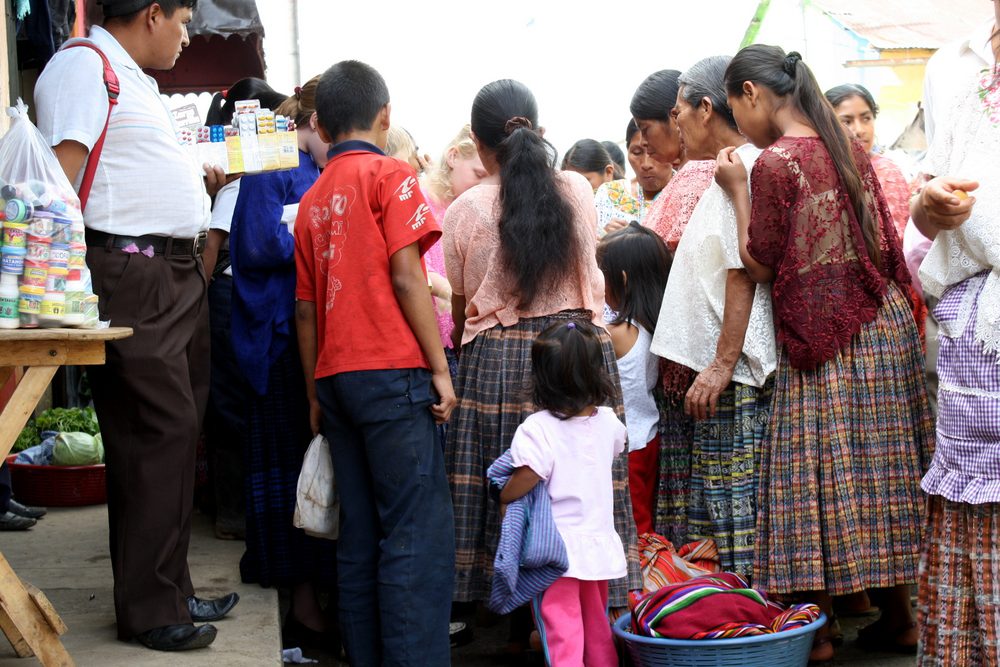
    I couldn’t stop grinning. The whole exchange was stunningly beautiful. The transformation from us as the onlookers (shoppers, takers, outsiders) to participants (included, welcomed, wanted) was astounding. It was like a switch had flipped. For that little bit of time, we weren’t just here visiting this culture, we were emulating it. Suddenly, instead of tolerating us, they were hosting us. It was delightful.

    My husband and older son had been running errands on the other side of town, and when they heard we were in the market, they came over to visit.

    When all the cake had been sold, we returned the stool.

    “You need to go home and make more cake,” the neighboring vendor said. “Come back this afternoon!”

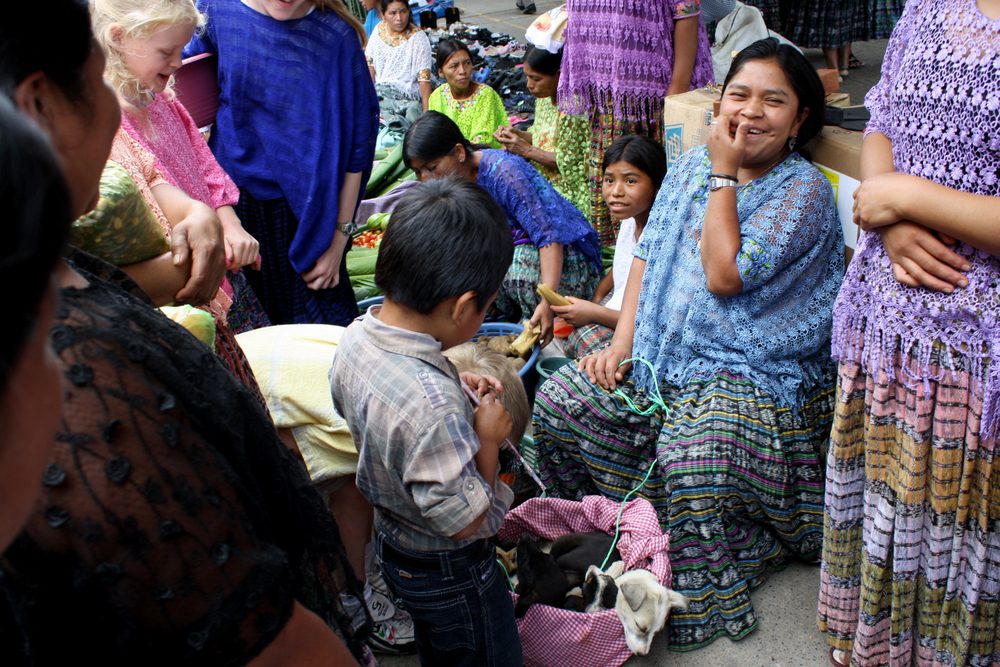
    On the way out of the market, we paused to admire a basket of puppies.

    One nipped at my daughter’s hand, causing her to jump back and making the women laugh.
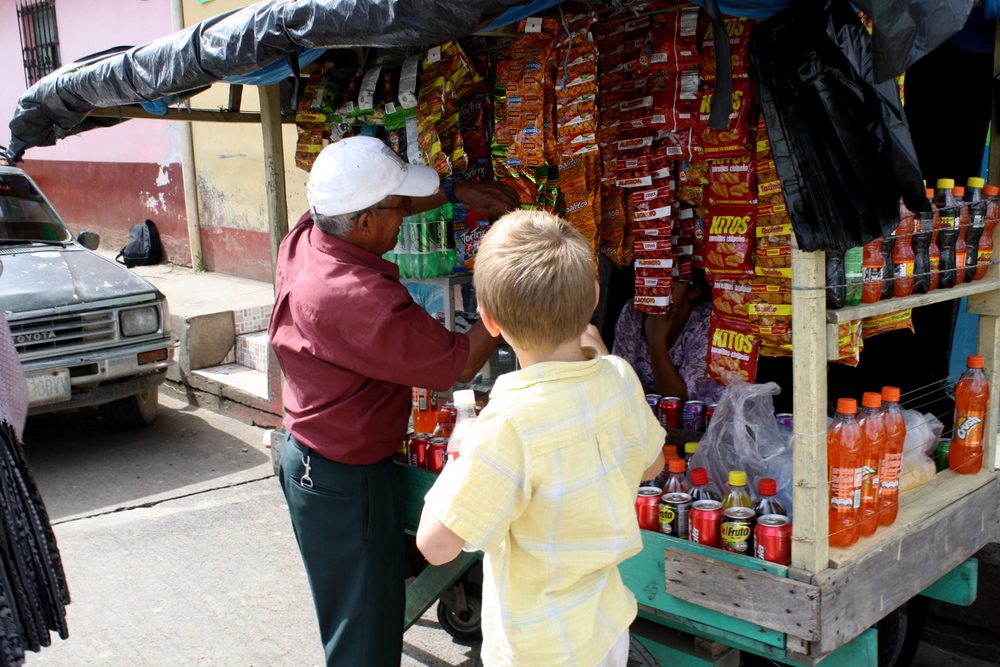
    I gave the children each two quetzales to spend on whatever they wanted. They loaded up on chips and soda and lollypops and then complained about feeling sick.
    And thus ends the tale of how I nipped boredom in the bud by making my children sell cake.

    The end.

  • my ethical scapegoat

    Sunday evening, this is what I posted on Facebook:

    All the thoughtful comments on my “What to do about Jovita” post are wonderful….but now I’m more tied up in knots than ever! It’s really not that big a deal, but as with any dilemma, there’s a whole lot of garbage/history/truth to either side of the issue. For some reason, this is the conundrum on which I am dumping all my angst. My ethical scapegoat, maaaa-aaaaa.

    I never came to a solid, this-is-the-answer solution. Instead, I decided on a two-pronged approach: pay Jovita half of Friday’s wages and inform her that I wouldn’t be paying for any more days off.

    “But here it’s the custom for workers to be given a paid holiday,” she said.

    “Actually,” I corrected, “that’s only in the case of salary workers, not part-time hourly workers.”

    I went on to explain that she was welcome to take off for holidays, or to take a day off if she wanted to rest, but from here on out if she didn’t work she didn’t get paid. And then I pointed out the banana cake and sweet roll intended for her break, rounded up the kids, and headed to town.

    I felt okay about the exchange. Not completely okay, but okay enough.

    I loved getting all your responses. There was such a range of approaches and beliefs, and as I pondered each suggestion, I began to get a clearer sense of why this is such a sticking point for me.

    These are the two voices I had warring in my head:

    1. generosity is Jesus mandated so JUST DO IT.
    2. there is more to the picture; be cautious, be careful, because exploitation, both being exploited and exploiting, does no one any good.

    All my life, the importance of generously helping the less fortunate was drilled into me. But then I came to Central America and began to understand that “giving freely,” as we in North America think of doing so, isn’t always all that helpful. In fact, it can be harmful, dangerous, and flat-out irresponsible. Erring on the side of generosity can actually be an error. Using words like “kindness” and “generosity” as cover-ups doesn’t make that error any righter, nor do they make us less responsible for committing that mistake. With the power to give comes the responsibility to act wisely. This requires that we be informed, that we really, truly, deeply know who we are helping and why and what the goal is. It requires accountability on both sides, time together, and lots of listening. It requires research and contemplation and hard thinking. It’s work.

    So I was struggling to reconcile these two voices in my head and then all YOUR voices chimed in and intensified the battle. It felt like both sides were equally right. It felt either/or. I was stumped.

    I believe that the two sides can be, need to be, reconciled—but it means that my understanding of both truths has to be expanded and deepened. Being generous might not always feel very generous. Being kind doesn’t necessarily feel rosy and sweet all the time. And on the flip side, it’s a given that I’ll be exploited at times. Plus, I could benefit from learning to let things go and ease up on my justice-oriented soapboxing. The idea is that somehow, with lots of sweat and wrangling, the two sides will eventually arrive at a clumsy sort of peace. Just maybe.

    If I’m lucky.

    Take, for instance, the concept of parenting—

    (Which is a really bad analogy because the notion of parent/child nations is taboo since we’re all supposed to be equals. However, we haven’t exactly treated Guatemala as our equal, and now they tend to think of the US as The Milk Cow, The Money Tree, The Sugar Daddy. So maybe it is a good analogy after all?)

    Good parenting doesn’t mean smiley children (or parents) all the time. It means looking at the big picture and helping the kids to do the same. It means towing the line and not always being adored. It means teaching and loving and working your butt off and demanding that they work their butts off, too, sometimes.

    It does not mean doling out candy and plastic toys to keep the peace.

    Any halfway competent parent knows this, and yet when we think of helping poor people, our gut reaction is to do just that.

    The more I spend time in Guatemala (or Nicaragua, or working in the foster care system, or involving myself in church politics or soup kitchens), the more I start to understand the complexity of the issues. The lines blur and I lose my footing. I start to understand more than just my side of the picture. Stuff gets messy. However, only then, when the lines blur and the complexities abound, can true helpfulness take place. Funny thing is, true helpfulness often ends up looking a lot different from what I imagined it would look like when I started out.

    Which leads me to wonder: how much of a right do I have to involve myself in situations on the other side of the globe? The other side of the country? The other side of my town? Unless I am willing to go there, to be inconvenienced, to pour my time and energy (let’s forget about money for awhile), then maybe I have no business trying to help?

    ***

    All this talk of helping reminds me of a children’s poem I memorized when I was little. That three out of the four children’s names in the poem corresponded to me and my brothers (we don’t have an Agatha, thank you Mom and Dad), tickled my fancy to no end. It’s the last stanza that keeps running through my head.

    Agatha Fry, she made a pie
    And Christopher John helped bake it
    Christopher John, he mowed the lawn
    And Agatha Fry helped rake it

    Now, Zachary Zugg took out the rug
    And Jennifer Joy helped shake it
    Jennifer Joy, she made a toy
    And Zachary Zugg helped break it

    Some kind of help is the kind of help
    That helping’s all about
    And some kind of help is the kind of help
    We all can do without
                      

    -Shel Silverstein

  • weigh in, please

    So here’s the sitchy aiy shun. Remember all that stuff I told you about Jovita asking for money? Without doing anything beyond what I reported, she stopped asking. For weeks now, there have been zero requests. It’s been lovely.

    But then on Wednesday when we were saying goodbye, she informed me she wouldn’t be coming on Friday (because it’s Chamelco Official Birthday holiday) and would I please pay her for her day off. Sure, take the day off, I said, but I’ll have to talk to my husband about the pay. Her request caught me off guard, and playing the subservient (snort) wife was the fastest way out.

    After she left, I stomped around the house, grumbling and mumbling. I’m your classic, uptight North American so I fall to pieces when people pull last minute plan changes on me. (You ought to see what happens when taxis stand us up, ha. It sends my non-scheduled husband into a freakout tailspin, so you can only imagine what it does to me.) Plus, I couldn’t shake the feeling that I was being had.

    I asked another gringo if Friday is a paid holiday, and he said it is, but only for salaried workers. Then I asked our landlord. She confirmed what the gringo friend told us, and then said that some of their workers showed up and others didn’t. Only the ones that came to work got paid, but choosing to take the day off was acceptable, too. Such is the life of the hourly worker. (Whether or not those hourly workers ought to get salary benefits is a whole other issue.)

    I want to be generous with our house help. I try to treat Jovita respectfully and to give her some extra benefits that she might not get at another house. But at the same time, I want to follow local customs.

    Part of me says, “Good grief, what’s the big deal? It’s only forty quetzales! She has seven children, her husband got laid off, she does a fabulous job, she’s reliable, and she never (at least for the last month) asks for anything. Cut the woman some slack, will you?”

    But another part of me says, “But this isn’t about me. It’s about how Guatemalans perceive North Americans as money-throw-abouts. Sticking by my guns and following local customs will be one for the Humanity Home Team. Because this is about dignity. By upholding the guidelines and being generous within them, I’m demonstrating that I am not to be taken advantage of. And by expecting her to hold up her end of the deal, I am showing that I respect her.”

    But maybe that’s cold?

    Maybe it’s better to give her the money so that we have The Good Feeling Thing that is so important in this culture?

    But maybe that Good Feeling comes at the expense of True Good Feelings that come from treating each other with dignity? Maybe I’m the one who has to play the toughie in order to bring our relationship to a deeper level, one in which we both respect each other as people?

    Maybe I’m full of crap and it doesn’t matter what I do?

    And what about all those bothersome Jesus teachings about Giving It All Away and Helping Anyone Who Asks?

    Please, what do you make of this? My husband is exhausted by my on-the-one-hand, on-the-other-hand hashing out and is no help whatsoever. Maybe your Sunday school class could give this a go-over and arrive at some brilliant solution?

    Jovita comes at eight o’clock Monday morning. I need to have a response by then.