I buy cider in bulk from a local orchard in the fall and then freeze it for Cider All Winter Long. I decided to do this a couple years ago (around the same time I decided to let loose and buy all the watermelon I wanted when it was in season), and it’s been one of my better life choices.
To freeze, I just pour out a cup or two from each gallon so there’s plenty of room for the cider to expand, and then stash the jugs in the freezer. It takes a day or two for the cider to thaw — and it must be completely thawed or else you get watery cider at the outset and then a bunch of sludge at the end — so I usually pull a jug mid week so it’s ready in time for our wild weekend revelry of sitting by the fire and eating popcorn.
But this post isn’t about hoarding cider. It’s about something better: a cider cocktail.
I invented this drink the other night and liked it so much that I made myself a second one. Then my husband tasted it. He doesn’t like alcohol so I expected him to shrug and walk away. Instead, he asked me to make him one and, when I kept forgetting (because I was deep in the middle of my wild weekend revelry of fireside sitting), he reminded me. Repeatedly. Eventually I got up off the couch and fixed him a cocktail and then he drank it all up super fast and smiled a lot.
I made the cocktail again the next afternoon so I could take photos, and gave my daughter, who was on her way out the door for a run, a wee sip, and now she claims that sip caused her to have an above-average run.
After much deliberation (just ask my friends, family, and coworkers), I’ve decided to name this The Spiced Onyx — “spiced” for the rum and “Onyx” for the name of the orchard from whence the cider cometh. (My older daughter said it should be called “cider-whoo,” for the loopy buzz one might get from it.)
The Spiced Onyx
1 cup fresh apple cider 1-2 ounces spiced rum 1 tablespoon dulce de leche ice fresh rosemary, optional apple slices, optional
Slightly soften the dulce in the microwave. Pour in a bit of the cider and whisk, shake, or blend until smooth. Add the rest of the cider and the rum, mix well, and pour into an ice-filled mason jar. Garnish with a sprig of rosemary and sliced apples, if desired. Go curl up by the fire and read a book.
Finally, it’s happening. I printed off my book, passed it to one of my friends to bind for me (via her work connections), and then, just last week, I smacked the book — an actual whole book, can you freaking believe it? — down on the table and announced, HAVE AT IT.
All along the kids have been begging to read it. “But it’s about us, Mom!” they’d wail. “You have to let us read it!”
“Oh, I will,” I’d promise. “Don’t you worry.”
Now, they are.
With the book as finished as I can get it, I’ve switched from writing to hawking, i.e. finding an agent. Everyone says agent hunting is a grueling, soul-killing process, and everyone is right. But! I’ve already spent nearly eight years writing the damn thing so: I’ve got endurance. I’m in this for the long haul. [she says with panic in her eyes]
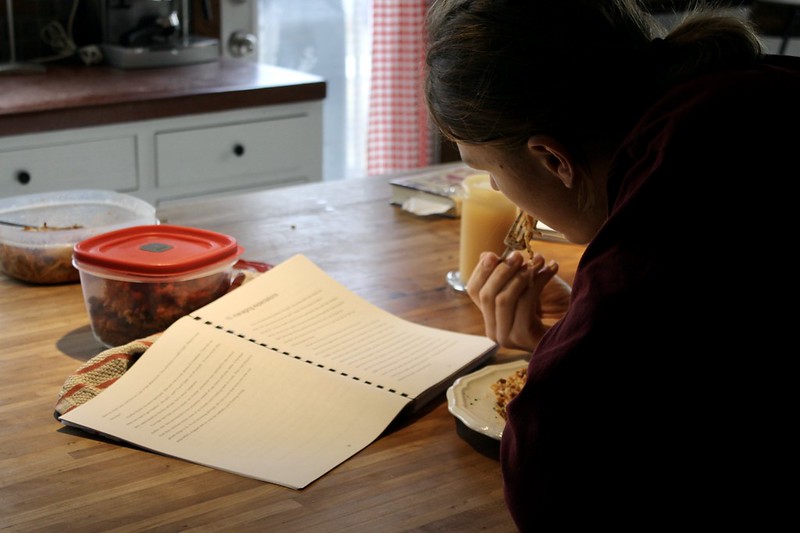
My younger daughter snatched the book up immediately. My younger son usually reads it when he’s eating: the other morning, he busted up over the part where my husband spelled out the word “push” in masking tape over the old tablecloth we spread atop the bedroom rug for my son’s homebirth. My husband reads it in fits and starts, over breakfast or in the early morning before everyone else gets up, and my older daughter reads it when she comes over in the morning to drop off Charlotte for the day and then waits for my husband to finish getting ready so they can go to work.* Once everyone finishes with it here, the book will go over to my older son and daughter-in-law so they can have a turn.
It’s sweet to see them all so excited, and it makes me a little nervous, too. I don’t usually spill my innermost thoughts about my children — about my parenting — to my children. I mean, they probably already know everything just by living with me, but saying it outloud feels different. More risky. A little scary. What if I haven’t portrayed them fairly? The last thing I want is for them to feel hurt or misrepresented. It’s a fine line to walk, being honest about myself while talking about them at the same time.
But that’s why they’re reading it, I guess: so they can tell me where I’ve got it wrong so I can fix it. Here’s to hoping the damage isn’t too great!
(And here’s to hoping I can find an agent, pleaseohpleaseohplease.)
***
*Over the weekend (I started writing this post last week), I changed course and told my older daughter she needed to be the first one to read it since it was her extreme late reading that pushed me to deviate so far from traditional educational practices. That same day she stopped by to pick up the book, and the very next morning she blew in the door and slammed it down on the table.
“You finished it?” I asked, my jaw dropping.
“Yep, at 11:30 last night. Seven hours.” And then, with a roar, “Take that, English people!”