• Full circle

    As soon as I realize that we would be eating supper in the dark if it weren’t for the wondrous invention of the electric light, I get hit with the urge to make Christmas cookies. I chomp at the bit until Thanksgiving passes (according to my personal laws and regulations, Christmas is not allowed to swerve out into the passing lane and cut off Thanksgiving) and then, only then, do I set free my inner child and start tossing flour and sugar all around the kitchen like nobody’s business. I have no limits, I exercise no restraint, I have no shame, and it is marvelous. (The grocery bills don’t exactly make Mr. Handsome sing for joy, but he doesn’t do much complaining when his mouth is full.)


    The first cookie I made this season was one that I haven’t made for a couple years because I could always count on my mother to bake them and then share with us—raisin-filled cookies. But this year I didn’t want to wait around for my mother to start baking. I wanted those cookies all for myself, and right away, please. So on Tuesday afternoon, in the middle of a long day of solid rain, I stuck Handel’s Messiah in the CD player and took the rolling pin in my own two hands.


    These old-fashioned raisin-filled cookies (a little spoonful of ground nuts and raisins tucked between two rounds of sugar cookie dough, the edges pressed gently together, and then the final touch—the only bit of adornment allowed—one little raisin poked into their caps when they are still hot from the oven) are plain yet comforting, honest in their unassuming modesty. In fact, they are so simple that many an unknowing person unwittingly bypasses them for the more glitzy sugar bombs—the gooey lemon cookies, the chocolate-nut toffees, the iced gingerbread men. Therefore, we don’t usually share these cookies with complete strangers because we’ve learned it takes a certain kind of person, mainly one of Pennsylvania Dutch heritage, to fully appreciate these labor intensive sweet cakes. But for those of us who grew up with them? Oh my, do we ever love our raisin cookies!


    From the way I’m going on about these cookies, it’s probably pretty obvious that they played a central role in our Christmas celebrations. I remember my father helping my mother set up the old metal meat grinder that she used to mash up the raisins and then watching, entranced, as the ground raisins, dark, moist, and richly fragrant, slowly snaked their way out of the side of the machine and softly plopped into the waiting bowl. My brothers and I would sometimes help to roll and cut the dough (with my mother in the background forever warning us against over-working it), and we’d wait impatiently by the oven for the cookies to finish baking so we could perform the raisin-poking honors.


    Nowadays I use a screaming food processor to chop up my raisins and walnuts (my mother left out the nuts), so for a few very loud moments the atmosphere in my kitchen is not quite as romantic as it was back in the good old, food processor-less days (which, by the way, still persist in my mother’s house). But then I’m done with the obnoxious (but oh-so-marvelous) machine and peace is restored and goodwill reigneth (until the Baby Nickel starts smashing his fists into my freshly cut circles of dough, but I’m ignoring that part for the sake of the romanticized Christmas cookie baking ideal that I’m forever striving after).


    Regardless of the method used, these cookies still produce the same results: my kids delight in these Christmas treats in the same way that my brothers and I did when we were little. And in this way, via raisin-filled cookies, I am completing one of my life’s (hopefully many) full circles. If only all traditions could be so delicious.


    Now it’s your turn. What’s one (or two or three) of your Christmas baking traditions?

    Raisin-Filled Cookies
    Adapted from the Mennonite Community Cookbook by Mary Emma Showalter

    These cookies are plain enough to be a part of the main meal (and they are probably much healthier than what many people call muffins), so as well as eating them for dessert, afternoon snacks, and with a glass of milk before bedtime, we sometimes also enjoy them for breakfast along with our cereal.

    There is always a little raisin filling left over after assembling the cookies (this time I had about half a cup extra), and it’s very yummy stirred into a bowl of warm breakfast oatmeal. As a matter of fact, you may find that you like the raisin-walnut puree topping so much that you decide to make a batch of filling for the sole purpose of globbing it atop your hot cereal.

    A note about rolling out cookies: Remember that less flour makes a more tender cookie. You want your dough to be floured enough that you can handle it, but still sticky enough that you get mad at it every now and then for gumming up the rolling pin, your fingers, the tabletop, etc.

    1 cup butter
    2 cups sugar
    2 eggs
    5 ½ cups flour
    1 teaspoon salt
    4 teaspoons baking powder
    1 teaspoon baking soda
    1 cup milk
    2 teaspoons vanilla
    1 recipe raisin filling (recipe follows)

    Cream together the butter and sugar. Add the eggs and vanilla and beat some more. In a separate bowl, stir together the dry ingredients and then add them to the creamed butter alternately with the milk.

    Cover the bowl of dough with plastic wrap and chill it in the refrigerator for about four hours or overnight. (It freezes well, too.)

    On a well-floured counter, roll out the dough till it’s about 1/4-inch thick. Use a round cookie cutter (I used a drinking glass) that is about two inches in diameter to cut out cookie rounds. Place the rounds on greased cookie sheets, leaving about two inches between cookies (they will spread quite a bit as they bake).

    Put a teaspoon of filling in the center of each cookie and then top with another circle of dough. Gently press down on the edges of the top cookie so that it sticks to the bottom cookie. (There is no need to use a liquid to stick the cookies together because the dough softens as soon as it hits the heat and the two cookies quickly melt together.)

    Bake the cookies in a 350 degree oven for 10-13 minutes, or until the edges are lightly browned (a little bit of brown gives the cookies good flavor), and the tops look dry.

    Let the cookies cool on the cookie sheets for two minutes before transferring them to a cooling rack. While the cookies are still quite warm, poke a single, solitary raisin in the top of each cookie, pushing it down far enough so that it won’t easily fall off, but not in so far that it disappears from sight. (This is a good job for the impatiently lurking kiddies.)

    Yield: About four to five dozen cookies.

    Raisin Filling

    2 cups raisins
    ½ cup walnuts
    1 tablespoon thermflo
    3/4 cup sugar
    1 cup water

    Put the raisins and walnuts into the food processor and pulse till they are finally chopped. (Or put them through a food mill or finely chop them with a knife.)

    Put the sugar, thermflo, and water in a heavy bottomed sauce pan. Add the chopped nuts and fruit. Cook over medium-high heat, stirring constantly, till the mixture has thickened — about 5-8 minutes at a gentle simmer. Remove it from the burner and cool to room temperature. At this point you can use it to fill the cookies, or you can store it in a covered container in the refrigerator (or freezer) till a later date.

    About One Year Ago: The Selfish Game

  • To go in my orange pot

    On Monday morning I walked into a local rinky-dink meat shop and fell in love. Actually, that’s not quite right—I didn’t walk into the shop and immediately fall in love. The moment of enamorment was actually two separate moments.

    The first moment was when the swinging door behind the deli counter got stuck open and I had a clear view of the butchering floor. A man was standing just inside the large room, his arm thrust deep into a skinned, four-legged beast which was dangling stiffly from hangers. As I watched, the man pulled his hand out, along with a handful of somethingorother, and then unhooked the animal, cradled it in his arms like a baby, and thunked it (it’s really a good thing it wasn’t a baby) down on the counter. I blinked, or glanced away or something, and by the time my eyes had refocused, the man was holding a large bandsaw in one hand and a tremendous “drumstick” in the other. The door swung shut then, putting an end to my little peep show.

    The second moment happened when I told the woman behind the counter that I needed stew meat but that I wanted it to be cut bigger than the little pieces in the showcase. “Could I have some of the lean stew meat in two-inch cubes, please?” I tentatively asked, not sure of proper butcher-shop etiquette. “I need three pounds.”

    “Three pounds, you say?” she hollered at me cheerfully. I nodded and she turned, pushed open the swinging door and shouted my order at the saw-wielding dudes in the back. “It will be a couple minutes,” she said when she returned. “Would you like anything else?”

    While I waited for my cut-to-order (!) beef, I listened to the boisterous meat-doler-outer and another customer (he was wearing a white coat and buying for his business) discuss the merits of tripe, the newly offered pigs’ stomach, and the benefits of using cow feet to make broth (and while I was there I saw another customer make off with a large bag of animal feet). When the conversation shifted to beef shanks (of which I bought two), I joined in, telling them about the glories of peposo.

    As I pulled away from the little nondescript shop on the edge of town, my bag of freshly cut stew meat, beef shanks, and side pork (which I thought was bacon but soon learned otherwise) settled on the floor of the passenger side, I nearly shouted with glee over my newly discovered treasure. I had just unearthed a shop that slaughters local meats (for the most part), that gives customers their choice of grass-fed or grain-fed beef, and that will cut the meat according to specifications! (I think all of that is true; I’m still figuring the whole system out.) Briefly I imagined that I was no longer living in the Shenandoah valley, but in a European town, one that was crammed (I give my imagination free rein when I’m in the car) with high-quality specialty shops. And so, in the spirit of celebration (and the reason that I had sought out the store in the first place), I went home and made Beef Bourguignon.


    This stew was a long time in coming. There were many little components that led up to its conception (both the idea and the reality) and if I told you all of them, it would exhaust you and I would run the risk of sounding whiny and pathetic. I’ll just tell you this:

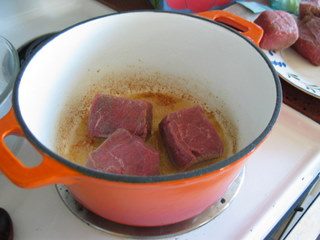
    *I have been wanting a lidded cooking pot that is for both the stove top and the oven, and last week I found one at a discount store: an enamel-coated, cast iron, five-quart pot, and the best part was that it was painted orange, just like in the Julie-and-Julia movie. Even as I was crouching down in the aisle examining every single label on the box, I knew that beef bourguignon would be the pot’s christening meal. I’m not usually sappy like that, but considering the circumstances (recently viewed movie, bedtime perusing of Julia’s cookbook) there was no other option. It was the right thing to do.


    *The ingredient list, while not really all that tricky, had me in a consternated fix on several different occasions. The “bacon” from the butcher wasn’t really bacon, and then I forgot to buy real bacon when I was at the grocery store so my sister-in-law kindly brought me some when she made a trip to town. There was no beef broth in the freezer like I thought there was, so Mr. Handsome had to stop on his way home from work to buy me some Swanson’s. I couldn’t find fresh pearl onions, so I bought frozen ones (and they were quite good). I used my last bottle of red wine, but at least I had a bottle of red wine to use. I greased up the kitchen two times—once when browning the beef and again when browning the mushrooms.


    *The process was different from what I’m used to, but that’s not saying much since I don’t really know much about cooking beef. Because this was a learning experience and I was determined to improve my technique, I followed the recipe to the letter. I braised the onions, browned the mushrooms (in four batches), towel-dried my beef cubes (and then bleached the towel), browned all sides of the beef in the bacon fat, drained the fat, browned the veggies (used exactly one onion and one carrot, no substitutions or embellishments), cooked the mixture for three hours (adding the broth towards the end when Mr. Handsome walked in the door), poured everything into a strainer, reduced and flavored the broth, washed out the pot, reassembled everything in the clean pot, and sprinkled the stew with freshly-picked-in-the-dark parsley. I even served the meal with peas and buttered boiled potatoes and red wine, just like Julia recommended. And it was good, kiss-your-fingertips good, richly sauced and fork-tender.


    Of course by then it was too late for me to take any pictures, so you’ll have to settle with a photo of today’s lunchtime bowl of beef.


    Beef Bourguignon

    Adapted (only slightly) from Mastering the Art of French Cooking by Julia Child

    3 pounds lean beef, in two-inch cubes
    1 tablespoon olive oil
    6 ounces bacon, chopped
    1 carrot, thinly sliced
    1 onion, thinly sliced
    1 bottle (750 ml) red wine (Chianti is first choice, but any wine will do the trick)
    3 cups beef broth
    1 bay leaf
    2 cloves garlic, minced
    1 tablespoon tomato paste (or sauce)
    2 teaspoons salt
    ½ teaspoon black pepper
    3 tablespoons flour
    ½ teaspoon thyme
    fresh parsley, chopped, for garnish
    ½ pound white pearl onions, braised (recipe follows)
    1 pound browned mushrooms (recipe follows)

    In your gorgeous five-quart, enamel-coated, cast iron cooking pot, lightly brown the chopped bacon in a tablespoon of olive oil. Scoop the bacon out of the pot and set it aside.

    Working in batches, brown all sides of the (towel-dried—any moisture and the meat won’t brown as nicely) beef. Set it aside with the bacon.

    Add the sliced onion and carrot to the fat and stir them around for a couple minutes until they are nice and brown. Carefully tilt the cooking pot and pour off the fat into a bowl. Dump the meat and bacon back into the pot on top of the veggies. Sprinkle the beef with the salt, black pepper, and flour and toss well. Put the uncovered pot into a 400 degree oven for 4 minutes. Remove the pot from the oven, stir the contents a bit, and put it back in the oven for another 4 minutes. Remove the pot from the oven and turn the oven down to 325 degrees.

    Pour the wine and beef broth over the meat. Add the tomato sauce, bay leaf, garlic, and thyme and stir briefly. Bring the stew to a simmer, clap the lid on the pot and slip the whole kit and caboodle into the oven. Leave it alone for three hours. In the meantime (or two days before, or whenever), prepare your baby onions and mushrooms.

    When the three hours is up, dump the pot’s entire contents into a strainer set over another large kettle. Wash out your fancy-schmancy, heavy-duty cast iron pot. Put whatever is in the strainer back in the now-clean pot. Add the mushrooms and baby onions.

    Put the pan of broth on the stove top and bring the sauce to a simmer. Cook it until it has been reduced to about three cups of liquid (or more, if you like—the sauce is amazing and I couldn’t get enough of it, so err on the side of too much), correct the seasonings, and then pour it over the meat.

    Bring the meat to a simmer, stir briefly, sprinkle it with parsley, and serve.

    Makes enough for 6-12 people, depending on how hungry they are and whether or not they love their beef.

    Braised Baby Onions
    From Julia’s Mastering the Art of French Cooking

    ½ pound peeled baby onions, fresh or frozen
    2 tablespoons butter
    2 tablespoons olive oil
    ½ cup red wine, beef broth, or water
    salt
    black pepper

    Melt the butter and oil in a saucepan. When the butter fizzles, add the baby onions. Cook the onions for about ten minutes, gently shaking the pan every so often and nudging them gently with a wooden spoon so that they turn over and brown evenly, more or less. Sprinkle with salt and pepper, and add the liquid.

    Transfer the (uncovered) pan to a 350 degree oven for 30-45 minutes, or until the liquid has completely cooked off. Gently turn the onions every ten or fifteen minutes so that they brown evenly.

    Serve immediately, or else store in a covered container in the refrigerator until they are called into service.

    Browned Mushrooms
    From Julia’s Mastering the Art of French Cooking

    1 pound mushrooms, cleaned and sliced
    2-4 tablespoons butter
    2-4 tablespoons olive oil
    salt

    Melt half the butter and olive oil in a large skillet. When it fizzles, add half of the sliced mushrooms, making sure that none of the mushrooms are overlapping (you want them to brown, not steam). When they are brown on one side, turn them and brown on the other side. Sprinkle with salt, scoop them out of the pan, and repeat with the second batch. Use immediately, or store in a covered container in the fridge until later.

    About One Year Ago: Chocolate Truffle Cake

  • On writing

    I’m at Panera, making myself write because I don’t want to write. Writing is such miserably hard work, especially when I don’t have anything pressing to say, but, nevertheless (insert martyr-like sigh), I’m forcing myself to Put Forth Words because this blog has become one of my disciplines; it’s one of the ways that I keep myself mentally healthy. It’s also one of the ways that I drive myself crazy. Go figure.

    Yesterday when we got home from church I felt blah, grumpy, out-of-sorts, dissatisfied, and apathetic. So I took a nap (was rudely awakened when Sweetsie chucked a book at Miss Beccaboo and Miss Beccaboo screamed like a stuck pig), went for a walk in the warm sunshine (a much-needed jolt of vitamin D), and drank coffee. After the Make-Things-Right Trilogy, I was finally able to start functioning. I made a double batch of chocolate frosting, turned six pounds of ground hamburger into sloppy joe meat, washed dishes, made phone calls, baked a batch of Julia Child’s Swiss Cheese crackers (butter, of which there was a half a pound, poured off the cookie sheets and puddled on the oven floor, clouding up the kitchen with stinky smoke), and processed half of the broccoli that Mr. Handsome brought in from the garden. But I didn’t write.

    Last weekend I saw Julie and Julia with some friends, and while I thoroughly enjoyed the movie, the parts that bothered me most were when Julie would sit down at her computer and type out a blog post. Just. Like. That. She had a full-time job, spent her (late) nights cooking and still managed to write witty, entertaining posts almost daily.

    Yes, I know I’m not supposed to compare myself, but those little pictures of someone effortlessly writing are enough to almost make me slap my laptop shut in despair. Writing for me can be torture. It can be fun, too, so I guess that makes my hobby fun torture, or torturous fun, whichever way you want to look at it. I’m a sucker for a good time, no?

    I break my writing process into three parts. Part One is the urge to write. If I’m lucky, it’s also the thinking part where I have an idea worth pondering. This part, if I have a good idea, is great fun because while I’m in this stage I easily create fabulous literary works of art…without ever cracking my laptop. More often than not though, I have the need to write something without any clear direction about what to write. I get a niggling IgottawriteIgottawriteIgottawrite feeling, but I have nothing to say, and, as you can imagine, this is a rather uncomfortable feeling.

    Part Two is a nasty slap in the face. I struggle (sometimes in vain) to get the words down on paper, a process which is almost never as smooth as I had hoped, nor the end result as witty. It’s the dirty stage, filled with editing, stops and starts, and the occasional Give Up, but it’s also a relief because I’m making myself do something.

    And then, if and when all the words line up right (or semi-right), there is Part Three, the moment of “publication” and the sweet buzz that follows. That buzz lasts for just about twenty-seven minutes, and then it fades away into a pleasant nothingness where I loll about guilt-free, reveling in having completed my job and not needing to do any more work.

    That blissful, blank, stuporish space lasts no more than a day, and then I’m back at Part One, with the bothersome need to write. If I don’t heed those urges, I feel guilty, and if I still don’t heed them, then I become depressed (no one cares, so why bother), and if I still don’t heed them, then I become belligerent (you can’t make me write, so there). And then I have to force myself to sit in a chair (thanks, Panera, for such a comfy stool) and write, even if I have nothing to say. Which, if you haven’t already noticed, I don’t.

    But at least I’m writing.

    So phooey to Julie and Crew for giving the False Impression of Easy Writing. Even if writing sometimes comes effortlessly and quickly (glory be!), it doesn’t always come that way. It’s like anything in life—you get the good stuff via the smokey kitchen, dirty hands, failed attempts, and aching muscles. Usually it’s worth it, though sometimes it’s not.


    So now I’m going to tell you about apple chutney. (Hee hee hee. You probably thought I was going to tell you about Julia’s cheese crackers, but, as you can see, I’m not. They weren’t good enough to validate a buttered oven floor, or for me to encourage you to smoke up your kitchen. [However, I don’t count the whole endeavor as a complete fail because I did learn some things, but I’m not going to go into them now—my point is simply that failures are not worthless, though most of the time I feel that they are.])

    This apple chutney is worth a retelling here, not least of all because there was no smoke involved. The chutney is tangy-sweet, made with, among other things, garlic, cayenne pepper, honey, and cinnamon. It’s a delicious addition to pork, if you are a pork-eating sort of person, or with something as simple as fried potatoes and bacon (oops, the piggy wiggled in there, too). I made this to go with mashed potato pancakes, and the crispy, cheesy, bacon-y pillows of potato were enhanced tremendously by the vinegary fruit. I still have most of a pint of chutney in the fridge and a latke recipe that is screaming to be tested, so I know (and hope) we’ll have at least one yummy supper this week.

    And now that I’ve completed a post, I can take a guilt-free break from this torturous addiction of mine. Whew, hallelujah, glory be, and … until next time.


    Note: I’ve been in Panera for two and a half hours, have drunk one and a half cups of coffee (only a third of which was caffeinated—I had my morning coffee before I ever left the house), have eaten two buttered hunks of baguette, and have taken two potty breaks (soon to be a third). I will not publish this post till I get home, so I’ll expend at least another half hour of mental energy on this project. Just so you know.

    Apple Chutney
    Adapted from Beni’s Family Cookbook by Jane Breskin Zalben, a collection of Jewish recipes. Does this mean that I’m committing a sacrilege by recommending that this chutney be eaten with pork? If so, my apologies.

    Zalben says you can use other fruits besides apples, mangos and peaches being two possibilities. If you like the citrus-y flavor, add some orange zest as well as the juice.

    7 cooking apples, cored, peeled, and coarsely chopped
    1 tablespoon peeled, minced ginger root
    1 clove garlic, minced
    1 teaspoon ground cloves
    1/8 teaspoon cayenne pepper
    1 teaspoon ground cinnamon
    1 cup honey
    juice of one or two oranges (or ½ cup orange juice)
    1 cup cider vinegar

    Combine all ingredients in a heavy bottomed saucepan. Bring to a boil and then lower the heat to simmer. Cook, uncovered and stirring occasionally, for about an hour, or until the mixture has thickened and is no longer juicy. Serve warm.

    Yield: About three cups.

    About One Year Ago: Two Thanksgiving Things.