• affinage

    The first time I met with my cheesemaking group and one of them mentioned affinage, I had to ask what it meant. Affinage, my cheesemaking friends explained, is the process of aging cheeses. Okay, I said, and then I spent the next year studiously avoiding the word because it’s French and I can’t pronounce French words to save my life, and because most of my cheeses were vac-packed: in their little plastic biomes, there was no mold, no rind, no excitement, so I didn’t feel like I was affinaging anything. 

    But then I did that Full Moon Blue and, the barrier broken, I shot out of the starting gate like my hair was on fire. I bought big, see-through, round plastic food storage containers from Webstaurant (not cheap but TOTALLY worth it) and promptly filled them with wheels of cheese.

    Currently, here’s what I’m affinaging (oh-la-la!):

    Jarlsberg-Style: I wondered if vac-packing was curbing eye development, and if I might be brining for too long (too much salt inhibits eye development), so I decided to attempt a natural rind from start to finish. I’ve had trouble with the rind being too soft/wet, but I think it’s finally stabilizing. . . and the cheese is now at room temp and beginning to swell.

    Double Gloucester: Thus far, this one is my favorite cheddar-style cheese so I decided to make it with a natural rind to see if that would add more nuance to the flavor. I’m mostly just brushing or dry rubbing the rind to keep the molds at bay. It’s looking pretty gnarly. 

    Smackered: I created this cheese — smacked down with a board to give it curved sides (it didn’t really work) and then ale-rubbed with a pinch of b.linens. I think I did pretty much everything wrong. It has a rash of mildew spots, I didn’t wash it frequently enough, and the b.linens never really took off, but I used the cheese corer to sample it last week and it was lovely. Which brings up the next question: when is it done aging? I have no idea. (Probably when I need the aging box for a new cheese, ha!)

    Unnamed, #121: Washed curd, a little salt added to the curds and whey, brined, and ale rubbed. The rind was smooth and pinkish until dusty tan-blue molds took over. It smells like cool gravel and kinda reminds me of southwestern colors and climate.

    Raclette: I am beyond excited about this one. The rind is wildly sticky-stinky (the other day when I told my husband to smell it, he took a whiff and then dry-heaved) and the most gorgeous peachy-pink. I’m not at all sure I can wait the full three months before tasting it.

    Gouda: I rubbed this one with a Belgian ale and it has a golden honey color and sweet, nutty-yeasty smell that’s driving me wild. I’ve switched from the ale rubs to a twice-a-week light salt brine rub. Thus far, it’s pretty darn perfect. 

    ale-washed gouda

    Affinage is incredibly laborious. Flipping a cheese might sound like no big deal, but consider the following tasks:

    *shlepping cheeses up from the cellar and then back down again
    *note taking
    *mixing brines
    *washing (or brushing/wiping) the rinds
    *maintaining a cheese-turning schedule
    *daily observation, researching, and troubleshooting
    *monitoring humidity levels and temperature
    *thinking, thinking, thinking
    *waiting

    smackered

    It takes up an awful lot of brain space, these cheeses do. I don’t know exactly what I’m going for, or what I’ll do with the cheese when I get there, or whether or not I want to replicate the same cheese or do something different (and if so, what?). The accute and perpetual state of cluelessness and uncertainty is exhausting. The cheeses are heavy and smelly and weird and my head hurts from thinking and I have no idea if I’m on the right track. 

    raclette

    So next time you see an artisanal cheese that you think is exorbitantly overpriced, know this: it’s not.

    This same time, years previous: perimenopause: Deirdre, age 46, ham and bean soup, pozole, salad dressing: a basic formula, doing stupid safely, all the way under, homemade grainy mustard, lemon cream cake, the quotidian (1.19.15), cream cheese dip.

  • four fun things

    I’ve decided it’s time to start smoking cheese so… 

    1. I had my younger son pull out an old electric smoker that someone gave to us, but it didn’t work. Or he couldn’t get it to work (which is the same thing as far as I’m concerned). 
    2. He got out an actual fire smoker — coals in the bottom and food on top — that I’d bought secondhand. It works great for meats, but we couldn’t get the temp to stay below the necessary 90 degrees that cheese needs. 
    3. He put coals in a pan and we tried to smoke the cheese in the grill but the coals kept dying.

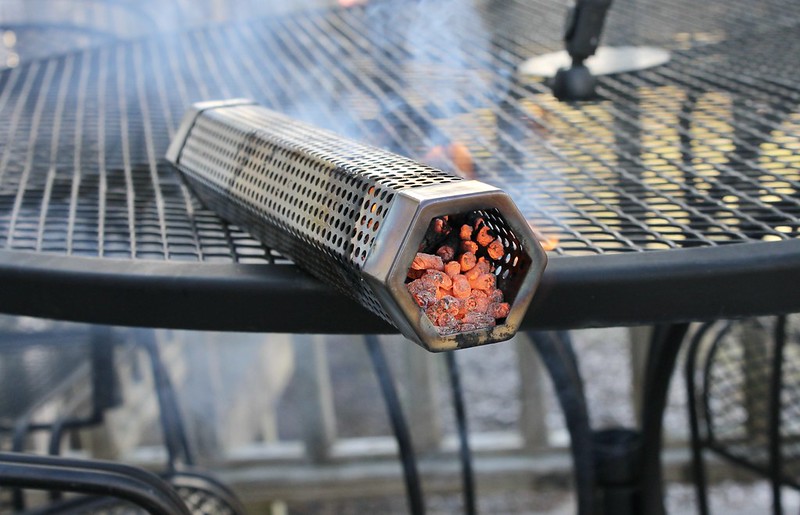
    And then I bought this sweet little do-hickey for 13 bucks and ba-BAM — billows of delicious smoke for hours. 

    Now my cheese world has exploded. The smoked cheddar is fantastic — like a whole new kind of cheese. I’m so excited to try Gouda and Toscano Pepato.

    Jarlsberg, Pepper Jack, Derby, São Jorge, Gouda (of course), and Toscano Pepato 

    ***

    The other day I happened upon a video of some of the behind-the-scenes filming of Napoleon Dynamite.

    I watched it multiple times, with multiple family members, and with immense glee. It was so fun to see Pedro, Uncle Rico, etc as their “real” selves (um … the actors, I guess?), and I was fascinated by how everyone seemed to be cobbling the movie together as they went. The whole process looked tedious, unglamorous — and wicked fun. 

    ***

    How many of you know what the Enneagram is? (This is not a rhetorical question. I really want to know! The enneagram is such a central part of how I understand people and relationships that I often forget that many people — most people? — don’t even know what it is.) 

    I always knew my number just from my reading, but then a few years ago I took one of the most in-depth Enneagram tests (some test out of South Africa that we had to pay for and gave me pages and pages and pages of analysis) and it confirmed what I already knew: I’m a raging 8. What number are you? Here’s a list of the best free tests, if you want to try one. (I just took the Truity test and I’m an 8.)

    ***

    Here’s an oldie but goodie. On the surface it’s about marriage, but really it applies to all conflict. For a clip that’s not even two minutes long, there’s an awful lot to unpack.

    I showed it to my kids this week, and they got a kick out of it.

    This same time, years previous: apple strudel, kefir, the coronavirus diaries: week 45, this is who we are, the quotidian (1.13.20), full house, scandinavian sweet buns, cranberry bread, through the kitchen window, roll and twist.

  • the disaster that wasn’t

    The other day I made a Fat Cow Cheese that bombed. Or I thought it bombed, anyway.

    Up until pressing it was spectacular, but then the rind stuck to the cheesecloth and the cheese was all firm on the outside and jiggly on the inside and I was convinced it was full of trapped whey that was going to make the cheese rot from the inside out. 

    So that evening I took it out of the press, plopped it into a bowl and then tore it into pieces while every fiber in my body screamed at me to stop. I salted it — I’d decided to forgo the planned-for brining — and popped it back in the press.

    This time the whey was like creamy milk so now I was losing the good stuff on top of everything else. I went to bed then, but I was so worried that when I woke up in the middle of the night I couldn’t go back to sleep for a couple hours for thinking about it.

    (In the dark of night I attempted to rationalize myself back to sleep by reminding myself of a piece of advice from LaNae Williams that I’d read in the NY Times: If there is an issue bothering me, I think to myself, “Will this still be an issue in one week or in one month?” If the answer is no, it’s a small problem so I let the stress go and move on. I told myself that, not only would this cheese problem not matter in a couple days, but I’d probaby have learned something from it and, in retrospect, be grateful for it, but — no dice. Still couldn’t sleep.)

    By the next afternoon when I pulled the cheese from the press, the curds appeared well-knitted and I felt a surge of hope. It still felt super tender in the center so, thinking there might still be excess whey in there, I dry salted the top of the cheese and then set it out to air dry. 

    And then it started cracking.

    Not the little hairline cracks that sometimes appear, but deep, innard-revealing chasms that — in the middle of the night, sigh — had me convinced once again, that the cheese was rotting, but this time from the outside in, since all kinds of bad bacteria were surely infiltrating the cheese through the gaping crevices. 

    The cheese itself still felt super soft on the inside. It was unstable, which made me afraid it would fall apart when I flipped it. That night, worried it might slump down into a big puddle on the table, I tied a cheese cloth around the sides of it to short it up, kinda like a belt. 

    The next day I had to vac-pack it which meant I had to cut it in half. Finally I’d see the inside. And . . .

    It was beautiful! Well-pressed, sweet-smelling, creamy. I was thrilled — and immensely relieved.

    And THEN [drumroll] . . . the night before, an idea had popped into my head: might the cheese make a good mozzarella? See, there are two main kinds of methods for making mozzarella — the fast version (here and here) and then a slower, cultured version which I’ve tried but, because I lack a pH meter, hasn’t worked. But this cheese was fully cultured, and then some. Why not crumble a chunk into pieces, pop it into the microwave, and try to stretch it? 

    People, it worked. Not only did it stretch beautifully but, fully salted and with all that culturing, it was the most wonderfully delicious, flavorful mozzarella I have ever, EVER tasted. 

    Normally when microwaving mozzarella curds, lots of whey is expressed and lost, but these curds retailed all of their fat. There wasn’t a drop of anything left in the bowl! (I didn’t cut off the rind so the mozzarella wasn’t completely smooth, but I didn’t care. It was still delicious.) 

    In the end, I made one half of the cheese into (what I’m calling) my Signature Fat Cow Mozzarella and then vac-packed and froze it, and the other half I vac-packed for aging. I think as it ages the rind will soften and the paste will stabilize and it will probably be just like the first Fat Cow I made, though maybe more crumbly because I milled in the salt. We’ll see!

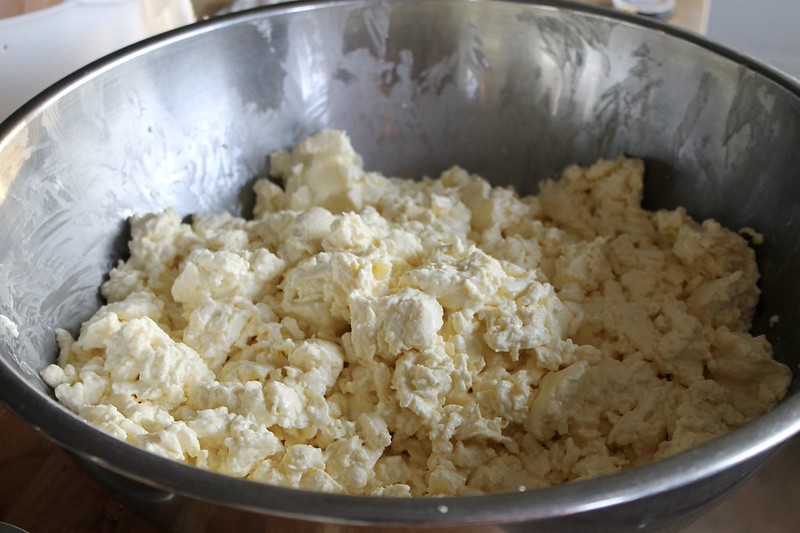
    Note: when making the mozzarella, I overheated one batch of the curds and then it refused to stretch. I glopped it into a container and now that it’s chilled it has the texture of a firmer cream cheese.

    To eat it, we dig out blobs and add them to calzones, pasta, mac and cheese, whatever — it’s freaking delicious. (I gave my older daughter a taste of it when it was warm and the texture of ricotta, and she promptly scooped a whole spoonful onto her plate and ate it with her breakfast.)

    So there you go, friends: yet one more valuable lesson from The School of Cheese. But Jennifer, you say, was it worth a few hours of lost sleep?

    Oh yes, most definitely.

    This same time, years previously: five fun things, 6.4 magnitude, the Baer family gathering of 2019, boys in beds, homemade lard, the quotidian (1.11.16), the quotidian (1.12.15), what we ate for lunch, crumbs.