• Snappy happy

    I’ve been taking lots of pictures.


    I checked a couple photography books out of the library and have been reading them like novels. I’m learning all sorts of new things, but mostly I’m just learning that I don’t really know anything about photography. It’s kind of invigorating.


    I don’t understand half of what I read, but that doesn’t stop me from trying. Much of the time, I just look at the pictures. But I don’t just look at them, I study study study them. And then I study them some more. It’s my attempt to learn to see like a photographer. How to move like a photographer. Photography is a dance, really. (And I’m the dancer who is tromping on toes and poking my elbow into strangers’ ribs, forever terrified that I’ll be booted off the floor.)


    Even with all my reading and picture pondering, when I pick up my camera and go outside, I draw a blank. What’s aperture again? Um, when is shooting in monochrome effective? Is my ISO speed too high?


    That my only human models are my children complicates matters even more. I’m convinced they move into the shadows and flare their nostrils just to provoke me.


    But I keep plodding along. My daughter is my most willing, though spazzy, model.


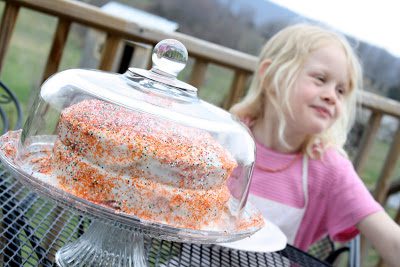
    I sat her beside the back door this morning and used a piece of white paper as a reflector to lighten the shaded side of her face. You can see the paper in her eyeball.


    Part of my problem is that I don’t know what I’m looking for. I don’t want my pictures to appear contrived, but at the same time I want an element of surprise, something that stands out and catches the eye, drawing the looker into the picture. Quite by accident, this last picture gave me that—one of her eyes is obscured by her hair which makes the other eye stand out boldly. I like that.

  • No trouble at all

    I’ve been doing an excellent job at writing a weekly menu and then sticking with it. Of course, things do get switched around or I’ll add new dishes in, but for the most part my plan gets followed.

    It’s such a relief. That half hour of planning on Sunday or Monday (and yes, it does take me that long) frees up my brain to think about all sorts of other stuff during the rest of the week. Like what desserts would best showcase my sour cherries and if it’d be acceptable to make yet another batch of flourless peanut butter chocolate chip cookies (yes, those cookies are always acceptable). And with my expert menu planning, I use up a lot more of my Put-Up Food. Three cheers for empty quart jars!!!

    This menu idea is not a new thing—I’ve written about it before—but then I got all loosey-goosey. My menus went haywire, and we lived on things like pancakes and eggs. (Which wasn’t that bad, really.)

    But now I’m on The Straight and Narrow again. I’m immensely proud of myself. In fact, my head is so high I have to look down my nose to see anyone else. (Please don’t stick your foot out or toss a nanner peel in my path, kay?)

    Seeing as today is Wednesday and the flies are buzzing around my flying fingers and the birds are singing outside and the fire in the woodstove burned itself out and my flourless peanut butter chocolate chip cookie is all—sniff—gone, I thought it might be nice if I’d share some details about my menu planning. It takes such a very lot of skill and expertise to draw up a menu so I’m pretty positive it’d be nigh near impossible for you to figure out how to do it without my profound instruction. And I love to be helpful.

    Don’t worry, it’s no trouble at all. Really.

    Here’s what you do:

    First, take a notebook and write the days of the week, in abbreviated form, in the margin of the page, skipping every other line.

    Second, draw a box around the abbreviated days.

    Third, write down a dinner idea for each day. You get bonus points if you include breakfast and lunch ideas. In parenthesis, jot down notes for yourself, like, thaw chicken, or make pancake syrup.

    Fourth, look at the menu before going to bed at night and upon waking in the morning.

    Fifth, cook the food and eat it.

    Would it help to see a sample from my menu notebook? Okay. Here’s what I came up with for last week’s menu. I hope you don’t mind that there aren’t any boxes around the days of the week—I’m not computer savvy enough to know how to make boxes (it’s one of my weaknesses)—but you can just pretend they’re there, right?

    Mon: curried lentils, rice, pie
    Tues: baked potatoes, corn, green beans, squash
    Wed: broccoli soup (for lunch), ham-and-egg bake, peas, applesauce
    Thurs: in West Virginia
    Frid: potato soup with eggs and bacon
    Sat: pesto (didn’t have it) and pizza (for supper)

    Other ideas are written in the margins: Finnish rolls, cream puffs, peanut pie, beer cupcakes, pumpkin pie, cherry cobbler, beans/tortillas/salsa, etc. I brainstorm pretty heavy on the sweets.

    So tell me, do you have any great menu planning tips up your sleeve that are just itching to be shared? Or are you a Menu Winger?


    Writing down that menu reminded me that I want to tell you about the egg-and-ham casserole we had for Wednesday’s supper. I think I’ve photographed it two separate time with the intention of telling you about it, but then I let it slide. Shame on me. It’s a simple dish, really. An ordinary dish. But it’s also a gentle dish, good natured, patient, and kind in every way. (Oops. It appears ‘Enry ‘Iggins is speaking through my cassy-roll.)

    It’s supposed to be a breakfast casserole. One of those splendid ones that you assemble in the evening and then pop in the oven first thing upon waking, after which you are permitted to shuffle off to do Other Things until it’s ready.

    It also works well for supper. Last Wednesday I assembled it first off in the ayem, lived Life for eight hours, and then while I was at my dance class, my husband popped it in the oven. When I got home, famished and sore, supper was ready, hallelujah.


    Egg-and-Ham Casserole
    Adapted from my Aunt Valerie’s recipe

    Other meats can be substituted for the ham. Already-cooked sausage and bacon are my favorites (you don’t need much to get a bunch of flavor), but Valerie also suggests chicken and shrimp.

    6 slices bread, cubed
    3/4 pound grated sharp cheddar cheese
    2 cups chopped ham
    3 tablespoons onion, minced
    6 eggs
    3 cups milk
    1 ½ teaspoons dry mustard
    2 tablespoons chopped fresh parsley (or 2 teaspoons dried)
    1/4 teaspoon salt

    Toss the first four ingredients together in a large bowl. In a smaller bowl, whisk the eggs and add the milk and spices. Pour the wet ingredients over the dry and toss gently. Pour the mixture into a greased 9 x 13 pan, cover, and set in the refrigerator overnight (or for about 8 hours). Bake the casserole, uncovered, at 350 degrees for 40-45 minutes. Allow to cool for 10 minutes before serving.

    This same time, years previous: playing Martha

  • The other one

    Before any more time elapses, I must tell you about the other cherry pie I made. There was the first one, of course. The double-crusted, cinnamon-spiked, tapioca-thickened one, and it was a real work of delicious art.

    But then somewhere I saw a link to Ruth Reichl’s blog and I thought, Huh? You mean Ruth keeps a blog? Well I’ll be a monkey’s uncle, and so I clicked over there fast as a wink, and sure enough, Ruth’s explosive hair and unflappable charm popped up right there on my computer screen. Of course I immediately signed up to get her posts. I miss the woman’s monthly columns in Gourmet—unlike other editors, she often wrote of deeper things than just the thrust of the current magazine.

    As I scrolled down through her posts, I happened upon her recipe for a sour cherry pie. Apparently it’s her tradition to make a sour cherry dessert at the start of each new year. (Isn’t that sweet?) Her recipe was written simply, in paragraph form, and I quick jotted down notes and then hustle-rustled us up some pie.


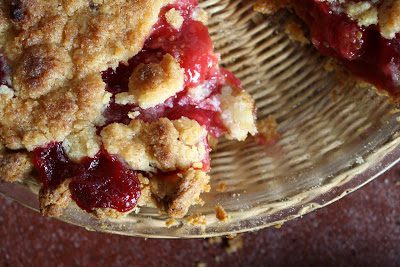
    I’ll be honest—(that’s a stupid-upid-upid thing to say—I’m always honest, of course)—at first I thought it wasn’t going to work. The cherries disintegrated mightily while they were thickening on the stove top, and my blind baked crust (from one of my recipes, not hers) baked up into a piece of lace, a buttery web of holes. But the part I was most worried about was the crumb topping—a stick of butter, melted, and a three-quarter cup each of flour and sugar that, when mixed, more closely resembled a sandy sludge than crumbs. But I forged ahead, sprinkling the paste in the best crumb-like fashion I could muster. It was a lot of crumbs, and they ended up forming a lid over nearly all the cherries.


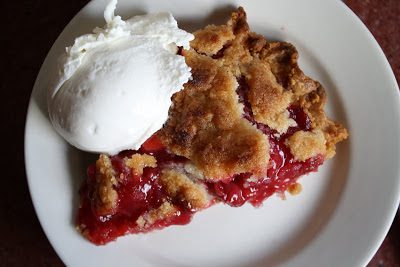
    And you know what? I never should’ve doubted those crumbs, let alone Ruth. (Who did I think I was anyway? A gourmet cook? Ha.) Those crumbs were fabulous! In the hot oven they transformed into a thick, hard lid that shattered like a sheet of ice when the knife hacked through. Crunchy and buttery-sweet, the crumbs were the perfect foil for the soft, tart cherries. I couldn’t keep my hands off the crumb shards. I kept plucking off the edge pieces and popping them into my mouth, yum-yum.


    Of course the crumbs’ underbellies softened a little by the next day. My mom has fits about this. She thinks soggy crumbs are the end of the world and so refuses to make crumb toppings for pies that aren’t going to be served that same day. I agree with her—crumb pies are best on the day they’re made (aren’t all pies?)—but while these crumbs did get a little soft, they certainly weren’t bad, and it definitely wasn’t the end of the world. (Mom, you gotta calm down, okay?) The bottom line: plan to eat this pie the same day you make it and then be thrilled if there are any leftovers.


    Sour Cherry Crumb Pie
    Adapted from Ruth Reichl’s blog

    To blind bake a crust: line a pie pan with the crust, crimp it, and prick it with a fork. (If you’re worried about your pastry holding its shape in the oven, you can line it with foil, and then fill the bottom of the pie with dried beans. Also, sometimes it helps to stick the shaped crust in the freezer for half an hour immediately before baking.) Bake it at 400 degrees for however long it takes to get just a little brown—10-20 minutes.

    I used my cream cheese pastry, and while the flavor was superb, the pastry didn’t have enough structure to hold up to a blind baking. Next time I’ll use a regular butter pastry.

    1 9-inch pie crust, blind baked
    3 tablespoons butter
    5 cups pitted sour cherries, frozen (and unthawed) or fresh
    2/3 cup sugar
    1 teaspoon lemon juice
    a pinch of salt
    3 tablespoons cornstarch
    2 tablespoons water
    crumb topping, recipe follows

    Melt the butter in a heavy-bottomed saucepan and add the cherries (and juice, if any) and sugar. Stir a couple times, and as soon as the cherries have thawed (this will happen quickly), add the lemon juice and salt. Make a paste with the cornstarch and water and add it to the cherries. Bring the sauce to a boil, stirring frequently. Once the filling is thick and clear—after a couple minutes—remove the pan from the heat.

    For the crumb topping:
    3/4 cup flour
    3/4 cup sugar
    1 stick butter, melted

    In another bowl, melt the butter and stir in the sugar and flour. Set aside

    Pour the cherries into the pie shell, and top with the slurry-like crumbs. Place the pie on a foil-lined baking sheet (the cherries are bound to bubble over) and bake the pie at 375 degrees for about forty minutes. Both the crust and crumbs should be golden brown and the cherries will be bubbling madly.

    Allow the pie to cool for about four hours before serving.

    (I just realized that I said “of course” four—4!!!—times in this post. Whoa, dude. Maybe I gotta calm down.)

    This same time, years previous: nutty therapy