After last year’s Fresh Air fiasco, I questioned the wisdom of inviting another child into our home. But then I did it. Of course. Because I knew that the chances of us getting another holy terror were pretty slim, and the truth is, that holy terror didn’t affect us all that much.
So we invited another child into our home.
Actually, she had come to stay with us at the very end of her trip last year because she done did wear out her welcome at her first host family’s house. We didn’t have any problem with her, so I crossed my fingers, hoped I wasn’t begging for trouble, and invited her back.
She was a good match for our family: loud, assertive, and opinionated. She fit right in.
I ended up really liking this little girl. She was super smart and articulate. She asked good questions. She was observant. She could see the big picture. She even called me out on my inconsistencies. (I didn’t like that so much, but sure did admire her for it.)
***
She arrived on a Tuesday, when we were in the midst of a big corn day.
She cried for a couple days, but then her homesickness faded. At first she had no idea how to entertain herself (this inability to play never ceases to catch me off-guard), but by Friday she was started some imaginative games. Thank goodness! Only then did I realize how tense I had been, waiting to see if she would catch on to how we do things at our place.
Her make-believe game of choice was Getting Your Hair Done. She loved playing with hair.
She also loved playing in the van. Combining the two was a brilliant stroke of genius (not mine). It kept them occupied for a very long time.
She braided my younger daughter’s hair for church. I think the Fresh Air girl wanted to do more braids, but my daughter had her limits. She is very particular about her hair, though you’d never guess it since it looks like a floppy mop most of the time.
Speaking of a floppy mop, I don’t know why we didn’t think to pull out the wig until the last day.
She couldn’t get enough of it.
(By the way, this wig needs a name. Tanya? Vanessa?)
***
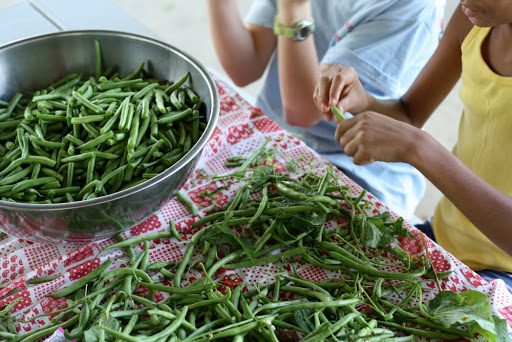
I tried to go out of my way for us to do fun things, and we did make it to the water a bunch of times, but the truth is, I was up to my eyeballs in garden stuff.
Next year I think we’ll aim for hosting during the first trip—August is just too… August-y.
She was pretty fed up with green beans and corn by the end of her visit.
I shared her sentiments completely.
***
This girl was over-the-top picky, so I
had my work cut out for me. Thankfully, I had my new weapon: French-style meals. By the end of the visit she was eating—and
all these were foods she claimed to not like at first—granola, peaches,
bananas, peas, beans, cucumbers, tomatoes, zucchini, and on and on and on. It
was immensely gratifying. (Also, I think she thinks we only eat in
courses. At every meal she’d ask, “How many courses are we having?”)
She was obsessed about what I would pack for her lunch on the bus.
“I need juice,” she told me.
“You need juice?” I challenged. “But you haven’t had juice for ten days and you’re doing just fine!”
“We had orange juice once,” she corrected me. “And mint tea.”
“I could pack you some mint tea. Would you like that?”
“All the kids on the bus will probably come back with water,” she muttered. “‘Cause everyone in Virginia is so healthy.”
***
The next to last day was hellish. The kids fought constantly. I kept having the urge to blame it on the Fresh Air girl, but then I remembered that there are days (many, many, many of them, in fact) when my kids fight all day long and sometimes for days on end. Ten days is a long time for a child to be together with a best friend, let alone a new person they didn’t know very well. It was only normal that things would fall apart after awhile.
zonked
I talked to my own kids, privately, about going out of their way to make the last day a good one. They rose to the occasion (secret fist pump!) and everything ended on a bright note.
This same time, years previous: around the internets, peach cornmeal cobbler and fresh peach ice cream, tomato and red wine sauce, vegetable beef soup, mustard eggs, and Russian pancakes