• finding my answers

    Back when I was writing my home education series, I expressed frustration that the Sunday school class—the one we were doing on education—never actually got around to the topic of learning. If learning is at the heart of education, I asked, then why aren’t we talking about it?

    A couple of you recommended Peter Gray’s book Free to Learn. After a bunch of pondering (and trying to scrounge it for free), I ordered it from Amazon. It was the smartest twenty bucks I’ve spent in a long time.

    Reading this book, my insides get trembly. I’m all fired up giddy. I have so much pent up energy and harebrained ideas, I can hardly settle down to focus on the actual words in the book because they are SO CRAZY INSPIRING THAT I MUST TYPE IN ALL CAPS AND FLAP. My husband is on pins and needles because he never knows what wacko thing I’m going to say next. I’m poised to scream radical ideas from the mountaintops while he’s frantically yanking me back from the edge and I’m all like, Just let me go, I want to flyyyyy!

    So what’s so wonderful about a boring old research-based book?

    First, it’s not boring. It’s facts and studies and evidence, but it’s approachable and friendly.

    Second, the topic is enormously relevant. Schools are an integral part of our society. Everybody learns.

    Third, Gray is an evolutionary developmental psychologist (in other words, he studies child development and education from a Darwinian perspective) who answers the question that no one else will: how do we learn. (Ironically enough, I doubt Gray’s ideas are anything our current educational system will want to hear. Which is probably the reason no one is talking about it.)

    Here. I’ll toss you some tidbits from my figurative mountaintop. If you’re not interested, duck and run. I hope I don’t squash anyone’s toes.

    Peter Gray says:

    *The educational system is not democratic. Our government proclaims that everyone is allowed freedom, liberty, and the pursuit of happiness, and yet we deny that to a large portion of our society, not because they’ve done anything wrong but merely because of their age. Why aren’t children (and their advocates) taking the school system to court?

    *Gray equates schools with prisons and then raises the hard question about all the people working in the educational system: “How can I say that these good people—who love children and have poured themselves passionately into the task of trying to help them—are complicit in a system of imprisoning them?” (67). Gray’s piercing critique is not an attack on people, but on the society we live in. It is complicated and dicey.

    *How do mammals learn? Through play, though Gray doesn’t get around to addressing this directly until page 139. (He spends the first part of the book talking about hunter-gatherer cultures, a progressive school called Sudbury Valley School, and our failing school system.) The more evolved the species, the more playful they are. Humans require incredible amounts of space and time to play in order to be successful. We’re not talking about just toddlers needing tremendous freedom to play, but children up to, oh say, the late teen years, gasp. (Remember that post I did a couple months back on what I will wish I’d done differently? Ha!)

    *Play is (and I’m snatching the section titles from pages 141-153) 1) self-chosen and self-directed, 2) motivated by means more than ends, 3) guided by mental rules, 4) imaginative, and 5) conducted in an alert, active, but non-stressed frame of mind. According to this definition, my blog is one hundred percent play.

    *There is no way that anybody can learn even a small sliver of all the information that is out there. Don’t spend time trying to get everyone to cover all the same topics: explore, discover passions, be different, play.

    *Young children learn by exploring their physical world; older children, ages 11 and up, learn by
    exploring other people’s minds. I am seeing this shift with my children. Last night, in addition to our normal suppertime crazy, there was an animated and extended conversation about all things China, tariff, and sanctions. Super fun.

    These nuggets are just the tip of the iceberg. The ideas in this book are startlingly radical. It takes a good bit of reading and pondering to wrap my mind around them. There’s no way I can do them justice in one little blog post. Even though I do not agree with everything Gray says (and I’m mighty skeptical of some of his claims), his book provides the best answer to my how-we-learn question that I have yet found.

    My paradigms are shifting. I have no idea where I’ll end up. The only thing I know is, I’m loving the ride.
    And now, if you’ll excuse me, I have a book to read … and a fretful husband to soothe.

    This same time, years previous: the quotidian (5.20.13), the trouble with Mother’s Day, the quotidian (5.21.12), the boring blues, and fowl-ness.

  • the quotidian (5.19.14)

    Quotidian: daily, usual or customary; 
    everyday; ordinary; commonplace


    A strategic hint from my children.

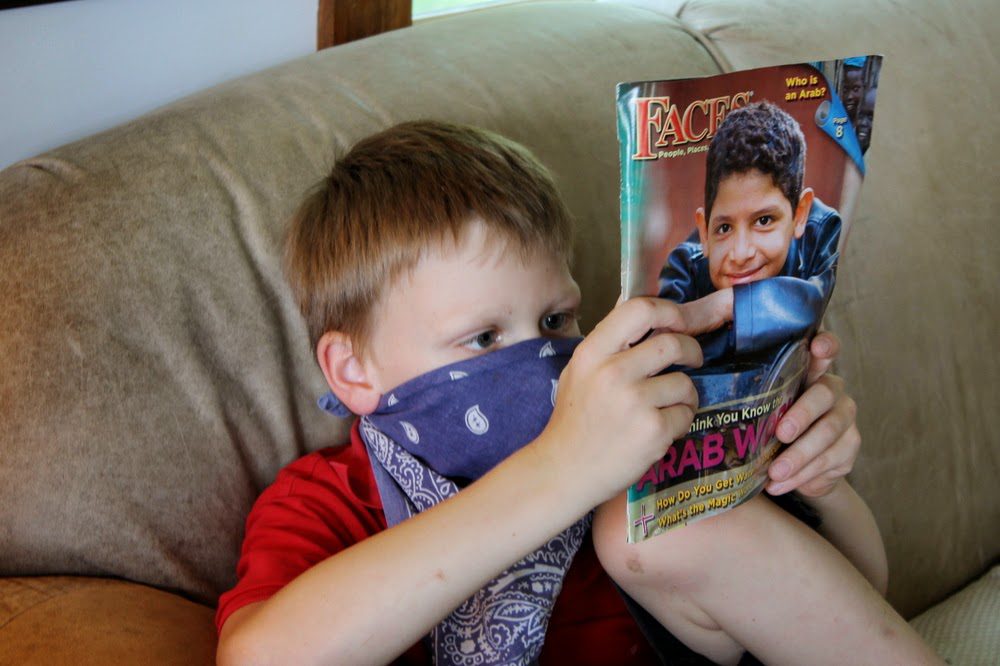
    Irony. 
    (The title of the magazine is Faces.)

    Morning chores under cover of Mother Nature’s invisibility cloak.

    The beautiful ordinary.
    Rain watching.
    Leaf armor.

    Rellenitos: better than I remembered.

    Fat and fatigued: three weeks to go.
    Saturday supper.

    He loved this book to the point of actually memorizing parts of it.

    Bare feet, sunshine, and green, ahhhh.

    This same time, years previous: help, a burger, a play, and some bagels, ’twas an honor, baked brown rice, my favorite things, rhubarb streusel muffins, strawberry spinach salad, caramel cake, cinnamon tea biscuits, and talking points, rained out.

  • crock pot pulled venison

    Before I talk meat…

    Your enthusiastic response to my plea for good book suggestions was so encouraging. First thing Saturday morning, I made a list of your recommendations. I researched books on Amazon. Then I headed into town to run errands and stop by the library. But woe—whoa—it was not to be. Our library, it so happens, doesn’t open until noon on Saturdays. I was crushed.

    Back home, I logged onto the library website and put entirely too many books on hold. Then I considered my options. A couple of you talked about rereading certain authors. This is not a new idea—I know plenty of people who reread their favorites every couple years—but this time I heard it differently and I was like, Well yeah, I don’t even know what my favorite books are about anymore. So I nabbed Bean Trees off my shelf and dived in. Let the party begin!

    ***

    Now. For the meat.

    Breaking news: I finally figured out how to cook venison.

    I’m timid around meat—afraid I’ll ruin an expensive cut with my limited know-how—and even though venison isn’t expensive and should therefore be less stressful, it makes me tense up even more because I’ve always thought of it as an inferior product. It has that gamey taste that everyone rolls their eyes about, and you have to know how to mask it just so or you end up with a bunch of tough meat that tastes like road kill.

    Not that I’ve ever eaten road kill.

    It’s not like anyone is ever out to acquire a nice cut of venison for a cookout, right? I know this because if it were so, they’d sell it in stores. But no. People just happen to have a hunter or two in the house and a freezer full of the stuff and then they are forced to figure out a way to use it up.

    The thing is, I’ve always known venison can be really good. I’ve known this because people with discerning palates have told me so. I’ve just never actually experienced it firsthand. So last fall when our neighbors offered us a piece of fresh venison, I, buoyed by an eternal and unfounded optimism, said, Sure, why not. I’d figure something out.

    The “piece” of fresh venison ended up being about half a deer. I stared at the pile of deer parts piled on the kitchen table, gulped, and handed my daughter a knife. A few hours later and we had a hefty stash of cubed venison in the freezer. (Thanks to The Google, the bloodier meat got soaked in salt water to remove the gamey taste. It worked.)

    Yesterday I thawed three of the packs and turned them into pulled venison and it was fabulous.

    Fabulous as in, I am so glad I have more venison in the freezer.

    Fabulous as in, my husband said, “No one would ever guess this was venison.”

    Fabulous as in, I forgot to photograph it because we were so busy eating.

    Fabulous as in, today I made a sandwich with some of the leftovers so I could take a picture, and my children fought over the sandwich.

    Never again will I feel shy around venison. Never again. This stuff rocks.

    Crock Pot Pulled Venison
    Adapted from Jane of Thy Hand Hath Provided.

    One reason I so like this recipe is that it uses any size cut of meat: big chunks, little chunks. They all get thrown in the pot together and shredded up at the end.

    I only made a couple changes from Jane’s recipe: I added a chipotle pepper (I wish I would’ve added more), and I deglazed the pan with some broth and didn’t discard any fat (you know how I feel about fat, yum-yum).

    5-6 pieces bacon
    2 pounds (or a little more) of boneless venison pieces
    ½ cup chicken broth (or red wine) for deglazing the pan
    3/4 cup brown sugar
    1/4 cup cider vinegar
    1 onion, chopped
    4-5 cloves garlic, minced
    1½ cups ketchup
    2 tablespoons Dijon mustard
    1-3 chipotle peppers in adobo sauce, chopped
    1 teaspoon salt
    1 teaspoon cumin
    1/4 teaspoon freshly ground black pepper

    Chop the bacon and cook it in a pan with high sides (to avoid splattering grease all over the floors). Remove the bacon bits and set aside.

    Rinse the pieces of venison to get rid of any residual blood. Blot dry. Working in batches, brown the pieces of meat in the bacon grease, making sure to get a good brown on both sides. When all the venison is browned, add the broth or wine to the empty, hot pan and stir vigorously, scraping the bottom to get up all the browned bits. Pour the liquid into the crock pot and add the bacon and venison. Add the remaining ingredients and stir.

    Turn the crock pot to high and cook for one hour. Reduce to low heat and cook for another 6-7 hours, stirring every couple hours. Right before eating, vigorously shred the meat with two forks. I did this directly in the crock pot, but you can remove the meat and shred it on a cutting board if you prefer.

    Serve the pulled venison on hearty buns.