Upon the recommendation of my cheesemaking group, I ordered a new book: The Art of Natural Cheesemaking by David Asher. The group warned me that the author was a bit rabid about the right way to make cheese. No freeze-dried cultures, they warned me. No plastic. Only fresh raw milk.
I hesitated — purists irritate me — but finally I ordered the book. And then I read every single page, some of them out loud to my (uninterested) husband, until, just this week, I finished the book. I even read the appendices. Every few pages, I’d shout Now I get it! Or, Listen to this! Or, Can you believe…? The other afternoon when I yelled I’M LEARNING SO MUCH, my younger son who was up in his room teaching himself about binary numbers called back, ME, TOO. Our house was positively glowing from all the lightbulbs going off. Or turning on. You know what I mean.

Here’s a brief summary of the book:
*Our food system is fear-based and highly industrialized, which means our food is being mass-produced in the most simplified, streamlined way for minimal variety and ease of production. The need for pasteurization comes about, not because raw milk is dangerous to consume, but because our milk is mass-produced from many cows, collected from farms and transported to the plant, processed into a uniform product, then packaged and shipped to stores. It’s how we handle the milk, not the milk itself, that is dangerous.
*The addition of yellow dye began in the industrialized revolution when they needed a way to mask inferior cheese. Some people have no emotional attachment to yellow cheese, but I do. I made a white Colby and just looking at it makes me feel sad.
*There is no need for added molds and freeze-dried cultures. Just as grain holds all the components necessary to ferment into sourdough — and grapes for wine, apples for cider, and cabbage for kraut — raw milk contains all the good bacteria needed to culture milk into cheeses.
*Instead of relying on freeze-dried cultures which are expensive, single-strain, and less resilient and flavorful (think GMO vegetables versus heirloom), use natural cultures such as kefir, yogurt, and buttermilk to start a cheese. Another option is to let milk sit out at room temperature to sour naturally, or use whey from a previous batch of cheese.
*The basic cheeses can be categorized as follows: stretched-curd (mozzarella), alpines (Parmesan and Tommes), washed-curd (Gouda), cheddar, white molds (Camemberts), and blue molds. Learn to make a simple rennet cheese and, depending on how you care for the pressed curd (reheating and stretching it for slow mozzarella, cutting and stacking it for cheddars, letting it sit out to grow white mold for the camemberts), you can make all sorts of cheeses. Each one will be different from the one before, depending on all the little variations that occur during the cheesemaking process. Natural cheesemaking is not focused on conformity.

I am not ready to toss out my vacuum sealer or dig a cave in my room, but this week I did scrape a bit of blue mold from a piece of sourdough, dissolve it in water, and add the water to a quart of yogurt which I then hung and proceeded as with yogurt cheese. Now it’s aging in the cold room. In a couple weeks, once (if) it grows blue mold, I’ll pierce it all over so the mold can work its way into the cheese.


And I started making kefir. (According to Mr. au Naturel, kefir rhymes with “deer,” so it’s to be pronounced Kuh-FEAR, not KEE-fur. It’s a hard habit to break.)
I got the grains from my friend down the road and quickly fell into a rhythm.

In the morning, I put a small lump of kefir grains — about a teaspoon or so — in a pint jar, top off the jar with milk and give it a quick shake. The next morning, the milk is solid, like jello. I schlub-schlub-schlub the contents into a strainer set over a mixing bowl and stir gently until all the kefir has dripped through and only the grains are left. I pour the kefir into a jar, date it, and pop it in the fridge. The grains go into a fresh jar and I start the whole thing over.

grains in a clean jar

top with milk, then shake

twenty-four hours later

stir through a strainer

grains for the next batch
The kefir grains keep multiplying, so every week or so I’ll dump half of them in the compost. I also keep a small jar of grains submerged in milk in the fridge. Like so, they should keep for weeks. If I ever need more grains, I just strain them out and start the process and, like a sourdough starter, after a day or two, they’ll be fully activated again. (Just this morning, I opened a small jar of milk-covered kefir grains from back in the beginning of December. The milk didn’t smell sour at all. Maybe a little sweet, if anything. How wild is that??)
The liquid kefir, I use either in smoothies, or in place of buttermilk in baking, or as a culture for cheese. Some people like to drink it, but not me. I don’t like how it tastes funky-yeasty and almost metallic. Purist Guy said you can’t detect the flavor of kefir in the final cheeses, but I’m not so sure. I think I taste something, like there’s a very slight “off” flavor. On the other hand, I might be detecting that because my cheeses are still fairly young. Maybe, after six months or a year, that flavor will disappear, or morph into something more complex.
And that’s the other thing: it could be that this is just what real — excuse me: natural — cheeses taste like. Yesterday, after feasting on about 20 homemade cheeses (my cheesemaking group met at my house and we gorged), some of which packed a flavor funk-punch, I ate a piece of store-bought marbled Colby and was surprised to realize it tasted like absolutely nothing.

How many cheeses can you count? (And that’s not all of them.)
Because kefir is wildly good for you, and because it’s free, and because I love the concept of letting the milk do all the work — using the cheesemaking methods to tease out the different bacterias, yeasts, and molds that the milk already contains — I’m sticking with kefir for now. I have a hunch it’s the right way to go. And it does make good smoothies as long as I add a couple bananas, a generous scoop of jam, and a bunch of other fruit to mask the flavor.

You might be asking, why use kefir as a culture and not yogurt? I use yogurt in Alpine cheese and that cheese is sweet and mild, with no weird funk whatsoever. The reason is this: Kefir is a mesophilic culture which means that, if you heat the milk to a higher temperature, above 106 degrees or so, it no longer works. So for my higher temp cheeses, like Alpine, I need to use a thermophilic culture, like yogurt, and for the lower temp cheeses, I need to stick with Kefir. (Or buttermilk! I haven’t tried buttermilk yet, but I plan to.) And some cheeses call for both meso- and thermophilic cultures — they kinda tag-team each other — so technically I can use both Kefir and yogurt for some cheeses, which I fully intend to soon do.
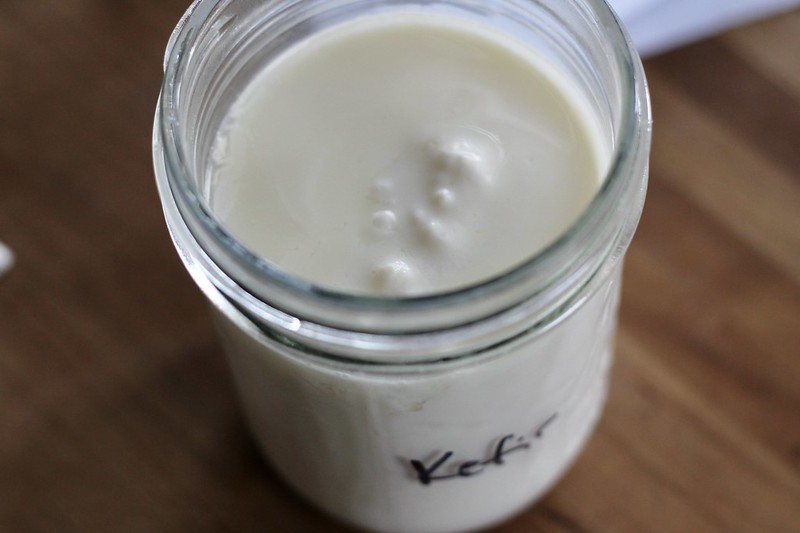
a fresh batch, ready to strain
P.S. I like to pick at Asher, but truth is, his is a fabulous book. I wish I had read it back when I first starting making cheese. In my stack of cheesemaking books (I have five) it’s moved to the top.

and so on…
Kefir
1-2 teaspoons kefir grains
1 pint milk
Combine and give a quick shake. Let the jar sit at room temperature. In the first twelve hours, give it a little shake once or twice, but then allow it to sit, undisturbed, over night. In the morning, it should be thick — it can be cut with a knife, but it feels more watery than yogurt.
Dump the contents of the jar into a sieve and gently stir, forcing the kefir through into a bowl below and separating out the kefir grains. Refrigerate the kefir to drink, or use in cheesemaking or baking. The liquid kefir should stay good in the fridge for at least a week. (If using for cheesemaking, only store for several days.)
Put the grains in a clean pint jar, top with fresh milk, and repeat the process.
The grains will multiply. If you get too many, it throws off the balance and the kefir will get wonky, so every few days, throw out some of the grains (or give them away). (Or you can just increase the amount of milk, accordingly.) For a pint of milk, you’ll need anywhere from a teaspoon to a tablespoon of grains. More than that is too many.
If you want to stop making kefir, place some grains in a small jar with fresh milk and refrigerate. Stored in this way, they should stay fresh for months. To use, simply strain out the grains and start the process (it may take a day or two for the kefir to reach full strength).
This same time, years previous: this is who we are, the quotidian (1.14.19), through the kitchen window, quick fruit cobbler, starting today, inner voices.