• A Sparkly Confession

    I like jewelry. You would never guess it from looking at me, though, because I hardly ever wear the stuff. Of my ragtag selection of necklaces that hang from the light fixture over the bathroom sink, I have one necklace that I love—I think it looks Celtic. I have one bracelet that I bought for, oh I forget, maybe eight dollars. And I have a simple golden wedding band. (The first time I wore it in the shower on my honeymoon, a chunk of soap stuck to it and I was quite alarmed, thinking that I had somehow damaged it. I’m not kidding when I say I don’t know much about jewelry.)

    Jewelry makes me nervous. I’m afraid that I’ll wear something tacky. Does this bracelet look stupid? Chintzy? Does this necklace go with a v-neck shirt or a turtleneck? Does it have to match my belt? What are the rules for this type of thing? Are there any rules? I end up not wearing anything (I do keep my clothes on) because it’s simpler.

    I still check out the jewelry at the thrift stores and on the clearance rack at Kohl’s. Once in a great while I find something that I can imagine wearing. But invariably something is wrong with the clasp, or one of the little baubles is missing, and I end up wearing it once, or not at all, and then dropping it into the garbage can.

    If I could be freed from my inhibitions (and if I had the money) this is what I would wear: Gothic-type necklaces (the silver pendulums and such), antique-type jewelry (tarnished silver and white gold) with intricate, yet modest, detail. I would wear small hoop earrings, or little dangly cock-eyed stars. An ankle bracelet. A toe ring. Definitely a toe ring.

    No pearls, no diamonds.

    This is funny, my jewelry crush. I don’t even have my ears pierced. My mother always said, “Why would you want to poke holes in your body? If you do that then you’ll be just like the women in those African countries that stretch their necks out with rings till they look like giraffes! Or those other people who poke holes in their lips and then keep putting bigger and bigger rings in the hole till their lip hangs down lower then their chin. That’s really no different then poking holes in your ears, right?”

    Back then, I never wanted to get my ears pierced, so it wasn’t like we were having a conflict or anything. We were just discussing.

    Eventually I did get my ears pierced, back when Sweetsie was about eight months old. I had the afternoon to myself, and I had a (pre-meditated) plan. I first went to the hairdressers and got my hair chopped off (I had only had long hair, ever since grade school) and then went to the mall to get my ears pierced. I figured that earrings went with short hair. I wanted to make sure I still looked feminine—what with my flat chest and cropped locks there was a slight chance that I was going to look genderless, and that was a little worrisome.

    I can go through unmedicated childbirth just fine, thank you very much, but getting a piece of metal shot into my ear unnerved me entirely. Would there be blood? What if she missed and shot the stud into my skull? Did that ever happen? It turned out to be no big deal—I gave dainty little yelps and she didn’t shoot me in the head so everything was cool.

    I cried off and on for a week over my hair, and my ears were sore. I finally adjusted to my short hair, but my ears stayed sore, even though I cleaned them religiously. My lobes swelled and were red (and yes, I got the non-allergenic kind of stud, whatever that was), but I persevered. But then it came time to take the studs out and put in some earrings. I could not put the earring in. It wouldn’t go. The hole wasn’t big enough. I pushed harder, but my eyes smarted. I just couldn’t do it.

    I called my girlfriend Kelly. “Just push really hard. It will go through,” she said.

    “But it hurts,” I sniveled.

    “It won’t after you get it through,” she pointed out, amused.

    My girlfriend Kelly is super tough when it comes to ear pain. When she was in middle school, her parents forbade her to get her ears pierced so she did it herself using a needle and a raw potato. She didn’t get the holes even, so now her piercings are lopsided. It doesn’t really matter though, because she’s beautiful. And she has long hair.

    I tried a few more times to force the ring through, but then I gave up. Going through all that pain just to look beautiful was stupid, I chided myself, attempting to turn my failure into some kind of virtuosity. You know, sour grapes. I let the holes grow shut, but I kept the cleaning agent and the studs and rings. I just may decide to make another stab at earlobe beautification someday.

    Is this crazy, my distress (granted, it is minor) over something so superficial? Yes, maybe. But there is a deeper longing under all that glitz, I think. There’s something so winsome, cheeky almost, about the spangles and bangles, loops and hoops. They catch the light and dance about, saying, “Look at me! Look at me! Look at me now!” Jewelry stands out; it is confident and bold. It has attitude. I like attitude.

    I’ve got plenty of pizzazz (if you doubt me, just check out those blue shoes in the upper right corner—I wore those to church), but I’m downright shy when it comes to jewelry.

    You’re probably thinking something along the lines of:

    1. What’s important is who you are, not the decorations you drape over your hot little body. (Thanks for the compliment.)

    2. Give your extra money away to people who don’t even have shoes to wear.

    3. Just wear what you like and stop worrying about it.

    Yes, well, that’s why I call this a confession. None of this truly matters, and I know that. I’m just talking, blowing smoke, so to speak. This is a little snapshot of how my mind works: I am inconsistent and I fret over the unimportant.

    And I’m willing to bet my bottom dollar (whatever that is) that you also fret over the unimportant. Hmm?

    So, go ahead and confess. I sure could use some company.

    Ps. And while we’re on the subject of piercings: When our first foster daughter came to live with us, she had a pierced tongue, multiple ear piercings, and a pierced belly button. She had one extra-big stud that she used to keep all her piercings open. She sat at our kitchen island entertaining Miss Becca Boo by first poking the ring through her ear (the high-up piercing), then her tongue, and then her belly button. “See, I can put it anywhere,” she explained, totally pleased with herself. (So much for sheltered homeschooled children.)
  • Two Thanksgiving Things (and a bunch of parenthesis)

    1. I keep a yellow legal pad on my desk so that I can jot down notes for this blog whenever new ideas pop into my head. Back when I first started this blog I jotted down “Thanksgiving—Pieces of April”. I nearly forgot about that note, too, because there is a fairly large chunk of pages separating that page from my present scratching page.

    But I remembered, thank goodness. And this is what I wanted to tell you. If you are in need of a refreshing and uplifting (my opinion, yes) movie (not appropriate for young children, though I can’t really remember anything questionable—maybe one sex scene?) for the Thanksgiving weekend, go rent Pieces of April.

    The plot is this: A young woman is estranged from her family (she was a wild child) and is living with her black boyfriend, and her family (her mother is dying of cancer) is coming to their apartment for Thanksgiving dinner. That’s it. But you should see it, if for nothing else then for the sight of her stuffing the turkey with entire stalks of celery.

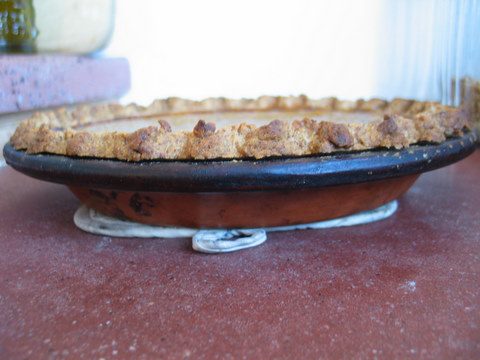
    2. What is a post on Thanksgiving without a pumpkin pie? That’s right. It’s not a Thanksgiving post. Therefore, I shall gift you with my recipe. (You best mind your manners and be thankful.)


    I normally make this recipe from butternut squash, but because I don’t have any butternuts this year, I’m making do with the pumpkins and squashes I pulled from my garden—they serve the purpose just fine (though I think they are a bit more watery).


    My children adore pumpkin pie. Yo-Yo Boy could easily tuck away a half a pie if I let him. And I often do because this recipe makes two pies (one an 8-inch and the other a 9-inch) so there is plenty to go around.

    And besides, I consider this pie to be a breakfast pie; in other words, good enough to eat first off in the morning. It’s mostly made of pumpkin, eggs, and milk, and if you use whole wheat in the crust, it couldn’t get much more nutritious (don’t argue with me about this). (Sure there’s some sugar in the filling, but hey, it’s not all that much—my baked oatmeal recipe uses almost as much sugar.)


    Of course, the pie is very good with a dollop of whipped cream on top, but we reserve that for special occasions. My children are thrilled enough when they hear I’m fixing pumpkin pie—they don’t even miss the whipped cream.


    Pumpkin Pie
    Adapted from The Mennonite Community Cookbook

    Updated, December 2015: Fill one large 9 or 10-inch pie shell with as much pumpkin pie filling as possible. Put the remaining 1-2 cups in a container and freeze. The next time you make pumpkin pies, thaw the leftover filling and then you’ll have enough for two large pies.

    2 cups cooked pumpkin
    1 1/3 cups brown sugar
    2 cups milk, scalded
    4 eggs
    ½ teaspoon salt
    1 ½ tablespoons cornstarch
    1/4 teaspoon ginger
    1/4 teaspoon cloves
    1 1/4 teaspoons cinnamon
    2 unbaked pie shells (8-inch and 9-inch)

    Using a hand-held mixer, blend together the pumpkin, eggs, sugar, and spices. Turn the mixer on low and slowly add the hot milk. Divide the pie filling (it will be very runny) between the two pie shells and bake at 400 degrees for ten minutes. Reduce the oven temperature to 350 degrees and bake for another 25-35 minutes, or until the filling has set and the pie is golden brown and slightly puffy.

    Note: If you don’t want to make two pies, just reduce the milk and pumpkin to 1 1/4 cups each, cut back the sugar to one cup, and keep the other spices the same—you should then have enough filling for one 9-inch pie. (I think.)

  • Feminism: Part Two

    So after the dinner we retired to the lounge for a devotional and then a movie.

    Oh-woman-of-nine-children led the devotional which was pleasant and even somewhat inspirational (this is high praise since modern day devotionals tend to make me angry rather than inspired). She shared her story, how she was a single mother and then got married and had stair-step children (as in one per year). She told of some debilitating illnesses she had experienced (such as one with the quaint name of, get this, “flesh-eating septicemia”) and how she and her husband had come to the decision to be foster parents. I didn’t agree with everything she said, but I appreciated where she was coming from. I respected her.

    But things went downhill when they got the movie out. Oh-woman-of-nine-children was totally thrilled to be showing us the movie. She kept saying that she couldn’t believe that no one had ever taught her this stuff—she had seen the movie for the first time just a couple months before. “We need to be teaching this to our daughters!” she trilled. So all the kitchen staff daughters joined us for the movie and the ensuing conversation.

    I can not imagine, ever, showing that movie to my daughters.

    I don’t remember what the video was called, but it was from the camp of Women Against Feminism and it consisted of two young women, beautiful and stunningly intelligent sisters in their early twenties, speaking at a father-daughter conference about why feminism was wrong and the importance of the father-daughter relationship. I agreed with a part of what they said, I disagreed with another part, and I was sickened by yet another part. I don’t want to go into all the gory details, yet (I feel a Part Three coming on), so this is what I will give you.

    They believe that:
    1. Females are to be under the covering of a man at all times—first their father’s, and then once they get married, their husband’s.
    2. Everything women do is to glorify their fathers/husbands. They are to carry out the vision that the men have. The women may do many different jobs/occupations, but whatever they do needs to further their father’s/husband’s mission.
    3. Women are to be selfless in all ways, gentle, listening, humble, intelligent, courteous, etc. They are also to take good care of their appearance so they are pleasing to look upon and bring honor to their husbands and fathers.
    4. They are to fully support their husbands and fathers, never questioning and challenging, but always helping them obediently.
    5. And so on.

    A discussion time followed the movie. One military wife shared about how in six years of military service she had acquired more medals than her husband had in twelve. She realized this (her success) was hurting him and so she left the military and thus saved her marriage. The ex-military woman said that her mother was a feminist who criticized her husband in front of the ex-military woman. This made Ex-Military Woman sad and upset and she vowed to not talk negatively about her husband in the presence of her children.

    (It is never right to disrespect another person. I did not realize that “feminism” equaled “disrespect for men”. In fact, according to my dictionary [and maybe my dictionary is outdated?] feminism means that men and women are equal. And the word “feminism” also refers to the organized activity surrounding the interests of females.

    So then, by that definition, those young women in the movie were feminists. They said, at one point in their lecture, that their mother was not superior to, but also not inferior to, their father. In other words, equal. [They just had different roles, no?] And they were speaking on behalf of an organization that focuses on the interests of females in a way that they believe makes women more fulfilled and whole.

    “Feminism” has taken on so many connotations that it may be hard to get to the root of the word, but from what I gathered, the speakers were equating “feminism” with the women’s liberation movement, and from what I’ve heard, some of those women in that movement were downright hateful and disrespectful to men. And like I said, it is never okay to be disrespectful and hateful to another human being. Ever.

    Maybe it would be more accurate for the women in the video to refer to their activity and organization as “Feminists Who Love Men”?)

    Another woman said that when she and her husband were first married and both working, she had been bringing home more money than he had. She felt bad about this and apologized to him. He laughed, “Honey, it don’t bother me none. Keep it comin’!” She told us, “Now, eighteen years later, we are no long in the same place as we were then, praise the Lord. It has taken some adjusting for us to get to this place, but now my husband agrees it is for the best.”

    (Wait a minute. But who led you to make that change? Your husband liked it the way things were, so did you force him to change? Were you, a mere woman, in charge of that decision?)

    The same woman later said that when she “comes before her husband—”

    (Eek! Does her living room sport a throne? The only throne in my house is the white enamel kind.)

    —with a question, she words it very carefully because she doesn’t want to sway her husband either way since it is very important for him to make is own decisions.

    (First of all, if I want to talk to my hubby I’m more likely to squawk, “Ho-o-o-ney, get your tight little hiney in here! I gots something I wants to say to you!”

    And second, are men such weak and fragile little creatures that we must tiptoe around them? That they can’t handle a different perspective? That they must be pandered to and babied like a six month old? No-no-no. I respect men way too much for that. Yes, they need to be built up and encouraged and loved and respected. We all do. But I respect men too much to tiptoe around them—they are real, solid, strong people who are big enough to handle differing ideas and opinions without wilting. At least I thought they were.)

    I badly wanted to join the conversation to state my observation that it seemed they were painting men as weak creatures, in dire need of our female protection; that the way they were talking it seemed like they thought women were more powerful than men; that I thought men were much stronger than they were making them out to be.

    But I didn’t say anything. These women were sincere, good women. We had just had wonderful pre-devotional conversation, and as a result I respected them and cared enough about them that I didn’t want to say anything to upset them. This was a time for them to be recharged and encouraged, and it wasn’t my place, nor would it have been appropriate, to antagonize them. So I kept my words to myself.

    Until the next morning when I lectured Mr. Handsome for over an hour about the kind of wife that he was supposed to have.