• Another use for

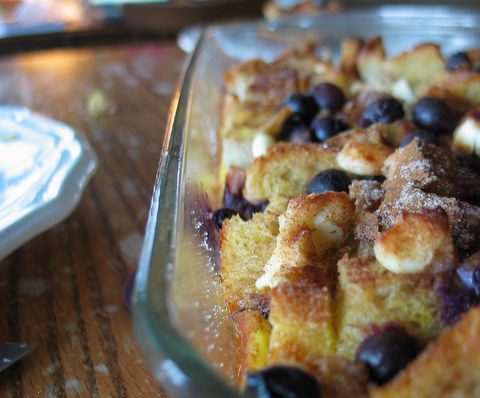
    Okay, here’s another Way-To-Use-Sourdough recipe: Baked French Toast. Of course it wouldn’t have to be made with sourdough bread (it would be really good with a cinnamon-raisin bread), but since I make it with sourdough, it belongs here, on this blog.

    Baked French Toast is kind of like a bread pudding, but much better—more eggy and breadier (I’m afraid that didn’t make much sense since bread pudding is made of eggs and breads, but, oh well), and the top gets crunchy and crusty from the cinnamon-sugar that you sprinkle over it before baking. It’s another one of my favorite breakfast recipes because it requires a soaking period, making it perfect for assembling the night before and then popping it into the oven after you blearily scuffle your way downstairs in the morning. And it’s fancy enough for company. The leftovers are delicious, too, only requiring a brief re-heating in the microwave.


    I have found that it is important not to use more bread than the one pound that the recipe calls for. I have often made the mistake of trying to add extra bread to the recipe, thinking more is better, but in this case it is not. A surplus of bread makes the dish too dry, so don’t do it.


    The original recipe called for an entire eight ounces of cream cheese, but it works fine with just four to six ounces of the cheese. Also, if you want to gussy it up, you can experiment by adding different fruits: fresh cranberries (first simmered in a sugar-water solution) with some orange zest are tasty, as are frozen blueberries (this last time I made three-quarters of the pan with blueberries and one-quarter without, for Yo-Yo). I suspect it would also be good with chopped apples (first sauteed in some butter and sugar), raspberries, dried dates, cherries, or raisins. And you could sprinkle some toasted pecans or walnuts over the top…

    Baked French Toast
    Adapted from The Grand Matriarch

    1 pound stale bread, cubed
    4 ounces cream cheese, in small cubes
    12 eggs, beaten
    1 ½ cups milk
    1/3 cup pure maple syrup
    3 teaspoons sugar
    ½ teaspoons cinnamon

    Mix the sugar and cinnamon and set aside.

    Grease a 9 x 13 pan and place half of the cubed bread on the bottom. Sprinkle half of the cubed cream cheese over the bread. (If the cream cheese is too mushy to chop, set it in the freezer for about fifteen minutes to harden prior to cutting.) Repeat.

    In a separate bowl whisk together the eggs, milk, and maple syrup. Pour over the bread. Tightly cover the casserole and put it in the fridge to soak for 8-24 hours (and I think you could get away with letting it there even longer).

    Right before baking, sprinkle the reserved cinnamon sugar over the casserole. Bake at 350 degrees for 30-40 minutes, until puffy, golden brown, and set (poke it in the middle with a knife to make sure it is no longer runny).

    Serve with maple syrup.

  • Gripping the pages

    If you read my sidebar updates, you know that I was reading Louis Sachar’s Holes to the children. I had read it to myself a year or two ago, but I didn’t consider reading it to the children because I thought it would be over their heads. But then a friend gave it to us for a Christmas present, causing me to reconsider. My brother teaches the book in his middle school English classes, so I called him up to get his opinion on the matter. He thought it over for a minute and then pronounced it a good fit. We had our next read-aloud.

    Once I started reading the book, we couldn’t stop. Or maybe I should say I could not stop. I didn’t even give the kids a chance to beg me to read just one more chapter—I simply plowed right through, ignoring the fact that there even were chapters. Needless to say, the kids were delighted; they found it hilarious that I couldn’t stop. We read the book in just a few days, reading some nights upwards of one-and-a-half hours.

    Holes introduced the children to a new genre of literature. The story isn’t your classic straightforward story, such as Ramona Quimby, Heidi, and Tom Sawyer. It’s a mixture of fairy-tale and real life, drama and mystery. I could practically see the wheels turning in their heads as they struggled to fill in the holes (the book could not be more appropriately titled).

    I found myself gripping the book extra tight during the scary parts and sometimes pausing to silently read ahead because I was too darn impatient. Other times the story line was moving so fast that I had to pause to give myself a chance to catch my breath. At one point Miss Becca Boo had to get up from the sofa and go stand in the doorway to put some distance between herself and the story—it was just too intense for her. However, despite the scare-factor, she adored the book, carting it around with her and showing it to anyone who walked into our house.

    We finished the book about a week ago. I was sorely bummed; what a letdown. After being on that high, I didn’t think there could possibly be anything out there that would be half as interesting to read, so we didn’t read anything—for a whole week. A couple days ago I forced myself to go dig out a book, any book, because we were missing our story time. The kids and I settled on Miss Hickory, which is a respectable book and one that the children enjoy. Even so, it leaves me feeling rather empty and unsatisfied. It’s just not Holes.

  • A premature indulgence

    I never baked a Brie until this past Sunday. I had eaten baked Brie at Christmas parties and on other special occasions, but I had never done one myself. I assumed they cost an outrageous amount of money, and baking one just to learn how seemed rather excessive, like stuffing and roasting a whole turkey just for me.

    But then, just a couple weeks ago, I went to my girlfriend Kris’s birthday potluck. As one of her contributions to the meal she had made a baked Brie topped with her homemade pear chutney and some almonds. Once I ate that, I couldn’t stop thinking about Brie.

    A few days after the party while on my last spend-what-I-want shopping trip, I took my traditional trek through the deli section where I spied some little rounds of Brie nestled cutely on one of the shelves of the little cheese island. The half-pound rounds were small, perfect for just a couple people, and cost four-and-a-half dollars. Hmmm, I thought. Why not? The expiration date wasn’t till spring—it would be the perfect specialty item to hoard, awaiting the time when I could bear it no long and simply had to consume something exotic.

    My plan would’ve worked just fine except that it’s hard to ignore Brie when it’s sitting on the shelf in your refrigerator, because despite the fact that it’s small and dainty and unobtrusive, it has a commanding presence. Come to think of it, anything with a high concentration of cream is virtually impossible to ignore, no matter where you hide it in the fridge.


    That’s how I found myself, just a week into our spending freeze (if I can’t make it more than a week without special eats, I’m going to be a basket case after the next couple months) calling up my brother and his wife and inviting them over for a Sunday evening dinner of snacky foods. There would be bean dip and tortilla chips, I promised, as well as fresh bread and Brie. They said they would come.

    So on Sunday afternoon I began the ceremonial act of preparing a Brie. I’m not joking when I say it’s a ceremonial act. It is. Try it for yourself if you don’t believe me. There is something pure about a Brie—all that soft white creaminess, molded into a chaste little round, encased in its exquisite downy-soft paper. So unassuming, but yet so complex. Handling such a delicate cheese, I discovered, makes you feel kind of elevated and clean; therefore, it is an appropriate activity for a Sunday afternoon.

    First, I removed the cheese from its box and set it in the pie plate. I had to pause in my cheese prepping ritual to call up Kris. “What do I do with this paper stuff that’s all over the cheese? Do I cut it off?” I asked.

    “Oh no! It’s all good,” she said. “You can eat the whole thing.”

    “Oh. Okay. Well, that’s good,” I said. It certainly couldn’t get much easier, I thought as I hung up the phone.

    Second, third, and fourth, I caramelized an onion and mounded it over the cheese, drizzled apricot preserves over the onion, and then baked the Brie. I also toasted a few slivered almonds and sprinkled those over the cheese immediately before serving.


    I do not have a picture of the finished Brie in all it’s gooey glory because it was already dark when the cheese was finally ready to eat and I’m afraid of taking pictures at night—that’s something I do not know how to do. Besides, I was stuck with a kind of single-mindedness once the cheese came out of the oven: Cheese is ready; eat cheese now.

    I ignored the other foods that we had for supper, opting instead to feast on the ethereal blobs of creamy cheese. I slathered it on my bread, delightedly snatching the bread crusts that my kids rejected (they were shocked, accustomed as they are to the standard rule of You Must Eat Your Crusts Period), using them to scoop up more of the onion-y, nutty cheese. Oh, it was divine! Food for the gods. Blissssss.

    The Brie served it’s purpose, albeit a bit prematurely, of numbing the slight sense of deprivation I had been experiencing. For the entire course of that meal and several hours afterwards, I felt spoiled, contented, and filthy rich. A little sad, too, because the cheese was gone. But mostly I felt smug—I had learned that I can, in a snap, turn out something that is simultaneously wickedly delicious and simply divine. And that, my dears, is quite comforting.

    Baked Brie
    Adapted from recipes I read on Epicurious, as well as from talking with my girlfriend Kris

    A small round of Brie, about 8 ounces
    one medium onion, quartered and thinly sliced
    1 tablespoon butter
    salt
    2 tablespoons apricot preserves
    2 tablespoons slivered almonds, toasted

    Remove the Brie from its box and wrapper and set it in a pie plate, indented side up.

    In a medium-sized skillet on medium heat, fry the onion with the butter and a sprinkling of salt until the onion is dark golden brown, about 30 minutes. Pile the onions on top of the cheese.

    Drizzle the apricot preserves over the onions. (To make thick preserves more drizzle-able, heat them in the microwave for a few seconds.)

    Bake the Brie at 350 degrees for 20-30 minutes, or until it looks relaxed and a little bubbly. Don’t be alarmed if the cheese oozes out and puddles on the plate—it will all taste good.

    Before serving, sprinkle the almonds on top. Eat while still warm.