The other day I made a Fat Cow Cheese that bombed. Or I thought it bombed, anyway.

Up until pressing it was spectacular, but then the rind stuck to the cheesecloth and the cheese was all firm on the outside and jiggly on the inside and I was convinced it was full of trapped whey that was going to make the cheese rot from the inside out.


So that evening I took it out of the press, plopped it into a bowl and then tore it into pieces while every fiber in my body screamed at me to stop. I salted it — I’d decided to forgo the planned-for brining — and popped it back in the press.
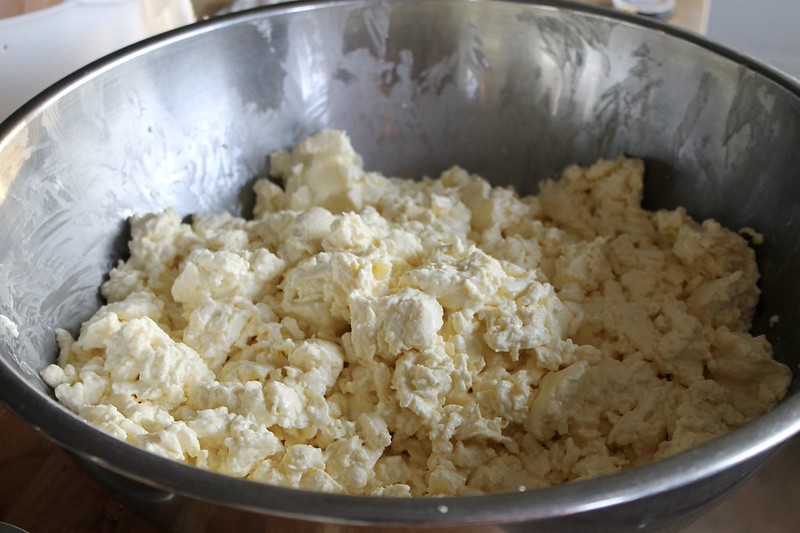
This time the whey was like creamy milk so now I was losing the good stuff on top of everything else. I went to bed then, but I was so worried that when I woke up in the middle of the night I couldn’t go back to sleep for a couple hours for thinking about it.

(In the dark of night I attempted to rationalize myself back to sleep by reminding myself of a piece of advice from LaNae Williams that I’d read in the NY Times: If there is an issue bothering me, I think to myself, “Will this still be an issue in one week or in one month?” If the answer is no, it’s a small problem so I let the stress go and move on. I told myself that, not only would this cheese problem not matter in a couple days, but I’d probaby have learned something from it and, in retrospect, be grateful for it, but — no dice. Still couldn’t sleep.)
By the next afternoon when I pulled the cheese from the press, the curds appeared well-knitted and I felt a surge of hope. It still felt super tender in the center so, thinking there might still be excess whey in there, I dry salted the top of the cheese and then set it out to air dry.

And then it started cracking.

Not the little hairline cracks that sometimes appear, but deep, innard-revealing chasms that — in the middle of the night, sigh — had me convinced once again, that the cheese was rotting, but this time from the outside in, since all kinds of bad bacteria were surely infiltrating the cheese through the gaping crevices.

The cheese itself still felt super soft on the inside. It was unstable, which made me afraid it would fall apart when I flipped it. That night, worried it might slump down into a big puddle on the table, I tied a cheese cloth around the sides of it to short it up, kinda like a belt.
The next day I had to vac-pack it which meant I had to cut it in half. Finally I’d see the inside. And . . .

It was beautiful! Well-pressed, sweet-smelling, creamy. I was thrilled — and immensely relieved.
And THEN [drumroll] . . . the night before, an idea had popped into my head: might the cheese make a good mozzarella? See, there are two main kinds of methods for making mozzarella — the fast version (here and here) and then a slower, cultured version which I’ve tried but, because I lack a pH meter, hasn’t worked. But this cheese was fully cultured, and then some. Why not crumble a chunk into pieces, pop it into the microwave, and try to stretch it?

People, it worked. Not only did it stretch beautifully but, fully salted and with all that culturing, it was the most wonderfully delicious, flavorful mozzarella I have ever, EVER tasted.

Normally when microwaving mozzarella curds, lots of whey is expressed and lost, but these curds retailed all of their fat. There wasn’t a drop of anything left in the bowl! (I didn’t cut off the rind so the mozzarella wasn’t completely smooth, but I didn’t care. It was still delicious.)

In the end, I made one half of the cheese into (what I’m calling) my Signature Fat Cow Mozzarella and then vac-packed and froze it, and the other half I vac-packed for aging. I think as it ages the rind will soften and the paste will stabilize and it will probably be just like the first Fat Cow I made, though maybe more crumbly because I milled in the salt. We’ll see!
Note: when making the mozzarella, I overheated one batch of the curds and then it refused to stretch. I glopped it into a container and now that it’s chilled it has the texture of a firmer cream cheese.

To eat it, we dig out blobs and add them to calzones, pasta, mac and cheese, whatever — it’s freaking delicious. (I gave my older daughter a taste of it when it was warm and the texture of ricotta, and she promptly scooped a whole spoonful onto her plate and ate it with her breakfast.)
So there you go, friends: yet one more valuable lesson from The School of Cheese. But Jennifer, you say, was it worth a few hours of lost sleep?

Oh yes, most definitely.
This same time, years previously: five fun things, 6.4 magnitude, the Baer family gathering of 2019, boys in beds, homemade lard, the quotidian (1.11.16), the quotidian (1.12.15), what we ate for lunch, crumbs.