• timpano!

    Years ago, my husband and I watched Big Night: fighting brothers, Italian accents, FOOD. I swooned the whole way through. The crowning glory of the movie, culinarily speaking, is the fancy dinner the brothers make to save their restaurant. (But, emotionally speaking, the scrambled egg breakfast scene stole my heart.)
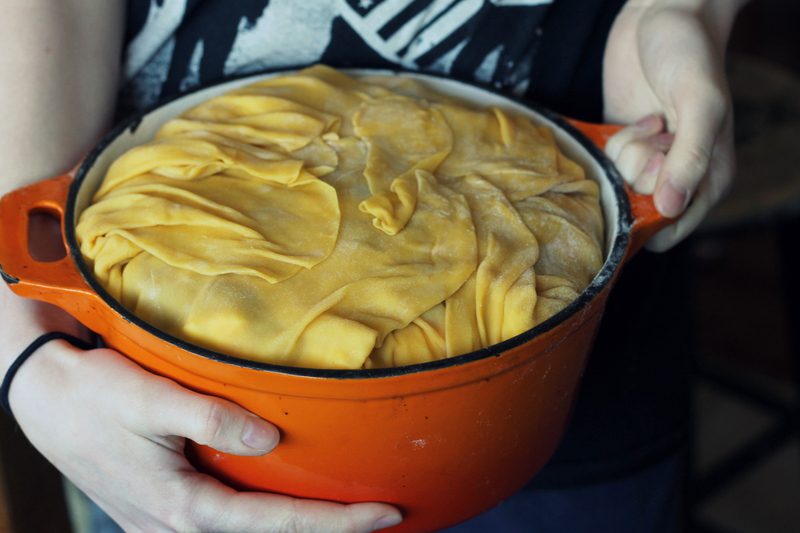
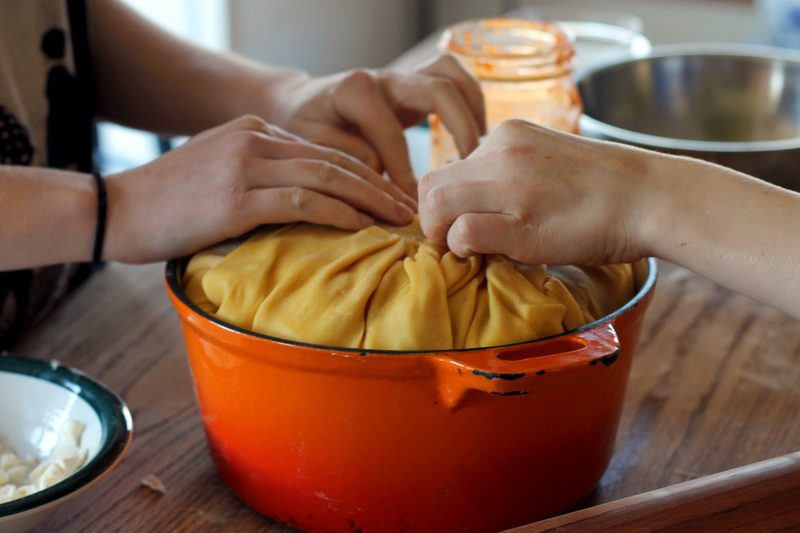
    For their big-bang meal, the brothers serve timpano (warning: language), an over-the-top cross between a lasagna, quiche, and empanada … whatever. Basically, just line a deep baking dish with a huge sheet of homemade pasta dough and stuff it with “all of the most important things in the world”—meatballs, hard boiled eggs, pasta, cheeses, ragù, Genoa salami—and then fold the pasta over the top to seal everything up tight and bake it in the oven.
    Ever since watching that movie, timpano has been on my mental to-make list. I don’t know why I waited so long or what it was that flipped the recipe to the forefront of my mind, but in any case, a few weeks back, I made it. To prepare for The Food Event, I watched the movie clip several times (really, I could watch it over and over…and I do), read articles and recipes, and sat through a couple youtube videos. I jotted down my plan and assembled ingredients. And wouldn’t you know, once the leg work was done, the actual making wasn’t all that difficult.
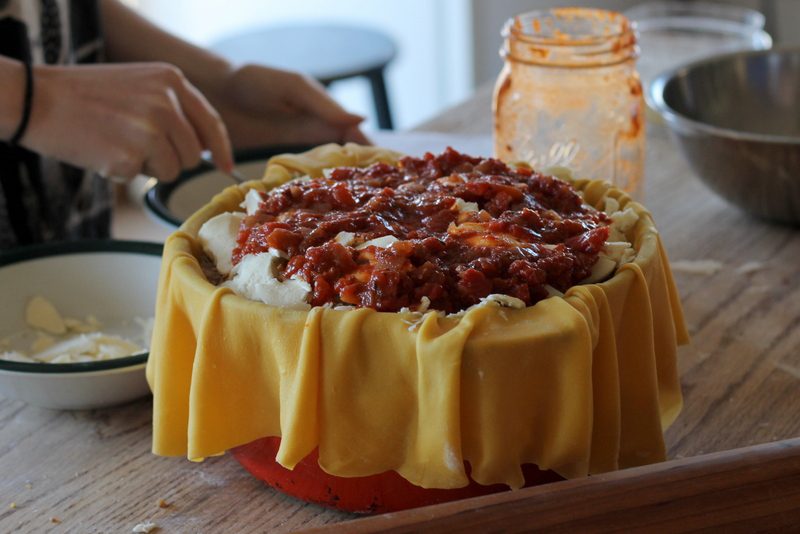
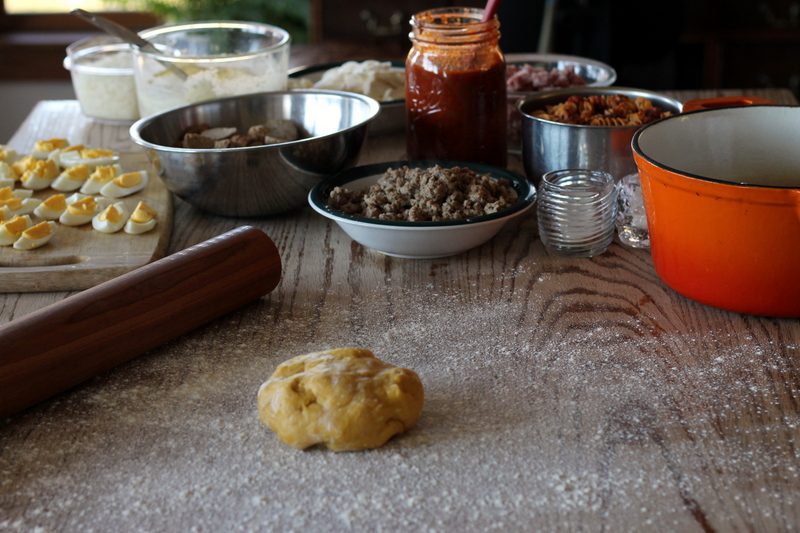
    In the movie, the brothers make everything from scratch: the meatballs, ragù, and pasta. But for my version, I took shortcuts. For the ragù, I used a quart of my homecanned red wine tomato sauce mixed with a pint of roasted tomato and garlic pizza sauce. I skipped the homemade pasta in favor of purchased (duh), and I used Costco meatballs. The other prep was mindless: chopping up the fresh mozzarella and Genoa salami, mixing the ricotta with an egg and herbs, boiling the eggs and pasta, frying some ground sausage.
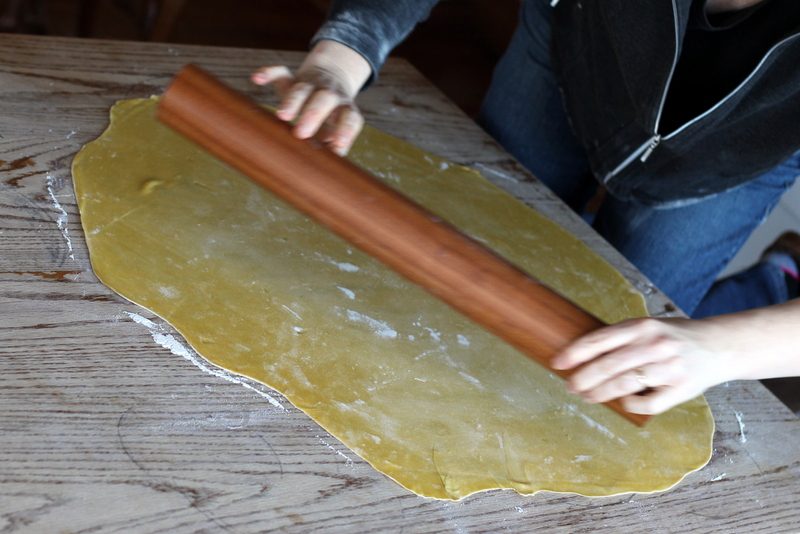
    I was a little worried about the big sheet of pasta dough, but I needn’t have been. It handled just like in the movie, thin and not at all tricky. In fact, it felt as solid and pliable as a piece of fabric. I wasn’t sold on the flavor, however. Kind of tough and bland. Next time I’ll increase the salt (my adjusted amount is reflected in the recipe below) and heavily smear the pot with butter to give more flavor.
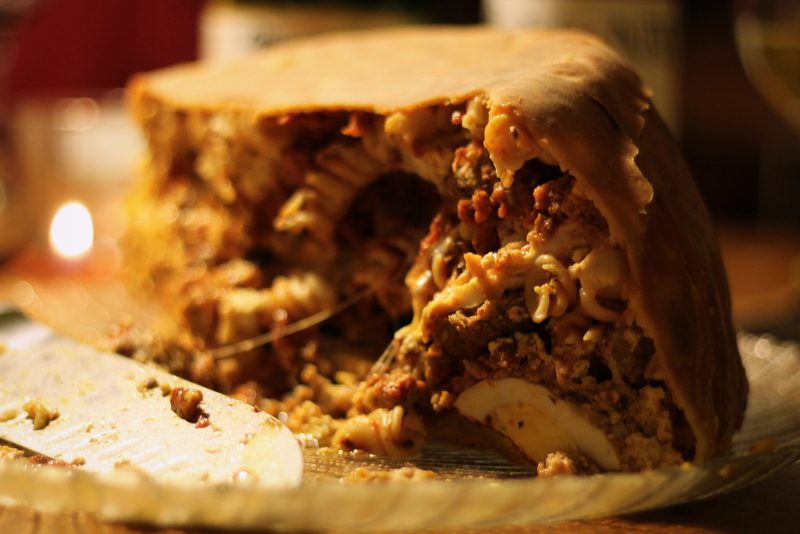
    The timpano was, of course, a hit. How could it not be?
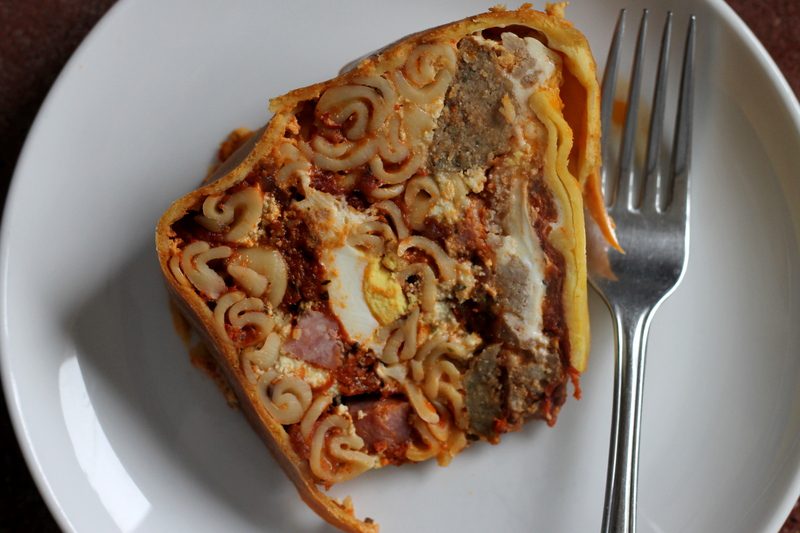
    in better lighting: the leftovers

    Timpano! 
    Adapted from everywhere.

    My homemade sauce/ragù was a little watery—make sure yours is thick. Once the timpano is in the oven, you have about two and a half hours of not doing anything which means this a great dish to serve for company or take to a potluck.

    To watch: Making Timpano on Youtube.

    For the filling:
    4-6 cups of ragù
    ½ pound curly-cue or ziti pasta, cooked and then mixed with 2 cups of ragù
    6 hard boiled eggs, quartered lengthwise
    1 pound fresh mozzarella, sliced
    2 cups freshly grated Parmesan cheese
    1 pound (maybe more) meatballs, quartered
    ½ pound Genoa salami, cut into small chunks
    1 pound bulk sausage, cooked
    2 cups ricotta mixed with 1 egg, 2 teaspoons dried basil, and a dash of freshly ground nutmeg
    3 eggs, beaten

    For the pasta crust:
    2 cups flour
    ¾ teaspoon salt
    3 eggs
    1 tablespoon olive oil
    several tablespoons water, as needed

    Put the flour, salt, oil, eggs, and 2 tablespoons water in a stand mixer and mix on medium (or mix by hand). Add more water as needed, until the dough forms a fairly stiff ball. Cover dough with plastic and let rest at room temperature for 1 hour.

    To assemble:
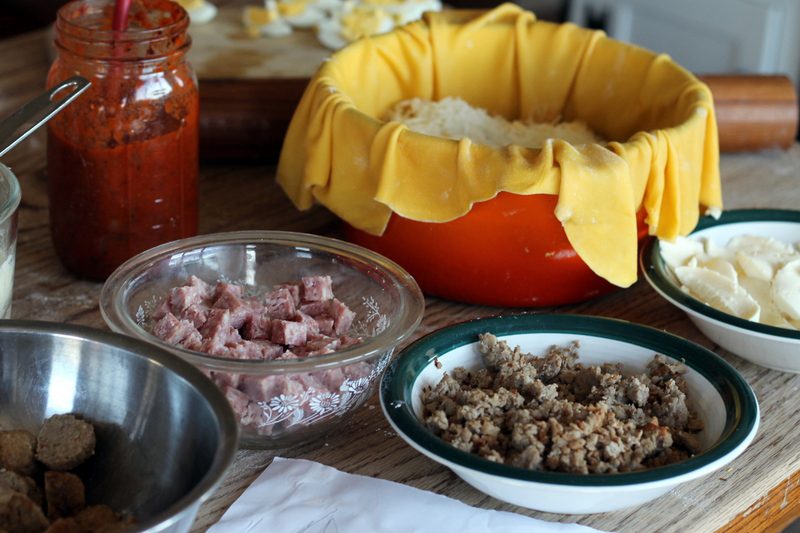
    Sprinkle the counter with flour and roll the pasta into a 26-inch round. Generously grease a deep baking dish with butter and line it with the pasta, letting the extra pasta hang over the edge of the dish.

    Put half of the pasta in the bottom of the dish. Spread it with half the ragù and ricotta mixture, then half the chopped salami and eggs, half the mozzarella and meatballs, and half the sausage and Parmesan. (Actually, after the base of pasta and sauce, it doesn’t really matter in what order you layer the fillings. Make up your own system.) Using the remaining ingredients, repeat the layers. Pour in the beaten eggs and fold the sheet of pasta up over the top to create a lid. Brush the overlapping sheets of pasta with water to stick them to each other.

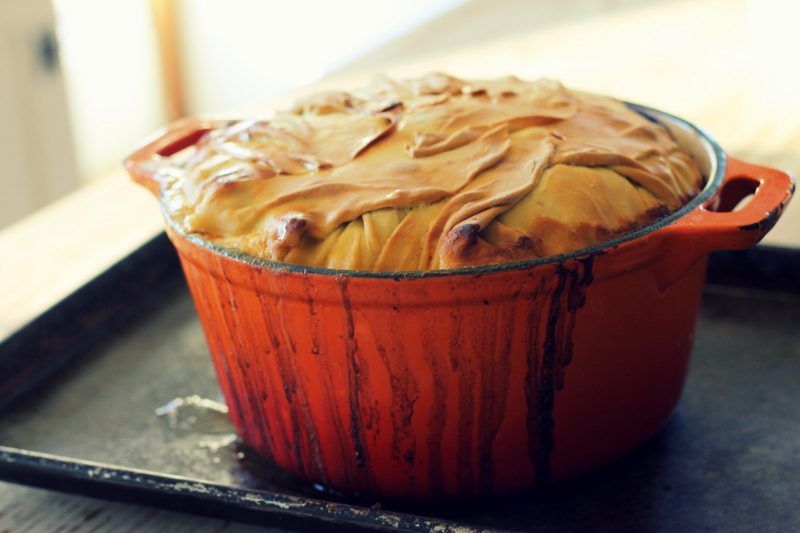
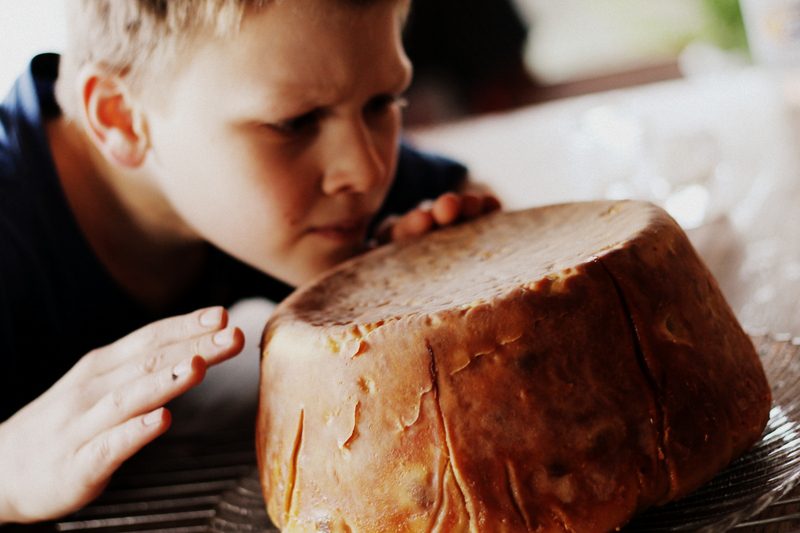
    Bake the timpano, uncovered, for about 1 hour at 350 degrees. If the timpano is getting too dark, cover it with foil or a lid. If it starts to bubble over, place the pan on a sided baking sheet. Bake another half hour. Remove the timpano from the oven and let sit undisturbed for 30 minutes. During this rest, the timpano will contract slightly. It should not stick to the pan. After the time is up, run a knife around the edge (just to be sure) and invert the timpano onto a serving platter. Let the timpano rest for another 30 minutes (so the fillings don’t ooze out when you cut into it) before serving.

    This same time, years previous: cheesy bacon toasts, chocolate mint chip cookies, seven, gourmet chocolate bark, on babies, and potatoes with roasted garlic vinaigrette.

  • loss

    Two weeks ago, my older daughter’s riding instructor, Leslie, went to the hospital with heart problems. On Saturday morning we learned that things didn’t look good. A few hours later, just when the blizzard was winding down, my daughter got the phone call that Leslie had died.

    in limbo, before the sad news

    The grief was tidal, a flood of tears and then, when they subsided, a flurry of phone calls and the scrambling to pitch in and help. There was a farm to take care of, after all, and a couple feet of snow to complicate things.

    Leslie’s sudden death triggered a rapid chain of events, jarring in their finality. Almost immediately, the farm started shutting down. Horses have been sold and relocated, Leslie’s dog went to a new home, tack is being sold. Soon Buttons, an old horse that Leslie couldn’t bear to part with, will be put to sleep and my daughter will be there for the procedure. Throughout everything, my daughter has stayed involved, mucking stalls, finding homes for the animals, snacking on the leftovers from the funeral meal, sorting and cleaning, and connecting with the other workers. There is healing in the closure.
     

    The day after the memorial service, one of Leslie’s sisters invited my daughter and her friend, up from South Carolina for the funeral, to the farm to pick out some things to remember Leslie by. My daughter came home with a framed picture of a horse (of course), one of Leslie’s t-shirts, and a pair of her old riding boots. The boots are tight but she wears them anyway.

    All too abruptly, my daughter lost a job, instructor, and dedicated cheerleader. She’s handling Leslie’s death well—so well, in fact, that I sometimes wonder if I’m feeling the loss more intensely than she is. From my vantage point, I see the big picture, can weigh just how much has been dashed. Through their shared love for horses, Leslie met a need in my daughter that my husband and I never will. Leslie respected and nurtured my daughter’s interests in ways I can’t, simply because I don’t understand that part of my daughter’s world. At the farm, with Leslie, there was such potential. And now it’s over. This is what hurts me most.

    in the very beginning

    For months, my daughter’s Mondays and Thursdays have been spent at the farm. Tomorrow is her last official day of work; all the horses should be gone by the weekend. New good things will come—already are, in fact—but for now, whenever I drive by the farm I get a twinge of sad. Leslie and her farm were such a gift to my daughter. All of us feel the hole.

    This same time, years previous: a Wednesday list, itchy in my skin, in which we enroll our children in school, travel tips, the perfect classic cheesecake, ice cream cake, and lemon tart.

  • object of terror

    When my younger brother was in high school, he did a sculpture of my older son (then just a toddler) for his art class. Eventually, he passed it on to us. Normally the bald-headed baby sits buried in a closet, but every now and then it rears its head (ha), appearing unexpectedly on someone’s pillow or as a prop for some imagined play. Lately, it’s taken up residence on my older son’s dresser.

    Last week, my younger kids set the bust on a stool, plopped a wig, sunglasses, and headphones on his bald head, and turned him into a punk-rock chorister, Christmas caroler, or something.

    Then they moved on to some other game and left the bust standing in the middle of the floor. When my older son walked into his room a few hours later, his marbled mini-me gave him quite a start.

    That evening while my older son was at his EMT class and the rest of us were downstairs, my older daughter went upstairs to get a shower. A couple seconds later, we heard an ear-splitting scream, followed by running footsteps and loud gasping breaths.

    Ha, I thought. She must have found the bust.

    But then I realized the gasps weren’t laughter, but racking sobs. What in the world? Had my son crossed the line and created some grisly scene? I tore upstairs, pissed off in advance. At the top, my daughter was wailing, hands over her face, shoulders heaving.

    “The shower,” she sobbed. “Behind the curtain.”

    I gave her a quick hug before stomping down the hall to investigate. Senses tingling, I pulled aside the shower curtain.

    Oh  good grief. No wonder! Not one bit grisly, sure, but deeply disturbing nonetheless. The statue was terrifying in its innocence. How perfectly, delightfully creepy.

    Back to my daughter I went. I wrapped my arms around her, buried my face in her hair, and exploded with laughter.

    “I’m sorry I’m laughing.” I could barely choke out the words. “But, oh, honey, he got you good.”

    My daughter cried for another couple minutes, but then her shoulders started to tremble—her sobs were turning to giggles.

    “I thought it was an alien and it was going to kill me!”

    The bust has now been relocated to our bedroom floor and the children have been strictly forbidden from playing with it. My son’s creativity may have been highly entertaining once, but I think that was enough trauma-humor to last us a good while.

    This same time, years previous: the quotidian (2.2.15), wheat berry salad, and moldy beans.