• Advice, please

    I’m in a pickle over my Nicaraguan red beans. Today when I opened the tin to scoop some out to clean, wash and cook for supper, they smelled like mold. I didn’t think too much about it since a cloud of earthy moldiness lingers about them at all times anyway. But after cooking them up, they tasted of mold. I don’t think each of the individual beans were tainted since some fork-fulls tasted fine, but there were enough of them in a compromised state that the cooked beans all together in the pot gave off an unappetizing aroma.

    Pre-supper, and post-feeding The Baby Nickel a snack of the questionable beans, I scoured the web, in my slow dial-up way, trying to answer the question of Is it dangerous to eat moldy dried beans, and What to do if your dried beans smell moldy, but I came up empty-handed.

    So we ate the beans for supper. I heaped on the salsa and sour cream, and then I had another helping—they weren’t too bad. The kids didn’t say a word them, and I certainly didn’t make any mention of the problem, but Mr. Handsome noticed the odd flavor. He ate them anyway, of course, having to set a good example for the chillens. And besides, I had decided that if we’re going to die, we’re all going to die together.

    But now I don’t know what to do. Save the beans? Chuck them? I still have fifteen to twenty pounds of these used-to-be gorgeous beans. And they still are gorgeous; I can see no signs of mold on them at all—they just taste of mold. I had neglected to put aside some of the beans for next year’s seed, so I picked over another quart of beans and now they’re sitting on the counter, ready to be run down cellar to the freezer. The beans will be okay as seed, won’t they?

    Ach, I don’t know what to do! Would you (yes, you!) stoop to help me in my distressful time of need? Pretty please? Below I’ve listed some options that should simplify your role of advice-giver. Just leave a comment, with the letter that best aligns with your thoughts on the matter, plus any clarifying remarks. I’d be most obliged.

    ***

    Please select one of the following:

    A. It is Super Dangerous to eat those beans! I can’t believe you ate them for supper. By ten o’clock tonight you will all be puking your guts out, mark my words.

    B. Eh, you’ll probably be just fine as long as you wash them well and cook them for the full amount of time. Toss in some jalapenos to counter the moldy flavor. (You might want to refrain serving them to any dinner guests, though.)

    C. You could probably remedy the fix by rinsing them in a bleach-water solution and then re-drying them.

    D. What are you thinking! Bleach your beans?! No-no-no, Honey. All you need to do is lay them out on brown bags by the wood stove to re-dry. So simple, really. (Bleach! My goodness, I still can not believe it.)

    E. Excuse me, but I disagree with “C” and “D”. It’s obviously a hopeless case—once your beans taste of mold, they will always taste of mold. You won’t get sick, but you won’t want to eat them either. The moldiness will just intensify over the next weeks and months. Soon your house will smell of mold. And then you’ll notice little fuzzy, black patches on your clothes and on your un-polyurethaned window trim—signs that the mold is taking over your house completely. The situation will shortly become dire. Not good, no, not good at all.

    F. Do not plant moldy-tasting beans because the resulting plants will spread disease and destruction to the entire garden. You must put on your to-do list: fly to Nicaragua to get new beans ASAP.

    G. The answer to your problem is so totally, like, duh, obvious; I can’t believe you didn’t know this already. What you need to do is ___________.

  • Biscotti: part two

    This was my first successful biscotti recipe; it’s one that I have been making for a good three or four years, at least.


    The recipe is scrawled on the bottom of a jaggedly-torn piece of paper, both back and front of which are covered with biscotti recipes. None of them were any good, except for this one. Actually, it can’t really be called a recipe because all I have written down is:

    Orange
    1 T. grated orange rind (more?)

    dried cranberries?

    I can tell, for no other reason than just because I can, that I’m supposed to follow the above recipe for Anise Biscotti, which I made the other day and accidentally left out half of the sugar, which caused the biscotti to end up tasting like that sand-coated popsicle stick I spoke of earlier, which, by the way, I have never tasted (the sandy popsicle stick, not the biscotti), which— Okay! I’ll stop!

    Um, where was I? Oh yes. The non-sandy biscotti.


    In this recipe, the classic combination of orange and cranberry won me over from the get-go. The dried cranberries add a sweet-tart chew that compliments and counters the citrus-y dryness. Mr. Handsome, not one to fawn over biscotti or any other dry Italian cookie, thoroughly appreciates this one. So, without further ado, I present to you…

    Orange-Cranberry Biscotti
    From my recipe file, kind of miraculously deciphered from my cryptic chicken-scratch

    1 cup sugar
    ½ cup butter
    2-3 tablespoons orange zest
    2 eggs
    3 ½ cups flour
    1 teaspoon baking powder
    ½ teaspoon salt
    ½ cup dried cranberries

    Beat together the sugar and butter. Add the eggs and orange zest and beat some more. Mix in the flour, baking powder, and salt. Stir in the dried cranberries.

    Divide the dough into two parts and on an ungreased cookie sheet shape each half into a log, approximately three inches wide and ten inches long. Bake the logs at 350 degrees for 25-30 minutes, cool for 10-15 minutes, slice, and re-bake, this time at 325 degrees for 15-30 minutes, turning once. (For more thorough biscotti-baking instructions, go here.)

    Store in an airtight jar.

  • Suiting my tastes

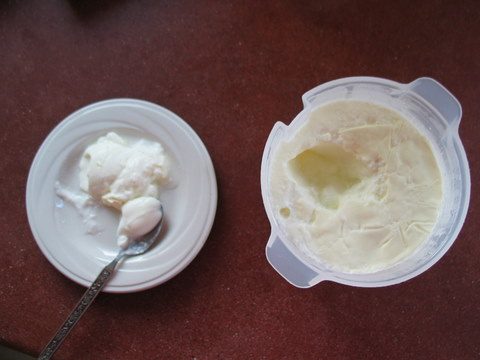
    I love whole-milk Stonyfield yogurt, the kind that has the thick layer of cream on top. It tastes like candy, not even needing any jam to sweeten it.

    On the other hand, my homemade yogurt is tangy-tart, almost too much so for my tastes. The rest of the family loves it, not seeming to mind its strong flavor, but I have to add an extra scoop of jam if I want to enjoy it.

    I’ve had a niggling idea that I could replicate the Stonyfield version, but for some unclear reason I just never attempted to. Until a couple days ago when, instead of measuring out the standard four cups of milk, I replaced a half cup of so of the milk with cream from the quart jar that sits on the top shelf of the fridge. I proceeded with my normal yogurt-making routine, the only change being that I occasionally stirred the milk as it cooled in order to prevent the cream from rising to the top and creating a gummy skin—I wanted the cream to be as incorporated into the milk as possible.


    The final product was an altogether different animal from my standard yogurt—satiny, rich, mellow. It set up faster, tasted less acidic, and even had a little layer of cream on top (though not as defined as the layer in the Stonyfield containers). I labeled the container “creamy” and then stored it off to one side in the fridge, reserving it for my consumption only. I’ve been eating it for my breakfasts (feeding French toast, eggs, or oatmeal to everyone else) and for my bedtime snack.


    I made another container yesterday and now I’m wondering how it would turn out if I used one part cream to three parts milk. Is it possible to create a yogurt that is even better than Stonyfield’s? Is it possible to use too much cream?

    The milk/cream mixture is heating up as I type these words and in a few short hours I will determine whether or not I am to become Stonyfield’s next stiff competitor. To be continued…

    (Yikes! I was so absorbed in wording that last sentence that my milk/cream boiled over!)