• banoffee pie

    When the cousins were here, we had pie three days in a row. At the start of the week, I knocked out three graham cracker crusts, wrapped them in plastic, and stashed them in the jelly cupboard. The first day I made a key lime pie. The second, a German cheesecake. And the third, a banoffee pie. [takes sweeping bow] My family thought they’d died and gone to heaven.

    Banoffee pie — a mashup of bananas and toffee — originated in Britain (I think) and is enormously popular, from what I’ve read. I’ve been wanting to try one for years (seriously!), and since I’d made a large batch of dulce de leche that week, and we had a bunch of ripe bananas on the counter and that final crust in the cupboard, that’s exactly what I did.

    The recipe was so simple — graham cracker crust, dulce de leche, bananas, whipped cream — that it felt trashy. I read it a bunch of times to make sure I wasn’t missing something, and then I read a bunch of other recipes, too, just to double check (and to familiarize myself with all comments and potential variations).

    I was skeptical that anyone would like it, but I was wrong. The pie might be kinda low-brow — kinda like the classic banana pudding (that I loved) — but hey, not all pies need to be intimidating. And banoffee pie can be as classed-up as you like, what with homemade whipped cream, raw milk dulce, and, if you’re feeling righteously industrious, homemade graham crackers — or not!

    Either way, it’s pie and people will gobble it. 

    Banoffee Pie

    Most instructions say to assemble the pie immediately before eating, but some people say it’s better on day two. The bananas will brown a little, but they also kinda meld into the dulce so it’s not terrible — just be sure to cover them well with the whipped cream to slow the oxidation. 

    Lots of recipes call for 2 cups (cans) of dulce and only 2 bananas. However, I scaled back the dulce by half (it’s so sweet) and double the bananas. 

    Variations I’ve considered but haven’t yet tried include 1) caramelizing the bananas, 2) adding rum to the whipped cream, or to the dulce, 3) using cocoa powder in place of grated chocolate, 4) putting a thin layer of chocolate ganache on the bottom of the crust before adding the dulce, 5) using a coconuty shortbread instead of grahams for the crust — and so on. Flavors that keep popping into mind include coconut, pecans, pineapples. Mess around!

    1 9-inch parbaked graham cracker crust (see below)
    1-2 cups dulce de leche
    3-4 bananas, perfectly ripe and without any spots
    2-3 cups sour cream whip (see below)
    grated chocolate, optional

    to assemble:
    Spread the dulce de leche over the bottom of the crust. Slice the bananas and arrange over the dulce. Top with the sour cream whip, making sure to completely cover the bananas. Flurry the top with freshly-grated semi-sweet chocolate. Refrigerate.

    for the graham cracker crust:
    1½ cups (150 grams) graham cracker crumbs
    1 tablespoon white sugar
    1 pinch salt
    3-4 tablespoons butter, melted

    Stir together the graham cracker crumbs, sugar, and salt. Add the melted butter. The crumbs should hold together when firmly fisted but not be so saturated that butter oozes out. Press the crumbs into a 9-inch pie shell and up the sides — use a metal cup, if you like. Bake the crust at 350 degrees for 10 minutes. Cooled crusts can be wrapped in plastic and stored at room temperature for several days, or frozen for longer storage.

    for the sour cream whip:
    2 cups heavy cream 
    1 teaspoon vanilla
    1 tablespoon sour cream
    2 tablespoons 10x sugar

    Combine all ingredients in a mixer and beat on high until soft to medium peaks form. 

    This same time, years previous: ricotta pancakes, how we homeschool: Milva, Samin’s soy-braised beef short ribs, what kind of stove should we buy, the quotidian (1.25.16), the quotidian (1.26.15), first day of classes, housekeeping, thoughts, gripping the pages.

  • two worlds in one week

    A few days after my older daughter moved moved back into our house (temporarily), my out-of-state brother’s three kids who are ages 4, 7, and 9 came to stay with us for a little over a week and just like that I went from having two fairly-independent children at home to six, three of which required full-time supervision, and was plunged back into the world of bedtime stories, snack-times, potty-training, communal bathing, and early-morning wake-ups. 

    Except it wasn’t exactly like it was when my kids were little because, this time around, I had three older kids to shoulder (an enormous portion of) the load.

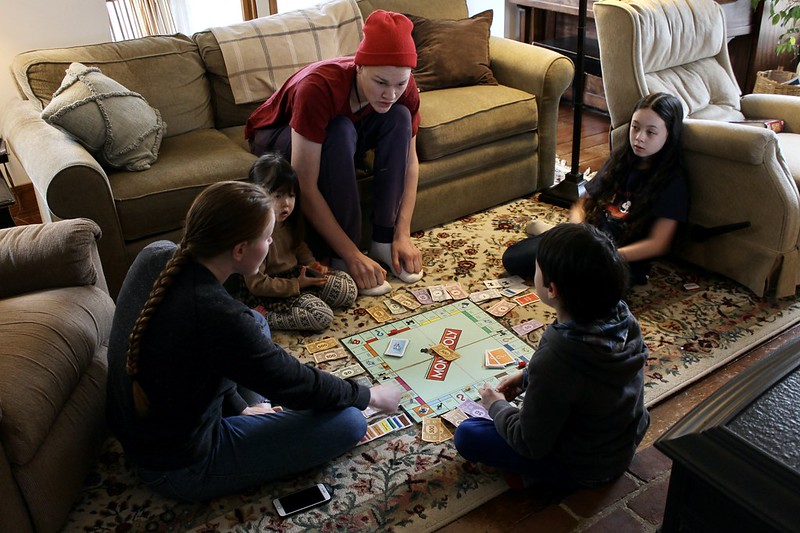
    My younger daughter managed bathtime and hair brushing. My older daughter supervised Monopoly sessions (and mediated the fallout).

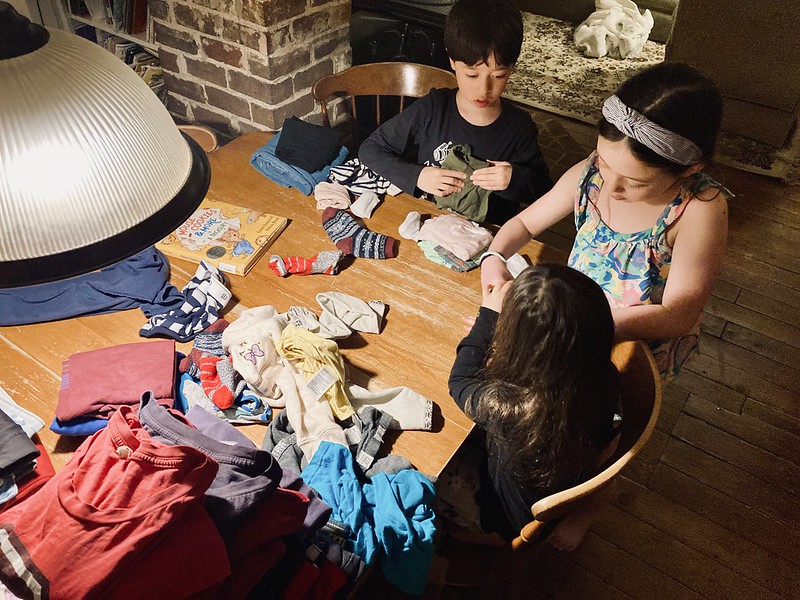
    All of my kids took on the job of “chore coach,” teaching their cousins the ropes of dish washing, collecting trash, bringing in firewood, folding laundry and so on, and then shadowing the kids as they began to do the jobs themselves. 

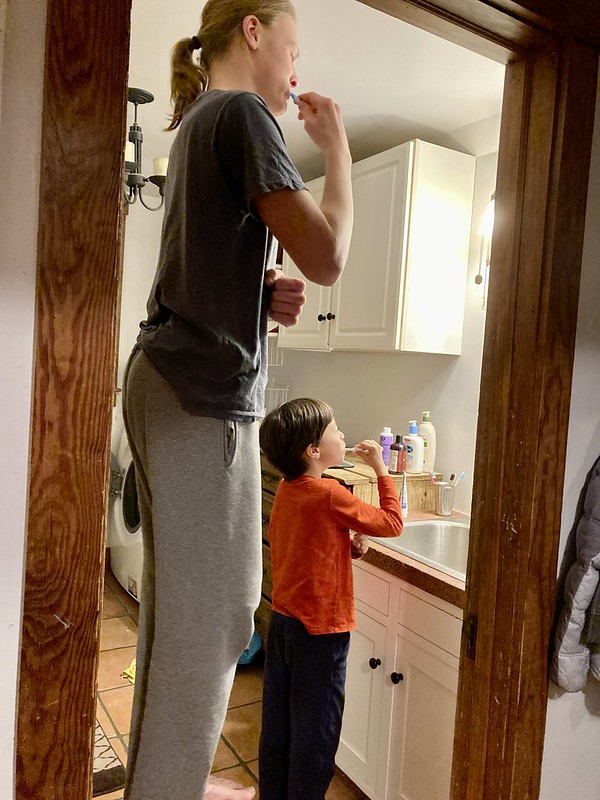
    not visible: the footstool my son is standing on

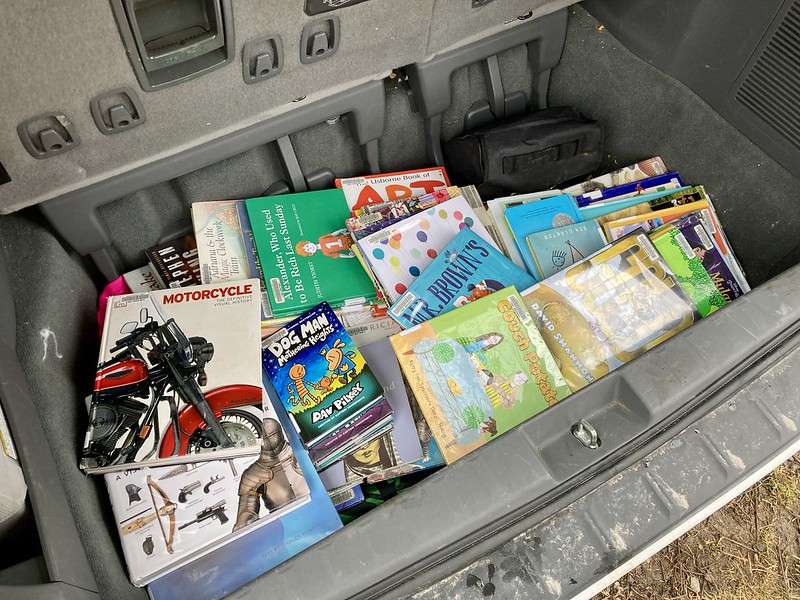
    We made excursions to Costco and Magpie (to get mini vanilla braids and to see the kitchen where my younger daughter was working), and to the library to stock up on books.

    78 books (the kids counted)

    Nearly every day, the littles left for several hours to go play at their cousins’ or my parents’ house, or the cousins came here, and one day my older son and daughter-in-law took them on a special outing to the children’s museum and then out for pizza. 

    And then almost as abruptly as it began, the whirlwind ground to a halt. My older daughter moved out on Saturday and the next day the three littles went back to their home — and I felt… I don’t know. Adrift? Relieved, definitely. Also, bereft. I was so glad to have my house back again, the burden of needy littles lifted, and yet —

    And yet.

    As my kids have grown and our family has moved from one stage to the next, the earlier stages fade. I’ve felt sad every now and then, sure, but since the changes were incremental — reasonable, wanted I could handle them, often not even noticing what I was losing. But for that one week that my brother’s kids were here, I was back in the thick of it again (which I always kinda hated but also sorta really loved because I thrive on chaos and adore all the organization, bossing, crisis management, cooking, and hands-on, in-the-moment work that goes with running a full house). 

    But this time my older kids were involved. We were all working together, rallying around these curious and cuddly children, and then the cousins left and we all went back to being our own people doing our own things, sometimes together but mostly independently as it should be and as I want it to be, but that bizarre mashup of two totally different life stages juxtaposed like that — young adult kids with the wee ones — reminded me of just how much I’ve lost and how grateful I am not to be doing that anymore and how much I miss it.

    Especially feeding people. That part might be my favorite.

    This same time, years previous: a week in cheese, the quotidian (1.24.22), four fun things, overnight baked oatmeal, a new routine, women’s march on Washington, blizzard of 2016, lazy stuffed cabbage rolls, hobo beans, rocks in my granola, and other tales, what you can do, multigrain bread.

  • affinage

    The first time I met with my cheesemaking group and one of them mentioned affinage, I had to ask what it meant. Affinage, my cheesemaking friends explained, is the process of aging cheeses. Okay, I said, and then I spent the next year studiously avoiding the word because it’s French and I can’t pronounce French words to save my life, and because most of my cheeses were vac-packed: in their little plastic biomes, there was no mold, no rind, no excitement, so I didn’t feel like I was affinaging anything. 

    But then I did that Full Moon Blue and, the barrier broken, I shot out of the starting gate like my hair was on fire. I bought big, see-through, round plastic food storage containers from Webstaurant (not cheap but TOTALLY worth it) and promptly filled them with wheels of cheese.

    Currently, here’s what I’m affinaging (oh-la-la!):

    Jarlsberg-Style: I wondered if vac-packing was curbing eye development, and if I might be brining for too long (too much salt inhibits eye development), so I decided to attempt a natural rind from start to finish. I’ve had trouble with the rind being too soft/wet, but I think it’s finally stabilizing. . . and the cheese is now at room temp and beginning to swell.

    Double Gloucester: Thus far, this one is my favorite cheddar-style cheese so I decided to make it with a natural rind to see if that would add more nuance to the flavor. I’m mostly just brushing or dry rubbing the rind to keep the molds at bay. It’s looking pretty gnarly. 

    Smackered: I created this cheese — smacked down with a board to give it curved sides (it didn’t really work) and then ale-rubbed with a pinch of b.linens. I think I did pretty much everything wrong. It has a rash of mildew spots, I didn’t wash it frequently enough, and the b.linens never really took off, but I used the cheese corer to sample it last week and it was lovely. Which brings up the next question: when is it done aging? I have no idea. (Probably when I need the aging box for a new cheese, ha!)

    Unnamed, #121: Washed curd, a little salt added to the curds and whey, brined, and ale rubbed. The rind was smooth and pinkish until dusty tan-blue molds took over. It smells like cool gravel and kinda reminds me of southwestern colors and climate.

    Raclette: I am beyond excited about this one. The rind is wildly sticky-stinky (the other day when I told my husband to smell it, he took a whiff and then dry-heaved) and the most gorgeous peachy-pink. I’m not at all sure I can wait the full three months before tasting it.

    Gouda: I rubbed this one with a Belgian ale and it has a golden honey color and sweet, nutty-yeasty smell that’s driving me wild. I’ve switched from the ale rubs to a twice-a-week light salt brine rub. Thus far, it’s pretty darn perfect. 

    ale-washed gouda

    Affinage is incredibly laborious. Flipping a cheese might sound like no big deal, but consider the following tasks:

    *shlepping cheeses up from the cellar and then back down again
    *note taking
    *mixing brines
    *washing (or brushing/wiping) the rinds
    *maintaining a cheese-turning schedule
    *daily observation, researching, and troubleshooting
    *monitoring humidity levels and temperature
    *thinking, thinking, thinking
    *waiting

    smackered

    It takes up an awful lot of brain space, these cheeses do. I don’t know exactly what I’m going for, or what I’ll do with the cheese when I get there, or whether or not I want to replicate the same cheese or do something different (and if so, what?). The accute and perpetual state of cluelessness and uncertainty is exhausting. The cheeses are heavy and smelly and weird and my head hurts from thinking and I have no idea if I’m on the right track. 

    raclette

    So next time you see an artisanal cheese that you think is exorbitantly overpriced, know this: it’s not.

    This same time, years previous: perimenopause: Deirdre, age 46, ham and bean soup, pozole, salad dressing: a basic formula, doing stupid safely, all the way under, homemade grainy mustard, lemon cream cake, the quotidian (1.19.15), cream cheese dip.