We were on the interstate, driving home from Massachusetts (more on this later), when the news of the insurrection broke. I was stunned and horrified, of course. But I was not surprised. The President had been rabble rousing for weeks, so I’d figured something was bound to happen.
Listening to the reports, it didn’t take long for me to grow exasperated with the newscasters and their tiresome “How could this have happened?” refrain — as though this came out of nowhere — but when they started with the somber intonations of “This is not America” and “This is not who we are,” that’s when I exploded.
“This is EXACTLY who we are,” I yelled at my husband, “and denying nearly half of our population — dismissing them out of hand as though they don’t even exist — is stupid. If we don’t see things for how they actually are — not as we wish them to be — then we will never change.“
A couple days later my mom forwarded a link to this video which succinctly encapsulates my thoughts. Watching it was cathartic. I’m not the only one.
I have relatives who were in the crowd that day — they didn’t go into the capitol, they say, but they were at the base of the steps — and I have other relatives who, watching from afar, were exultant.
With my friends, I puzzle over the best approach. My ideas run the gamut: from mockery to serious debate, from lambasting rage to loving rebuke, from complete disengagement to silent watchfulness.
Nothing I come up with feels right.
Awhile back, I heard a report on how best to engage with people who are ensnared in conspiracy theories. The solution is simple, the guy said: hours and hours of conversation in which each theory is painstakingly broken down into bite-sized chunks and overlaid with facts. It’s a tedious exercise in logic, reminiscent of the sort of conversation a parent might have with a teen (speaking from experience here), and there are two key requirements: lots of available time, and a close relationship important enough to warrant the time commitment.
Regarding my personal connections, I have the time but not the closeness — so, so much for that. Not that it really matters, though — the guy on the report said that it’s all but impossible to detangle someone who is committed to conspiracies.
Discouraging, no?
So I try to take the long view. What can I do now that, five years from now, I will feel proud of? What about fifty years from now? I think of the future history books and try to imagine myself in them. I mean, not me as in Jennifer’s Going To Be In A History Book!, but my position in the pages. Where will I fall?
Better yet, where do I want to place myself?
Thinking this way doesn’t really change anything — I’m still mystified and repulsed by these staggeringly bizarre theories — but it helps me stay open and hold my anger (of the retaliatory, unhelpful sort) in check.
These conspiracy theories (and all the other accompanying dangerous and damaging ideologies) aren’t going away any time soon, so if you have any brilliant insights for how to cope and/or confront them, tell me. I need help figuring this out.
Up until now, Covid has felt dangerous and real, but also distant.
Not anymore.
Yesterday, a healthy father of four — a man that my husband has worked with and whose family lives just a few miles from us — died from Covid. Just down the road, there is now a wife without a husband and four children without a father, and an entire community is stunned, reeling with heartbreak and rage. The collective grief hangs heavy.
Over the last year, it’s seemed that the people who got Covid were hush-hush about it. I figured their secretiveness had to do with confidentiality, but then a friend who tested positive posted an article about the stigma of Covid.
Apparently, there’s a shame component to getting the virus — people who get it are often viewed as having done something wrong and are therefore blamed for their illness. Which is ridiculous: some of the most careful, responsible people have contracted the virus while others who’ve blatantly disregarded every precaution have been just fine.
Bottom line: toss the shame and share the symptoms, says the article. Covid is real — and it’s random (five members of our friend’s family tested positive, and he was the only one who had a cough, and he didn’t develop a fever until after he was in the hospital) — and the more we talk about it, frankly and openly, the better we can care for ourselves and each other.
What with the sky-high numbers, cold weather, over-crowded hospitals, slow vaccine rollout, this new, highly-contagious strain of the virus, and now this devastating death in our community, it feels like we’re fast approaching a whole new level of the pandemic. Almost daily, I learn about another friend, or friend of a friend, who has tested positive. It’s sobering.
No, scratch that. It’s terrifying.
Choices we’ve made that have, up until now, felt like reasonable risk may soon cross the line to dangerous. As a family, we’re beginning to talk about these next few months and the changes we may need to make to stay safe.
One small ray of hope: my older son — because he’s a volunteer for the rescue squad — qualified for the Covid vaccine. One down, one to go. I am so grateful.
Remember when, a year or two ago, I did that post about breaking the fruitcake barrier? I failed, but ever since fruitcake’s been in the back of my mind. This fall I decided to try again. (I just went back to that post — it was a freakin’ six years ago. SIX YEARS AGO. I thought for sure it was no more than three. Did we tesser through time or something?)
This fall, it was a post by Joe that got me back in the fruitcake game. He put out an alert — a rallying cry to start the fruitcake — and I was like, Oh right. Maybe this time?
The recipe he suggested appeared to have a solid ingredient list — all real fruits and nuts, none of that neon red and green crap — and the method sounded pretty classic: soak fruits and nuts overnight in booze and orange juice. Make cake. Bake. Cure for a couple months, brushing with rum on the regular. So that’s what I did. And it worked!
Or at least I think it did. I mean, it feels like the right thing, but is it? I wasn’t raised with fruitcake — I’m more fruitcake virgin than connoisseur — so how do I know this is actually a quality fruitcake? Are there better ones out there, or is this the end of the road? I know I like this one — a lot — but just because I think it’s good doesn’t make it so.
And then I realized that my uncertainty might not be all my fault. Fruitcake, by its very nature, is a study in contradictions.
Solid as a brick but not hard. Chewy but not gummy. Cakey but not light. Rum-soaked but not alcoholic. Expensive but not flashy.
See, it’s not just me. Fruitcake is confusing.
I gave away two loaves as Christmas gifts, which felt risky. Fruitcake’s a notoriously hard sell. Would anyone else appreciate it?
In her thank-you email, my sister-in-law described it as “a super-dense, moist, deluxe gingerbread loaf.” And when I wrote back asking for her honest opinion, she said, “I liked it more than I expected to! After eating it several days in a row, though (it was a big loaf!), I realized that I’d enjoy it more in small quantities, farther apart. Maybe ’cause it’s pretty dense/intense?”
And in an email from my mother: “I just cut into the fruitcake. It is good! Wow–figs!”
Not exactly a rave, but not bad either.
In my house, I’m pretty much the only one who eats it. (My husband likes it but never really thinks to eat it unless I serve it to him.) I often have a slice for breakfast with my coffee. What with all the nuts and fruits, it feels like a real food (and here’s yet another contradiction: it’s less fruitcake and more fruit bread), so I think of it not as a desert but as an honest-to-goodness meal.
Making the fruitcake, I ran into a few hiccups:
Storage space. The recipe calls for storing the cakes in a cool place, or in the fridge. I was afraid all my “cool” places were too warm — and I certainly didn’t want to risk ending up with a bunch of expensive loaves of mold — so I played it safe and used the fridge. Which was a giant space-suck but still doable.
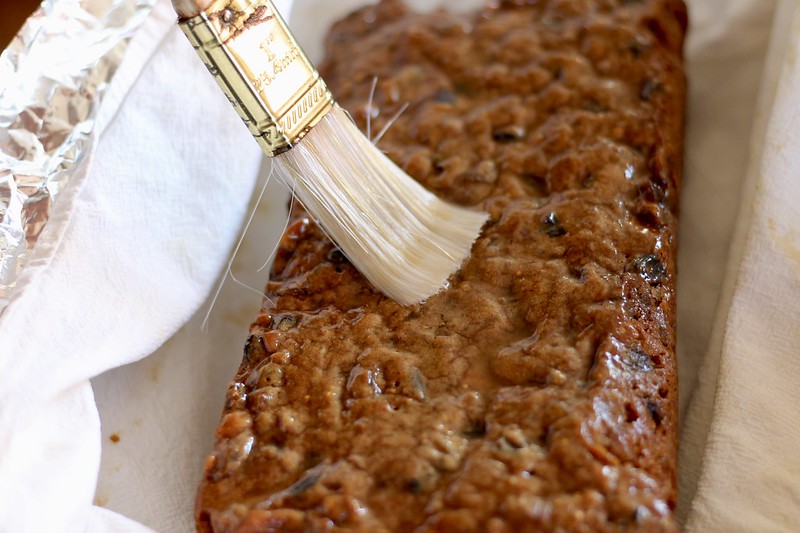
Rum brushing. I worried I was doing it wrong. Was it too much? Were the loaves turning soggy gooey? Would the rum be overpowering? I emailed Joe and he said to persevere. So I did. (Except, because it was such a chore, I grew lax and inconsistent. Eventually, I assigned the task to my older daughter’s to-do list and she became our resident rum brusher of fruitcakes.)
The wrap. Instructions said to wrap the loaves in cheesecloth and foil. I didn’t have cheesecloth so I used a cotton cloth which, because it was thicker, made me worry that I was rum-soaking the cloths instead of the bread. Also, the cloths turned an unappetizing shade of brown which made me think of wound bandages, mummies, and burial cloths. You’re welcome.
I’m halfway through one loaf (now wrapped in clean plastic), and there’s one more loaf stashed in the back of the fridge still wrapped in its rum-soaked burial cloth.
Since fruitcakes practically last forever, there’s no rush to eat them. I can nibble whenever I want, all winter long.
It’s nice.
Classic Christmas Fruitcake Adapted from Joe Pastry.
The original recipe says to halve the apricots. I bought my dried apricots already diced, so that saved time. The dates were to be left whole and the figs were to be halved, but I quartered all of them. You can use either brandy or rum (and maybe others?). I used rum.
day one: the fruit and nut mixture 2 cups golden raisins 2 cups currants 2 cups dried apricots, chopped 2 cups dried figs, quartered 2 cups pitted dates, quartered 4 cups chopped walnuts 2 cups chopped pecans ½ cup chopped candied ginger zest of 3 oranges zest of 3 lemons 2 teaspoons cinnamon 1 teaspoon ground allspice 1 teaspoon mace ½ teaspoon cloves 1 cup baking molasses (not blackstrap) 2 cups rum (or brandy) ½ cup orange juice
In a large bowl, combine everything down through the spices and toss to mix. Add the molasses, rum, and orange juice and still well. Cover with plastic and let sit at room temperature for 12 hours or so, or over night.
day two: the cake 1 pound butter, at room temp 3 cups brown sugar 8 eggs 1 tablespoon vanilla 4 cups flour 1 tablespoon baking powder 1 teaspoon baking soda 1½ teaspoons salt
Cream the butter and sugar. Add the eggs and vanilla and beat well. Add the dry ingredients and mix until combined. Pour the cake batter over the fruit and nut mixture and stir until thoroughly combined. It will smell like heaven.
Divide the batter between four large (9x5x3) loaf pans that have been buttered and then lined with parchment paper. The loaf pans will be quite full. (I used some of the cake batter for a mini loaf because I was worried they’d overflow, but the cakes didn’t rise much so I probably could’ve gotten all the batter into the four pans.)
Bake the loaves at 275 degrees for two hours. They’ll be golden brown — and an inserted toothpick will come out clean — and your house will smell divine. Allow to cool for ten minutes before turning the loaves out of the pans onto a cooling rack.
Once completely cooled, brush the loaves all over with rum (or brandy): tops, sides, bottoms. Wrap each loaf in cheesecloth (or a clean, thin cotton cloth) and then in foil. Refrigerate.
Every three days or so, brush the loaves with rum. Sometimes I brushed the tops. Other times I brushed the bottoms (and then stored them upside down). Give the rum treatment regularly for the first couple weeks (I put “rum the fruitcakes” on my calendar so I wouldn’t forget), and then every 5-7 days for the next couple months.
I’m no longer rumming my cakes, but depending on how long the last one lingers in the fridge, I may end up giving it another brushing or two. I like rum.