• peach pie with bourbon and fresh rosemary

    Last week in the bakery, I made peach pies. 

    It took several tries to arrive at one I was happy with. First, I made the one I wrote about here, but the bourbon flavor wasn’t strong enough and it was too sweet. So then I made a new recipe that called for macerating the peaches and then mixing the juice with two cups of dry rosé and reducing it down to almost nothing. Which made a good pie — I loved the delicate pink color — except I couldn’t detect the rosé, and what’s the point of using all that rosé if you can’t taste it?

    And then I tried a bolder method: a whole cup of bourbon cooked down to just a few tablespoons and then infused with fresh rosemary. With this pie, while I didn’t detect the bourbon and rosemary outright, those two ingredients added complexity and depth, turning the ever-insipid peach (sorry, peach lovers) into the flavorful, more peachy, affair I was pining after.
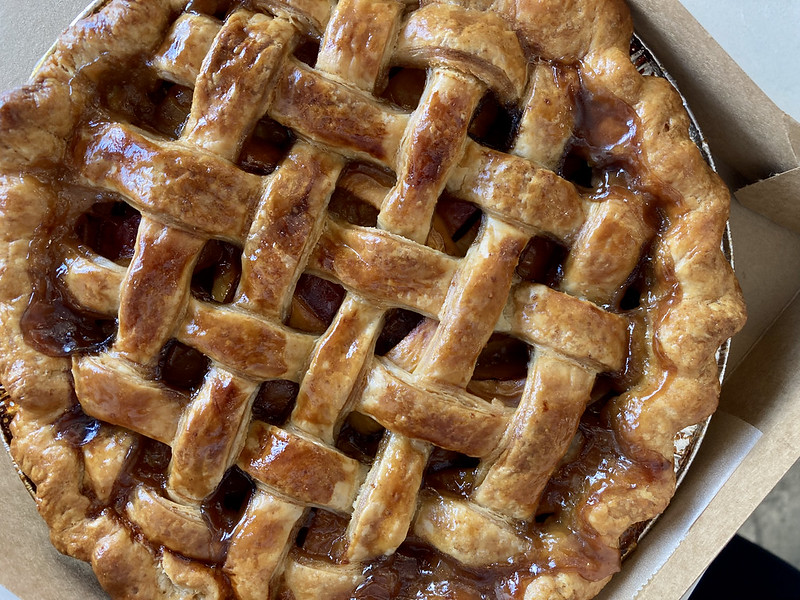
    pre-ordered pie awaiting pickup

    Also! I left the peaches unpeeled, and then carefully arranged them in the pie shell, skin-side up. This way, with the peaches packed in tight, they didn’t cook down into mush and the skins added a lovely peachy color. The skins, I was delighted to discover, did not, in any way, detract from the texture of the pie.  

    Because I baked the test pie on a Friday and it was still too warm to cut into by the end of the day and the bakery and diner were closed that weekend (Redwing!), I was forced — FORCED — to take the whole pie home with me so it could be properly taste tested. 

    And boy oh boy, did we ever taste-test the heck out of that pie. We had it for dessert that night, and then I had it for breakfast the next morning, and then I had it again that afternoon, etc, etc., until, within just twenty-four hours, we’d managed to taste test that pie straight into oblivion. 

    My job is so hard. 

    Peach Pie with Bourbon and Fresh Rosemary
    Adapted from Erin Jeanne McDowell’s recipe in the Poughkeepsie Journal.

    1 recipe (2 disks) rich butter pastry
    4-5 firm, juicy peaches
    1 cup bourbon
    2 sprigs fresh rosemary
    ½ slightly-rounded cup dark brown sugar
    ¼ teaspoon salt
    4 tablespoons butter
    3 tablespoons cornstarch

    Roll out one disk of pastry and place it in a 9-inch pie plate, allowing the excess to hang over the edge of the plate. Roll out the second disk of pastry and cut it into strips: you can either make a lattice directly on the filled pie, or weave it on a piece of parchment and then flip it onto the fruit-filled pie. At the bakery, I make stacks of lattice weave and then store them in the freezer to have on hand for easy pie assembly. 

    Pour the bourbon into a medium-sized saucepan and bring to a boil. Reduce the heat and simmer until it’s reduced to one-fourth cup. Remove from heat and add the rosemary. Steep for a couple minutes — or longer, if you want a stronger rosemary flavor. Remove the rosemary and squeeze/press to get every drop of the rosemary-infused bourbon reduction. Add the brown sugar and return to a boil. Cook for a minute, stirring steadily. Remove from the heat and add the butter and salt. 

    Measure the cornstarch into a small bowl. Add a little of the hot bourbon caramel sauce and whisk until smooth. Add the cornstarch slurry back to the bourbon mixture and, whisking constantly, boil for one minute. Remove from heat. (At this point, the caramel can be refrigerated for a few days — maybe even weeks — until ready to use.). 

    Pit and slice the peaches. Do not peel. Toss with the caramel sauce and then arrange the slices, cut-side down, in tight, concentric circles, tucking in peaches where needed to make a well-filled (but not heaping) pie shell. Pour the remaining caramel sauce over the peaches. Top with the lattice weave and crimp to seal. Brush the lattice and edges with an egg wash (1 egg yolk mixed with a pinch of salt and a bit of heavy cream). 

    Bake the pie in the bottom half of the oven at 400 degrees for about an hour, or until the center is bubbling and the crust is golden brown. If needed, cover the tops and/or edges with foil to protect from burning. Cool to room temp and serve with vanilla ice cream. 

    This same time, years previous: Italian meringue buttercream, lemony cream cheese frosting, all practicality, on his own, the quotidian (7.21.14), how to beat the heat, braised cabbage, salvation’s chocolate chip cookies.
  • farmers cheese

    I’m up to my eyeballs in cheese. I keep trying new things, making mistakes, figuring out little tricks, testing, retesting, reading, researching, and photographing. Problem is, I’m not taking many (any?) notes. So then I try to remember what I did and why I liked it (or not) and my brain about near explodes because IT’S TOO MUCH and I keep wishing I’d posted the recipes that have turned out good but cheesemaking is such a work in process that I’m not sure it’s worth putting anything out there yet because I really don’t know anything and I’m probably doing it all wrong anyway but I guess I have to start somewhere. So! In the spirit of streamlining the chaos that is my brain so that I can better focus, I’m going to begin posting about the methods and recipes that, even though they aren’t perfect or proper or authentic, are, more or less, working.

    First up: farmers cheese.

    From what I’ve read, any cheese from cottage cheese, to soft spreadable cheese, to hoop cheese counts as farmers cheese, but to me, a Lancaster County-born child, farmers cheese is the soft, sweet, mild, slicing cheese that we ate in sandwiches and gobbled up as a snacks. 

    At least that’s what I think we did. My mom will read this and probably be like, Farmers cheese? What’s THAT.

    Actually, this cheese is really paneer, that super-quick cheese everyone loves to eat in their saag. Paneer is made by boiling milk, adding acid, straining, gently pressing, cubing, and then eating, and paneer has no salt. When I first made my paneer like that — saltless — I was like, Um, hello, this would be better with salt. So I made it with salt and it was.

    And then I tried slicing the salty (so not actually) paneer and it tasted like… FARMERS CHEESE: toothsome, sweet and soft, salty, delicious. Of course, this is definitely not the farmers cheese I ate growing up — that stuff for sure had rennet and cultures and who-knows-what-all-else added to it — but the texture and mildness of the salty paneer is, I think, delightfully similar. And yet different! Therefore, I’m calling it farmers cheese.

    Please note: Homemade cheese is (probably) never going to taste the same as store-bought (nor should it, I suppose), so adjust expectations accordingly. This does not mean one should settle for something less, or be thrilled with an inferior product, please no. Just understand that, as home-canned applesauce and grass-fed beef and homemade yogurt are substantially different from their mass-produced, store-bought counterparts, so too it goes with cheese.

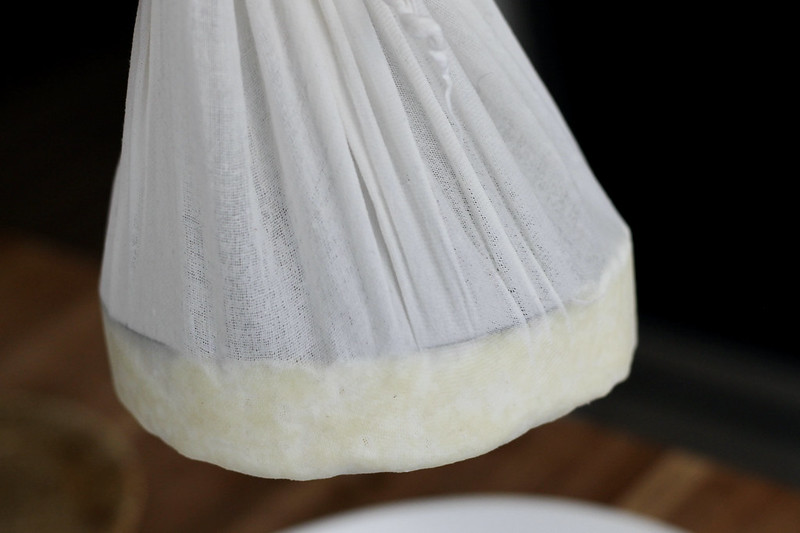
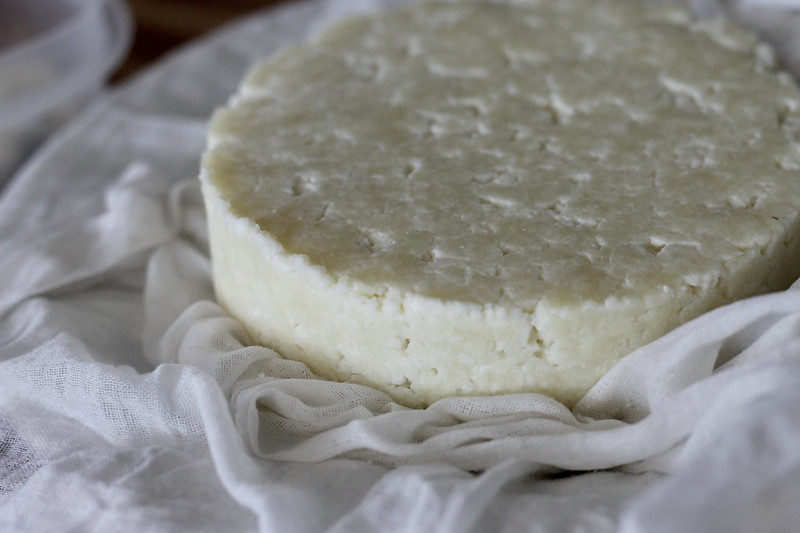
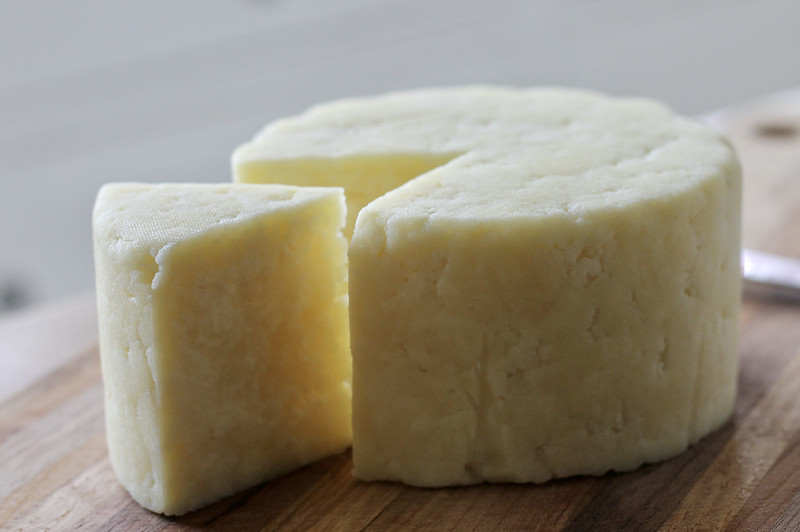
    Here is a wheel of farmers cheese in the middle of the pressing process…

    This photo was taken about an hour and a half into pressing, after I’d just pulled it from the press to flip it. Then I put it back in the press at 40 pounds of pressure for another hour or so — the first photo is of the final product. The above cheese was made from two gallons of milk, and the final weight was one pound and six ounces.

    The other day, we had slices of farmers cheese with our tomato sandwiches for lunch, and for supper, I grated some to go on top of my salad. Last night I used a whole bunch on homemade pizzas, along with salty halloumi (more on that later, maybe) and a bit of store-bought mozzarella and no one had any idea I’d used homemade cheeses. In other words, even though paneer, and subsequently this farmers cheese, isn’t supposed to melt, it definitely melded sufficiently well with the other cheeses to not be a distraction. (And I’ve since read that frying it up in some melted butter is a good idea…)

    And if a fresh, quick-cooking, slicing cheese wasn’t exciting enough, get this: it freezes beautifully! I pulled a wheel from the freezer, just to double check, and, sure enough, it was totally fine. (I thought it might be a little dryer, but that could be because I may have just pressed that particular batch longer.) I plan to stock up on a bunch of these cheeses in the freezer. If nothing else, I can always cube them and toss them into stirfries and dahls and pasta salads. I read somewhere that in India, paneer is actually considered a vegetable, and considering our grassfed milk source, I guess paneer is just a fancy word for “vegetable protein.”

    So now, whenever the milk tsunami threatens to overwhelm, I can quick knock out a cheese or two and pop it into the freezer. Knowing I have this super-fast recipe up my sleeve, I feel much less intimidated by the daily influx of milk.  

    Farmers Cheese
    With inspiration from many sources, but most notably Home Cheesemaking by Ricki Carroll.

    Feel free to scale the recipe up or down. Just keep in mind that it takes 2 teaspoons citric acid, and 2-3 teaspoons salt, per gallon of milk.

    No citric acid? No worries! Substitute vinegar or fresh lemon juice, about 4 tablespoons (of either one) per gallon of milk. To rid the cheese of any vinegary/lemony flavor, you may want to briefly rinse the bag of curds, prior to salting and pressing, with some cold water.

    2 gallons milk
    4 teaspoons citric acid dissolved in ¾ cup warm water
    2-4 cups hot water
    4-5 teaspoons non-iodized salt

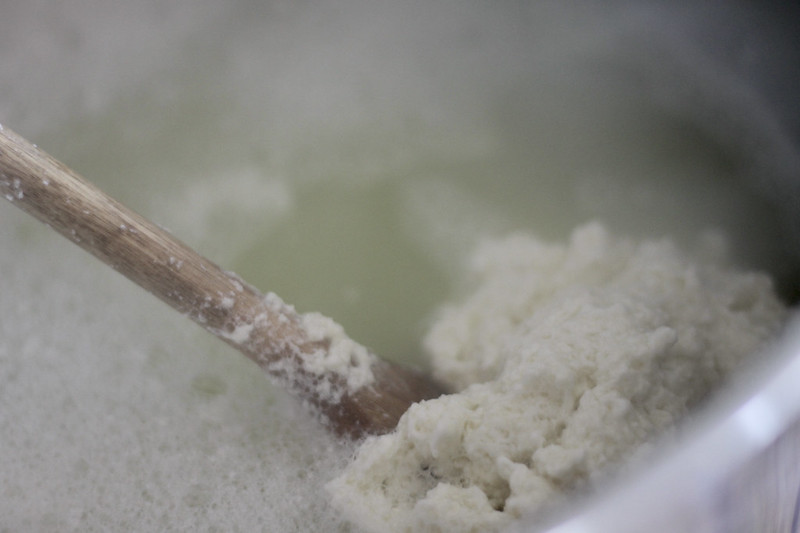
    Bring the milk to a boil, stirring occasionally. Reduce the heat to low and add the dissolved citric acid. Right away, the curds will start to form. Cook for another 15 seconds or so, stirring gently, until the whey is mostly clear (as opposed to being milky). 

    Turn off the heat, and add the hot water. (This is supposed to make a softer cheese — I have no idea if it works, or how, but I do it anyway, simply because I like the idea of a softer cheese.) Let the whey and curds set for 10 minutes; the curds will settle below the whey. 

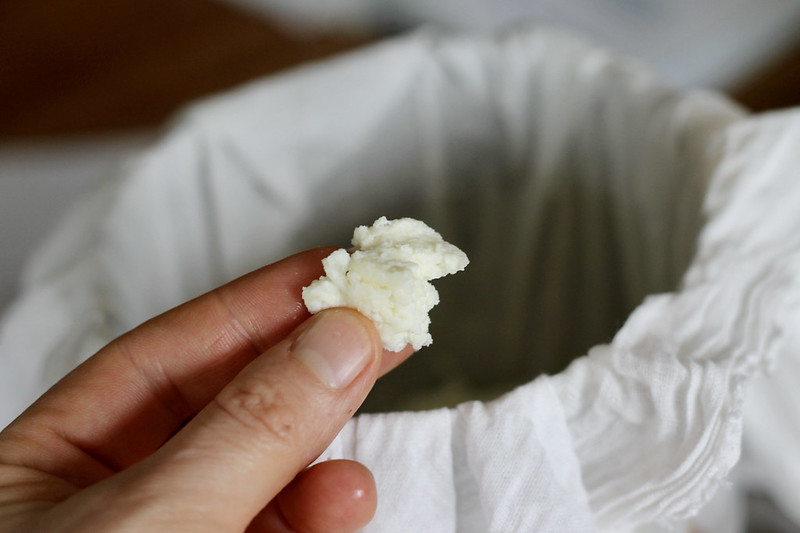
    Ladle the curds into a piece of cheesecloth. Sprinkle with salt — make it saltier than you think is healthy; during pressing, the saltiness will dissipate — and, using your fingers, gently stir it in. At this stage, the curds are delicious as is. They make a great afternoon snack with apples and pretzels. Yum, fresh cheese!

    Put the curd-filled cheesecloth into a cheese mold (or rig up some sort of pressing arrangement, like by putting the bag of curd in a colander and placing a bowl of water on top) and press at very low pressure — 5 pounds — for about 2 hours. 

    OR, if you want a smoother, firmer slicing cheese, remove the cheese from the mold after 30 minutes, flip, and press at 20 pounds for another 30 minutes, and then repeat the process, increasing pressure and the amount of time it’s being pressed after each flip. For example, if it was pressed at 20 pounds for 30 minutes, scale up to 30 pounds for an hour and then 40 pounds for 2-3 hours, etc. In other words, mess around until you land on a final product you like.

    The cheese can be eaten immediately, or wrap in plastic and store in fridge (in the fridge, it should last for a couple weeks), or freeze. 

    This same time, years previous: the quotidian (7.20.20), in the kitchen, the quotidian (7.20.15), Saturday nights, statements, in my kitchen (and barn), picklehead, zucchini parmesan frittata.

  • the quotidian (7.19.21)

    Quotidian: daily, usual or customary;
    everyday; ordinary; commonplace

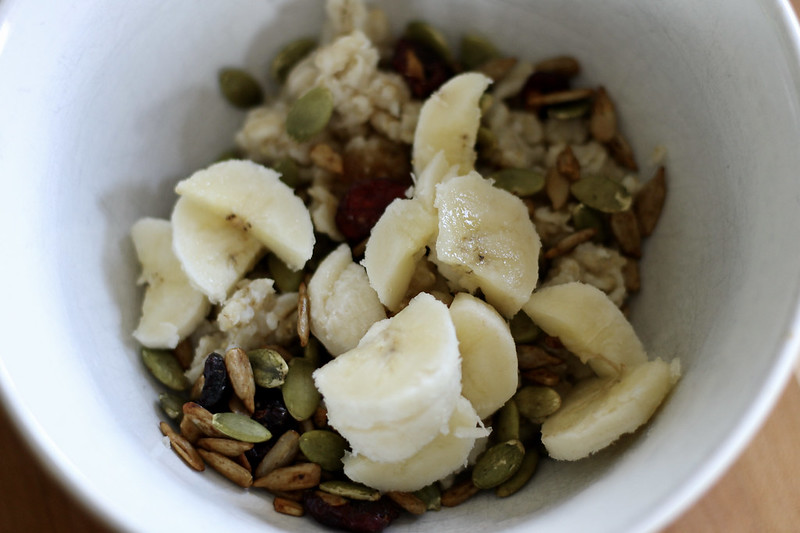
    Costco’s salad topper is also good on oatmeal.

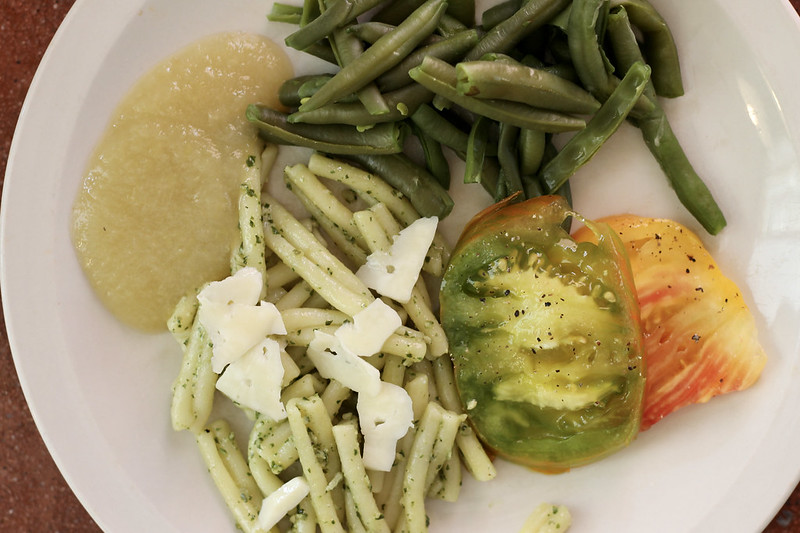
    Summer plate.

    To flour or not to flour?

    Curbside break.

    Granola, the lux version.

    For a salad no one much cared for.

    Homemade sour cream whips up great!

    Inching their way into the kitchen (and my heart).

    Controlled lovies.

    She brought me home a lampshade from my mom.

    Instructions attached.

    Ever hopeful.

    Play reading.

    Bringing in Butterscotch.

    On a summer evening, you can find me here.

    This same time, years previous: backyard wedding, three shining dragon eggs, the delegation, last night, sweet sixteen, the quotidian (7.18.16), apricot pie.