• cheese tasting: round two

    After I screwed up my camemberts, I emailed a person who, I heard through another friend, makes white mold cheeses. I wondered if she might be willing to tell me about her process? She wrote back, How about we start a cheesemakers club? and the very next week, we held our first meeting. (I joked we should call ourselves “Blessed,” as in “blessed are the cheesemakers.”) 

    There are five of us — FIVE cheesemakers! what a wealth of resources! — but only three of us could make the first gathering. No matter. We talked fast and hard for over two hours and ate enough cheese for about a half dozen people: mozzarella, Colby, Caerphilly, Monterey Jack, ricotta, Gouda, year-and-a-half Asiago (which was delicious and tasted of … Time), and a couple marinated soft cheeses, plus some fails — rubbery jalapeño cheddar (mine) and bubbly feta (not mine) — because none of us are uppity and this is all about the learning. Also, there was wine and gingery lemonade and chutneys and crackers, etc. 

    Seeing the host’s cheesemaking operation was both fascinating and liberating. The differences between us — for cultures, she uses mostly kefir (rhymes with deer, I did not know this!) and yogurt and buttermilk, rather than freeze-dried powders; she lets her cheeses age in a wine fridge, uncovered and unwrapped, for months — were inspiring. I left feeling emboldened to trust myself more. People have been making cheese for years. This is not rocket science (though we all agree it is magic).

    her mozzarella is incredible: buttery, and with the characteristic string cheese tear

    Before I show you some of my recently-opened cheeses, a couple notes: 

    *I’ve noticed that our milk has changed flavor dramatically: almost all traces of farmyness— what I think of as that distinct raw-milk flavor— have vanished. We’re treating the milk the same, so my best guess is that it’s either because the weather is getting colder and the grass is changing, or because Daisy’s at a different point in her lactation. Or maybe both? 

    *And an update on the freeze-dried yogurt culture: The second batch of yogurt I made using culture from the first batch turned out perfectly fine. It may have been ever so slightly tangier, and maybe a touch looser, but it was hard to tell. So there you go!

    Dill Havarti (Number 1)
    This was my first cheese, made on Sunday, September 29. (To date, I’ve made 37 aged cheeses.) I forgot to let it set for forty-five minutes after adding the mesophilic culture, and I thought I might not have added enough salt, and it got bounced around a good bit, temperature-wise, since I was still in the middle of setting up my operation — aka The Murch Method: “Commit first, figure it out later” — but it turned out okay.

    Not great, but passable: light, chewy, dilly, mild. There were bits of orange around the edges, but I shaved them off and there was no weird flavor. 
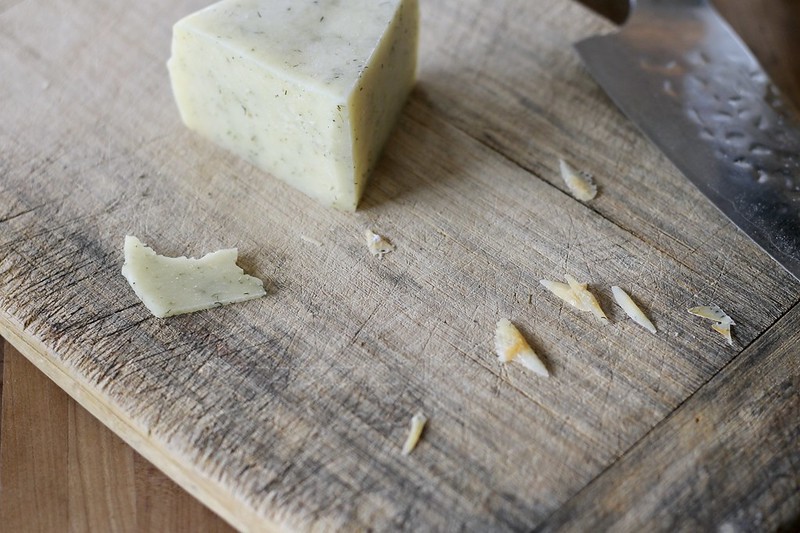
    It definitely needed more salt which makes me wonder: even though it’s already aged, could I soak the remaining cheese in a saturated salt brine for several hours, air dry, and repack?  

    My favorite way to eat this one is with crackers and chicken salad.

    Stirred Curd with Jalapeño (Number 6)
    For this cheese, I simmered 3-4 tablespoons of jalapeño in some water, added the water to the milk (three gallons) at the start of the process, and then added the cooked jalapeño when I added the salt, after milling the curds.

    There was a distinct jalapeño flavor but hardly any heat, which was disappointing.

    See those white streaks running down through the cheese? I have no idea what that’s about. Also, the texture was rubbery and chewy.

    Before aging: do the bits of white curd signify anything, like they were too cooked?

    It’s edible, but only just. What a bummer. 

    Caerphilly (Number 25)
    Oh goodness, this one is good.

    Caerphilly is a high-yielding, Welsh cheese; the recipe I used came from Gavin. The method is easy — a sort of cheater’s version of cheddaring in which the curds are cut into slabs and then briefly stacked on top of each other, and then there are a lot of rapid-fire rounds of pressing and turning during which the top and bottom gets salted repeatedly. The cheese only ages for three weeks which, in the world of cheesemaking, is no time at all.

    The results are, as I already said, fabulous: salty and creamy, with a deliciously mild flavor and slight tang. My notes read: MAKE MORE! 
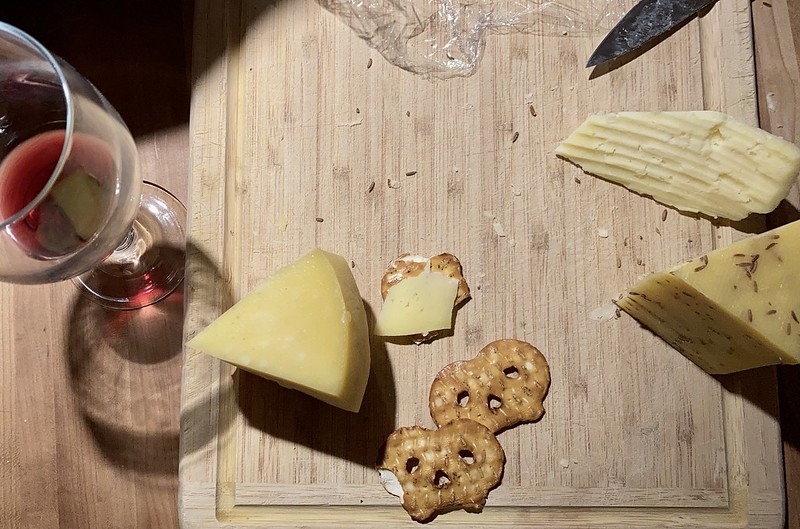
    clockwise from top: caerphilly, farmhouse caraway, butterkäse

    When I pulled this out for a pre-supper snack, my husband couldn’t stop eating it, and for several days straight, I ate this cheese for lunch tucked into a leftover Magpie biscuit, with ham and mustard. 

    It doesn’t get much better than that.

    Butterkäse (Number 19)
    Again, this is one of Gavin’s recipes. I made it with four gallons of milk and a quart of cream, as is my custom since our milk is lower in fat. Partway through the aging process, my cheese developed little black spots on the top and bottom; they wouldn’t wash off, so I just let them be.

    Turns out, they’re flavorless and no one died, so cool-cool. (And Gavin said— because, yes, I went to the top dog straightaway— those spots are actually brown and totally harmless.)
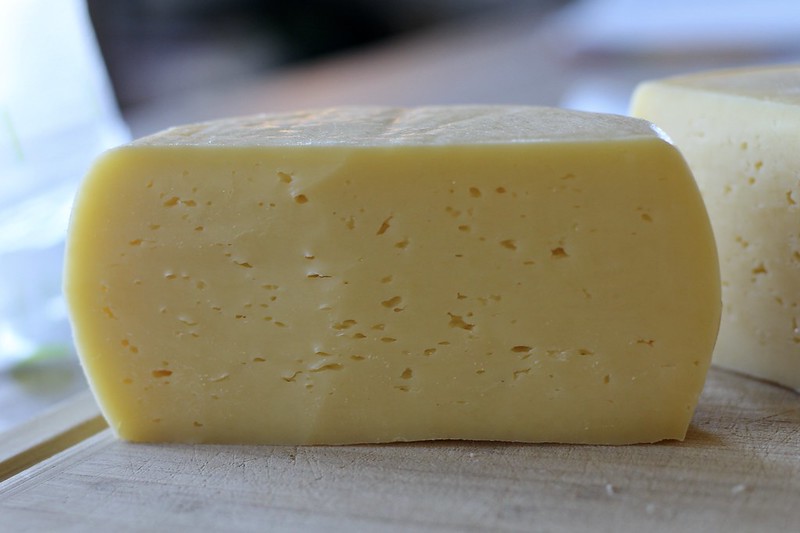
    As for the cheese itself, my notes say, “Buttery, small holes, soft, delicious, soooo good!!! MAKE MORE.” So I guess I will.

    Farmhouse Cheddar with Caraway (Number 20)
    With the caraway, I followed the same process that I did with the jalapeño: cook the seeds in water, add the water to the milk in the beginning, and add the cooked caraway along with the salt.

    the other cheese is butterkäse

    The cheese was nice, mild and somewhat dry (firm?) with a distinct (and delicious) caraway flavor. (Again, I felt like the texture was ever so slightly on the side of rubbery. Not sure how to fix it…)

    This makes a great snacking cheese. I kept thinking it’d go great with pretzels and apples and beer.

    Derby (Number 15)
    I made this British cheese (similar to cheddar, but easier) with the Jersey milk and the mesophilic whey leftover from making a gouda. It’s supposed to be aged for six months, but it can be eaten as early as four weeks. My notes say, “At first, farmy. On second thought, okay. Dry, lots of holes … actually quite good!” 

    But then when my husband tasted it, he was like, “That’s on the edge of off.” [eats more cheese] “Nope, that’s definitely off.” And it did taste off, I agreed, but it also tasted quite good. Or at least I thought so. The texture, anyway, is awesome. I had it today in a meatloaf sandwich. (Building it, I got a little carried away.)

    But about this cheese: I think I need more opinions. Feel free to swing by and give it a taste!

    Gouda (Number 7)
    Rubbery (ARGH), with good, but mild, flavor. 

    Derby on the left

    About this rubbery issue: what am I doing wrong? Best I can figure, it’s either because I’ve added too much rennet (but I really don’t think this is the case since I’m meticulous with measurements and most of the cheeses are not rubbery) or because I’m heating the curds too high or too fast or too something. But I’m temping and timing every step, and my notes don’t even make mention of any weird variations or screw-ups. So what’s going on?

    a spot of harmless mold

    Look at the Gouda (right) compared to the Derby (left):

    They’re both made from three gallons of milk, but the Gouda is so small and tight. Grr. Is it because the Derby was made with the Jersey milk? Or because the Gouda’s curds were misheated somehow? The Derby might have a funk but at least it looks nice. Humph.

    (I have several more Goudas aging right now. They feel quite different from this one— softer, fatter, more voluptuous— so maybe they’ll be better?)

    This same time, years previous: change, sourdough English muffins, guayaba bars, success!, Thai chicken curry, the quotidian (11.16.15), the quotidian (11.17.14), lemony lentil goodness, so far so good.

  • the quotidian (11.15.21)

    Quotidian: daily, usual or customary;
    everyday; ordinary; commonplace

    Sedentary stabbing.

    Korean meatballs no one liked.

    Carrot smiles.

    Soup base.

    Got a good spice combo for mulled cider? Hit me up.

    Fact: there is no such thing as a good sweet cherry pie. Prove me wrong.

    Colby.

    The Milkmister.

    Mmmm, pie!

    The one-trip girl: lazy or smart?

    Little kid(s), big mess.

    “If you know, you know,” as my younger daughter says.

    Friday night, my son’s fiancé made supper: the tater tot casserole she grew up with…

    …and we introduced her to Napoleon Dynamite.

    This same time, years previous: my new kitchen: the refrigerator, Shakespeare behind bars, enough, for now, gravity, lessons from a shopping trip, the wiggles, why I’m glad we don’t have guns in the house, chicken salad.

  • perimenopause: Laura, age 48

    After I published that post about menopause, there was a collective “we need to talk about this more!” response. My solution? A series of posts— this is the first— in which perimenopausal women* share what they’re going through (because perimenopause is, I think, the stage that’s talked about the least). To the generous, gutsy women who have weathered my (very) personal questions with such grace and humor: thank you. Through you, I am gaining a better understanding of myself, my body, and what it means to be a woman.

    *All names have been changed.

    ***

    So…perimenopause. How’s it going?
    I feel like I am in the middle of my perimenopausal journey. I say this without any formal hormone testing, but just by understanding my own body and being aware of signals. I still have regular periods, but I feel hormonal shifts and my periods are changing (mainly getting lighter and shorter and darker in color). The last year has been incredibly challenging for many reasons and, probably because of family stress and the pandemic, I minimized what may have been going on for me internally — which definitely was impacting my experiences with the larger factors going on in my life.

    When did you notice that things were changing? 
    Honestly, no one ever talked to me about perimenopause. I knew menopause had happened to my mom and grandmother, but I never knew that there were YEARS building up to that. So when at age 46 I started noticing a change, it never occurred to me that these changes could be hormonal. I felt emotional — sometimes invisible to my family and friends — and I felt a sense of increased anxiety, especially worsened phobias and worries about loved ones. 

    Are you still feeling emotional?
    Strong emotions have been the primary symptom for me. Also, I’ve had increased anxiety, or maybe it’s a lessened tolerance for anxiety. I need more time alone, and more quiet time. My frustration tolerance is significantly reduced. At the same time, this anxiety is usually about something bad happening to my children or other loved ones. I am not worried about myself; in fact, I feel more confident.

    With perimenopause has come sudden and severe weepiness and deep sorrow. This could look like me crying unpredictably in a public space (not where others are crying) and/or me sobbing for the woes and ills of the world. One night I was crying so much I felt as if I might die from sorrow. This was such an intense and scary feeling. I did not feel suicidal. I thought the sadness would literally kill me. I discussed this with my partner, and then later with my doctor, because it was unlike any other feeling I had had before. When I woke up the next morning, I was surprised to be alive.

    Have you had other symptoms?
    A symptom (which my doctor has yet to find a solution to) is itchiness in my inner thighs and around my vulva area; the itchiness is so persistent that at times it wakes me up. My doctor has prescribed various creams including cortisol, but nothing seems to work. The itchiness very much correlates to my cycle; I can tell when I am ovulating, or when I am about to begin my period, because the itching starts again. I am very self-conscious about this symptom and frustrated that there does not seem to be any clear solution. In fact, when I explain to my doctor that I think it is hormonal, she minimizes it.

    One unexpected symptom has been an increase in sex drive. I can honestly say that it is the one time in my almost 30-year-old marriage where I want sex more than my partner does. I always assumed that this would be reduced in perimenopause but for me it had the opposite effect. It was not uncommon for me to want sex every day or multiple times a day (this has subsided now so I wonder what was going on).

    Insomnia. It sucks.

    I read in a book that perimenopause is kind of like puberty in reverse. This was helpful to me in that it gave me permission to not fully understand what was going on with my body. There will be changes I don’t understand: it’s okay to simply be curious about them and just ride it out. Whenever I notice something different in my body I think, “Oh, well that’s weird.”

    Have you talked to your children about what you are going through?
    I wrote a letter to my husband and children to try and explain to them what I was experiencing, and to explain the frequent weepiness and my sense of feeling invisible. It was helpful to me to explain it to them in that way. One of my daughters responded with “Yay for reverse puberty!” I think my son just said he loved me.

    In what ways has your perimenopause correlated to (or not) your periods? Have you noticed any patterns? 
    I have always had very heavy periods with strong PMS symptoms, so I assume this may be in part why I am experiencing significant symptoms in perimenopause. At least when I have checked in with some friends it seems that they did not have as many issues as I have been having. So yes, to me there seems to be a correlation. 

    Has perimenopause impacted your body image?
    This is also weird but I think my body image has actually improved. (My worry had always been more about my own body image — not at all about what my partner was attracted to.) I have had steady weight gain over the past twenty years but, while I still have moments of feeling self-conscious, I have just decided to not worry about it, or even really try to change it anymore. Now, I am much more comfortable lying in bed completely naked when previously I would want to cover up with a sheet or something. 

    What about sex?
    My partner is very open and listens to me whenever I want to talk about this. Interestingly, he reports that my body (specifically the inside of my vagina) feels different to him during sex — and that this is a good thing. I am not sure what that is about but it seems like something has moved, or changed, in a way that is good. I don’t feel that difference from my end.

    I waited until my mid-40s to purchase my first sex toy, and I think it has made a dramatic difference in helping me with perimenopause. It is an external stimulator that is truly amazing. I had never really been into masterbation much — probably a combination of shame from my childhood and also the societal message that I needed someone else in order to feel good in that way — but now I am able to control when and how I have orgasms, and I think the frequency of these has been incredibly helpful for my perimenopause symptoms. My partner is totally in favor of this new “hobby” and finds it attractive and healthy. I wish I would have bought one in my 20s.

    What has surprised you about this experience? What do you wish someone had told you?
    Another thing I had never used until my mid-40s was weed. I started to self treat my emotional issues with a microdose of indica combined with CBD (gummies): Lume, Ripple, in powdered form, and Colorado’s Mountain High gummies, which were the best ones I ever had but have not been able to find them since. This was very helpful and I can’t believe I waited so long to use it. I have rarely taken an amount that makes me feel “high” but instead have noticed reduced anxiety and improved sleep/relaxation. I wish I would have started that a long time ago. I think it is funny that sex toys and weed have been my most effective “treatment” of perimenopause symptoms, but it’s absolutely true.  

    Any other resources to recommend?
    I really enjoyed the book What Fresh Hell Is This. In the book, they mentioned THC-infused lubricant, but I have not been able to find it at any dispensaries. (I did try to make my own with THC tincture and coconut oil, but it did not work.)

    What are you learning about yourself? 
    I am craving more connection and knowledge about these changes from women who have experienced it before me. For that reason, I am really glad you are doing this project. Once I hit menopause, I hope to have some kind of a ritual with friends to mark the era and celebrate. 

    ***

    This same time, years previous: introducing how we homeschool: a series, my new kitchen: the island, the quotidian (11.12.18), George Washington Carver sweet potato soup with peanut butter and ginger, butternut squash galette with caramelized onions and goat cheese, refrigerator bran muffins.