• Alpine Cheese

    The first hard cheese recipe I’m sharing here, this Tomme (the generic name, and what I tend to call it) is extremely easy and straightforward to make, and the results are wonderful.

    If I were to teach a cheesemaking class, I think I’d start with this one since it’s supremely accessible and doesn’t require a long aging time. The only uncommon ingredient is rennet (if you’re local, I’ll share), and the only special tool is a thermometer: all the other supplies and ingredients can be cobbled together from an ordinary kitchen.

    If you’re so inclined, that is, of course. No pressure!

    The process goes like so. Heat milk to 106 degrees. Stir in the calcium chloride (if using pasturized milk), some yogurt, and the rennet. Leave the milk alone for the better part of an hour to set up and then cut the curd. Stir gently for half an hour before draining off the whey and pressing. Salt. Done.

    This cheese is dry-salted— salt is applied to the surface after pressing— and the method sounds complicated, or at least weird (it seems impossible that the salt will work its way into the center of the cheese, but it does), so here. I’ll break it down for you.

    Seven teaspoons of salt, one for each gallon of milk.
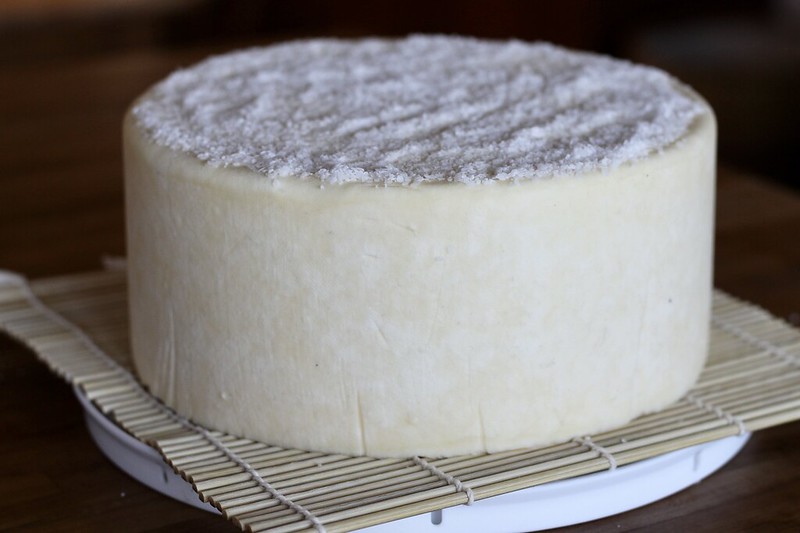
    Rub the salt over the top of the cheese.

    Cover the cheese with a lid, or, in this case, a bucket. Let sit at room temperature for a day.
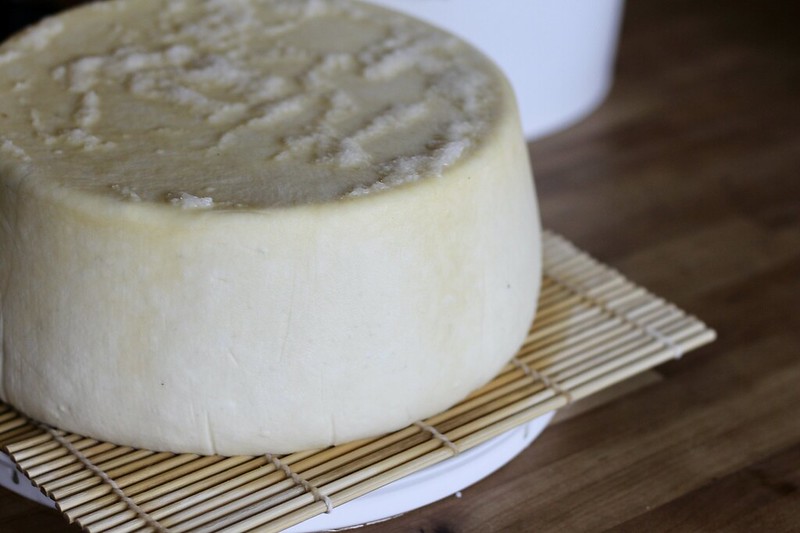
    Twenty-four hours later, the salt is mostly dissolved and a few tablespoons of whey have pooled under and around the cheese. Drain off the whey and rub the remaining salt over the top and sides.

    Excess whey to be discarded.

    Flip the cheese and rub seven more teaspoons of salt over the bottom-now-top of the cheese.
    Cover with a lid and let rest at room temperature for another day.

    Rub the excess salt over the sides. Set the cheese on a clean, dry mat to air dry for a couple days
    before (vacuum sealing, if desired, and) transferring to the cheese cave to age.

    The young cheese is mild and salty, perfect for stirring into mac and cheese or stuffing in a sandwich. I don’t know what it’s like when it gets older, but I have no doubt it’ll be wonderful: probably like it is young, only more so. (Cheeses and humans are similar in that reguard: both intensify with age.)

    A few weeks back, I finally invested in a large, 8-gallon kettle. I got it from Webstaurant (through Magpie) for about 120 dollars and I am so, so, so happy with it. I also purchased a larger basket for my cheese press. Larger wheels of cheese equals fewer cheesemaking days. Now I make a new cheese every four days or so. Per recipe, I use about seven gallons of milk (can’t go all the way to eight, since that’d be level with the top of the kettle) which yields about six pounds of cheese. (It’d be more if I had a Jersey but I’m not fussing. Daisy’s milk has been exceptionally delicious these last few months.)

    photo credit: my younger daughter

    Lots of people have been asking what I’m planning to do with all this cheese. Well, it’s like anything seasonal: preserve what’s abundant now for when it’s not later. According to my calculations, I think we typically eat anywhere from 2-3 pounds of ordinary hard cheese a week, like Colby, cheddar, and Jarlsberg. (This number doesn’t include my cooking cheeses: mozzarella, cream cheese, ricotta, and Parmesan.) In other words, if I have 200-300 pounds of cheese squirreled away by the time Daisy dries up, we should be good for a couple years, with some left over for gifting.

    The cheese cave overflow. I keep the room at 45-50 degrees so the whole room could be a cave. . .
    IF it stayed winter year round.

    Which is the other thing I’ve been doing with this cheese. I’m not big into Christmas gifts — it’s just not something I really think about — but this year was different. People have been banging down my door to buy the cheese, but the process is far too time consuming, and the results too random, to even consider attaching a price tag. Giving them away, however, felt totally different.

    I had so much fun collecting all the thrift store baskets, creating cheese cheat sheets for each basket, googling how to wrap cheeses (it took me a sec to figure it out; those early baskets were gnarly) and then tucking in a bottle of wine, maybe a sleeve of crackers, and several sprigs of rosemary.

    Come to think of it, if I continue sharing cheese at the rate I’ve been, I’ll probably need more like 500 pounds. Daisy, pick up the pace, lady. The world needs you!

    Alpine Cheese (Tomme)
    Adapted from Gavin Webber’s recipe.

    I’m writing the recipe as I make it in my large pot; feel free to cut the amounts in half.

    To account for the amount of time the cheese will need to be pressed, either start this cheese first thing in the morning (so you can get the first 12 hours of pressing in before you go to bed), or about mid-afternoon.

    7 gallons whole milk
    1 quart half-and-half OR heavy whipping cream
    3/4 teaspoon calcium chloride in 1 cup cool water (if any of the milk/cream is store-bought)
    3/4 cup plain yogurt
    1 teaspoon rennet in 1 cup cool water
    14 teaspoons non-iodized salt

    Pour the milk and cream into a large pot and heat over high heat, stirring occasionally, until it reaches 106 degrees. Turn the heat off. Add the calcium chloride, if using, and stir well. Thin the yogurt with some of the milk and then add it to the pot, stirring well. Using an up-and-down motion, stir in the rennet (do not mix for longer than one minute). Put the lid on the kettle and let rest, undisturbed, for 45 minutes.

    After the rest time, check to see if the curd has a clean break. (If not, let it rest another 15 minutes and then check again.) Cut the curd into 3/4-inch cubes. Let rest for 10 minutes to heal (firm up). Very gently, stir, lifting the curds with a large spoon and cutting the ones that are still too large with a paring knife— this will take about another 10-20 minutes.

    Set a timer for 30 minutes, and then check the temperature; it probably dropped a few degrees. Turn the heat to low and, keeping the thermomter in the whey, slowly stir with your hand, lifting the curds from the bottom and swirling in the heat. When the thermometer reaches 106 degrees, turn off the heat and remove the thermometer. Keep swirl-lift stiring with your hand. With the other, hold a book and read. When the thirty minutes are up, the curds should be the size of baked beans and feel like the white part of a soft, poached egg.

    Let the curds and whey sit, undisturbed, for 10 minutes. Pour off all the whey (save it for ricotta, if you want). Line a colandar with cheesecloth and scoop all the soft curds into the colandar. Let rest for 10 minutes to drain. Transfer the curds in the cheesecloth (use it like a hammock) to your cheese press, either a commercial press, or one you’ve jerry rigged.

    Press lightly for about an hour. Flip and press (a little harder this time) for another hour, or three. Flip and press at medium pressure for twelve hours. Flip and press at medium pressure for another twelve hours.

    Remove the cheese from the press. Place it in a large plastic box that has a lid. (Lately, I’ve been setting the wheel of cheese on a piece of bamboo matting that’s set on a bucket lid and then placing the bucket upside down over it as the lid, on account of the cheese not fitting in the bottom of the bucket because the bottom is more narrow than the mouth.) Spoon 7 teaspoons of non-iodized salt on top of the cheese (1 teaspoon salt per gallon of milk) and rub it over the surface. Place the lid on the container (or the bucket over the top) and let rest at room temperature for twenty-four hours.

    After twenty-four hours, pour off the salty whey, flip the cheese, and smear another 7 teaspoons of salt over the bottom-now-top of the cheese. Since the cheese is fairly damp, feel free to rub some of the salt down over the sides, too. Once again, cover and let rest at room temperature for another twenty-four hours. Air dry for 1-3 days, flipping daily. Vacuum seal (or sit directly on a bamboo mat, high humidity) and age at 50 degrees for 6 weeks, flipping a couple times a week.

    This same time, years previous: marching, how we kicked off 2016, high on the hog, what it means, the quotidian (1.6.14), headless chickens, buckwheat apple pancakes, candied peanuts.

  • a new dress

    I was waiting to tell you about the dress I wore to the wedding celebration until we got the photos— so I’d have something to go with the post— but, wouldn’t you know, turns out no one took a photo of me in my dress. (Guess that shows how I rank, ha!) So this morning, just as the sun was cresting the hill, I slipped into the dress, zipped up my boots, and made my younger daughter come outside to photograph me in the freezing cold. 

    This was the first time I ordered from eShakti. I’ve known about them for years — first through Jenny Lawson, and then via other websites and real-life friends — but not until my older son got engaged did I get serious about scrolling through their website. After extensive deliberation, I finally placed my order

    When I showed the dress to my mom, she commented that it looked like plain Mennonite garb. Oh shoot. The front was a little cape-like, but I didn’t want to look prairie-girl plain! Probably, I told myself, that’s just Mom’s bias showing through. No one else is going to think that (unless they, too, were raised with a plain Mennonite preacher father). 

    And sure enough, when I modeled it for the kids, they were impressed. “It’s like something out of Game of Thrones,” my older son said. “Do you have a cape?” 

    A cape? HA. Talk about generational change.

    At the wedding, I got so many compliments on the dress. Each time, I’d launch into a whole spiel about eShakti. How customers can customize the dress — sleeve and skirt length, the neckline — and/or have it made to their size specifications (though mine was just an ordinary medium 10). How — get this — almost all the dresses have pockets (unless you request otherwise). “And it’s warm,” I’d say. Feel!” And I’d shove a fistful of jersey cotton skirt into their hands. 

    I was worried that the belted waist would feel restrictive, but it’s actually just a cinched elastic waist with a belt overtop. I wore a small slip, not because it’s see-through (it’s not), but because I was worried my black tights might make it bunch weirdly. Probably, it would’ve been fine without.

    The dress really is wonderful, so snuggly and warm.

    The extra long sleeves made me happy, so toasty-cozy — I’m forever pulling them down over my hands for extra warmth.

    And the pockets! I don’t think of myself as a pocket person, but goodness, these were lovely. So deep and warm. Without even thinking, I kept slipping my hands into them.  

    A couple weeks before the wedding, I panicked and ordered another dress (higher neck, shorter skirt), just in case. Maybe I’d wear it to the officiation? It arrived as we were dressing for the event, I kid you not. I quick tried it on, but it felt more like something a chorister would wear to a concert, so the next week I mailed it back. 

    This is not a sponsored post (none of my posts ever are), but eShakti gives all their customers little cards to hand out to people who compliment the dress — so that’s what the pockets are for! — as well as a social media code to share.

    If you decide to shop eShakti, use this code: you’ll get 50 dollars off your order and I’ll get a 25 dollar credit to my next order.

    I’ve already got my eye on this one (but with three-quarter length sleeves).

    This same time, years previous: how we homeschool: the Suburban Correspondent from Virginia, today, how to make a fireball, breaking the fruitcake barrier, sweet and spicy popcorn.

  • what we ate

    I don’t think I’m ever going to be consistant enough with my photography to be able to do an actual “what we ate in a week” post, but a “some of what we ate in the last month” post? Now that I can do.

    ***

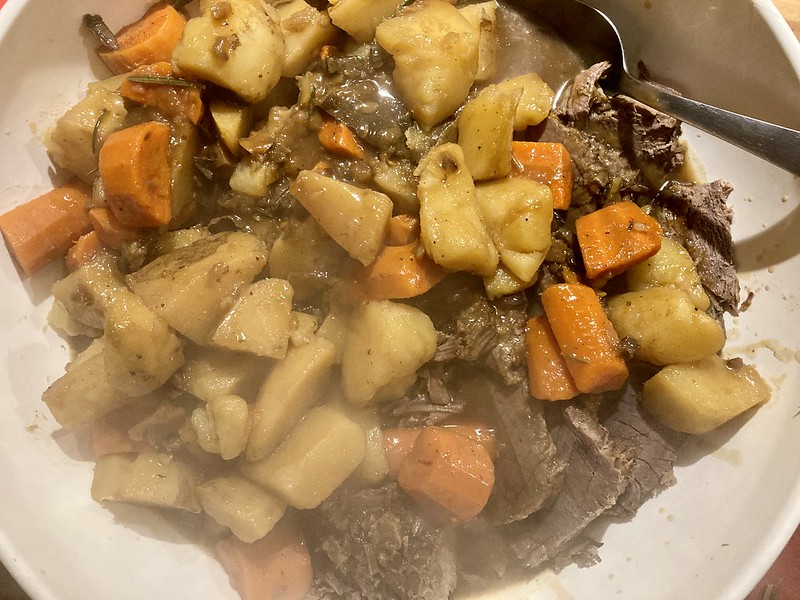
    The first real thing I cooked in my ippy (aside from potatoes) was a pot roast.

    The process involved a few steps, like browning the meat, pressure cooking the meat and then removing it prior to pressure cooking the veggies, and then quick mixing up the gravy, but it was by FAR the best roast I’ve ever made. We feasted that night, and then again the next day on the leftovers, savoring every bite.

    I had plans to use the leftovers in a pot pie, but then my older son begged to take them home and that was that.

    An entire roast, gone in about twenty-four hours. Pure magic, that ippy is!

    (But then I tried oatmeal and it bombed: burned and gummy.

    Maybe because I delay-cooked it with an overnight soak? Not sure. Must play more.)

    ***

    I’ve recently been digging the fried rice.

    A great, last-minute meal, it’s the perfect way to use up all sorts of random veggies and leftover meats. I usually have rice getting hard in the fridge: a quick sizzle in a hot, cast iron pan with plenty of olive oil (or bacon fat), followed by a splash of water and a lid, and it steams back to life even better than it was the first time around.

    While the rice is cooking, I sauté some onion (celery, cabbage, garlic, whatever) in a separate cast iron pan. Carrots and other hard veggies get a brief boil in a saucepan. I scramble eggs. And then I start tossing things together, adding, leftover peas, sesame oil, a splash of fish/soy/hot sauce, etc, to taste. Green onions and/or fried cheese round it out.

    ***

    One night for supper, we had breakfast: pancakes, bacon, and smoothies.

    Weekday mornings, with only two kids at home (and since my husband leaves early and I often go running first thing), it’s yogurt and granola, or cereal, or eggs and toast, or whatever anyone wants, but I miss making pancakes!

    We’ve been eating a lot of smoothies, too: kefir (more on this soon), bananas (just bought a huge amount to freeze), frozen berries, jam.

    ***

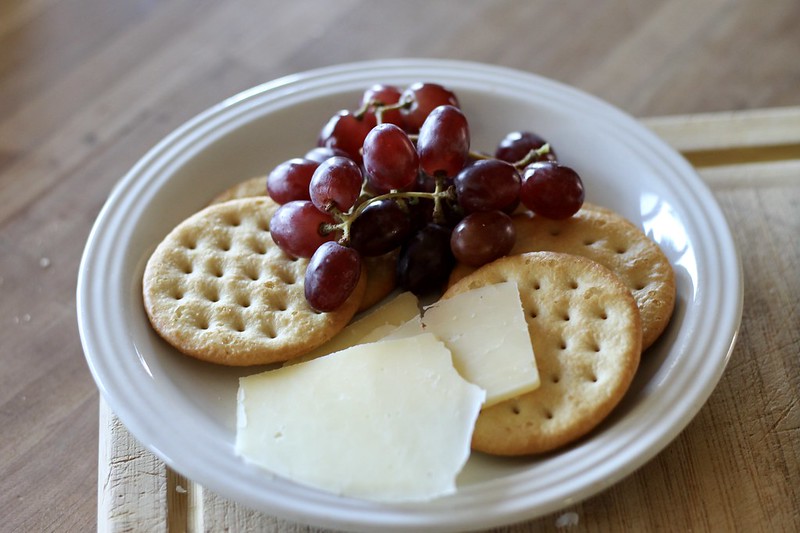
    Left to my own devices for a solo meal, I often resort to cheese and crackers. With a sliced apple or a grapefruit, it’s pretty near perfect.

    There’s something so satisfying about it: the crunchy crackers, the cheese’s salty creaminess, yum.

    I often cut into a new cheese late morning when I’m beginning to get hungry, or late afternoon when I hit my draggy slump. The thrill of a new cheese is the perfect pick-me-up.

    ***

    Pizza night makes everyone happy. This particular night, I also made a pulled pork (leftover from Magpie) pizza with bottled barbecue sauce instead of tomato sauce. I think it worked.

    Pizza is a great way to use up random cheese bits: ricotta, mozzarella, something sharp(ish) that no one much liked. One recipe of dough makes three big pans: we feast, and then the leftovers get packaged up in one-person meal-sized portions for quick work lunches for my husband.

    ***

    These days, wedding leftovers are the name of the dinner game! Assorted soups, cider, cans of whipped cream (oo-la-la), homemade marshmallows and hot cocoa mix, rolls, chips, jams and hot sauces and salsas, whoop!

    Oh, and tons of cookies.

    The brown sugar cookies‘ mottled icing is due to freezing/thawing.

    I keep trying to off-load them on people (because there’s no justification to do more baking if I have a freezerful of cookies and I’m itching to bake), but my husband is like, Noooooo!!!! I want all the cookies, wah! For him, a bunch of cookies equals easy lunches: just run down cellar and load up a container with snacks. His favorite cookie used to be white chocolate cranberry, but the Kitchen Sink ones are making him reconsider. Something about that caramelly chew….

    ***

    The night after the wedding celebration, my husband and I went to our small group gathering, leaving the younger two kids to recuperate at home alone. When we got back, this was waiting for us on the table.

    We followed the instructions.

    ***

    My younger daughter called me from work to see if I’d be interested in some mac and cheese. Picturing a couple plastic containers of leftover pasta, I said sure (of course). And then she walked in the door with a large terracotta pie plate heaped high with homeade, unbaked mac and cheese — the fancy kind topped with crushed Ritz crackers. Apparently the head chef had made too much for some (private?) event, lucky us!

    A couple nights later when I baked it up and served it for supper, my husband borderline raved about it. And rightfully so. It was super cheesy and flavorful (spicy, even!). We all loved it. (Now if I can just get my hands on that recipe….)

    ***

    Have you tried a hot chocolate bomb?

    My aunt brought us five of them when she came for the wedding. She made them herself, and she said she’s still testing them, though I’m not sure why since they seemed to work just fine. Drop one in a mug of scalded milk and stir. The chocolate shell dissolves and the tiny marshmallows hidden inside float to the top, and there you have it: a fancy cup of hot chocolate.

    We have two left (only because I’m hoarding them): one peppermint and one plain. I call dibs on the peppermint!

    ***

    This same time, years previous: the quotidian (1.4.21), just for sparkles, when cars dance, of an evening (and a morning), baguettes, my jackpot.