• (Not so) simple fare

    More often than not, the simplest food is the best. Quite a bit of what I eat falls into the category of simple fare, but I often neglect to tell you about it because I figure that you already know about it, enjoy it, and, like me, take it for granted.

    Take peas for example. We eat them a lot. I like to serve them alongside macaroni and cheese or Indian chicken. They’re an easy vegetable to prepare and one that the children like, or at least eat with minimal complaining. If I’m throwing together a quick meal, or one that involves a vegetable side dish that the kids don’t like, I usually pull a bag of peas out of the freezer compartment, dump them in the kettle, add some water and salt, and bring them to a boil. It’s faster and less time-consuming than making carrot sticks.

    That is, unless you grow your own peas. Then they are time-consuming beyond reason. The work that goes into growing your own peas (planting, weeding, picking, and shelling) transforms them from an every-day fast food veggie into a gourmet food on par with fresh mozzarella, sourdough bread, and homemade grape juice.

    Miss Becca Boo and I (and The Baby Nickel, but he didn’t really help that much) picked peas the other morning and then that afternoon all four of the kids and I spent a couple hours perched on kitchen stools, bowls of peas nestled in our laps and empty pods strewn across the table. It was a nice time (we chatted and played the [boring] game “I’m Going On A Trip and I’m Taking…”), but shelling the peas was still a chore, one that involved hunched shoulders and sore fingertips. The reward for our labors seemed hardly worth it—not even a whole half-gallon of peas. How in the world do families raise enough peas to eat for an entire year? You’d be shelling peas for a whole week!

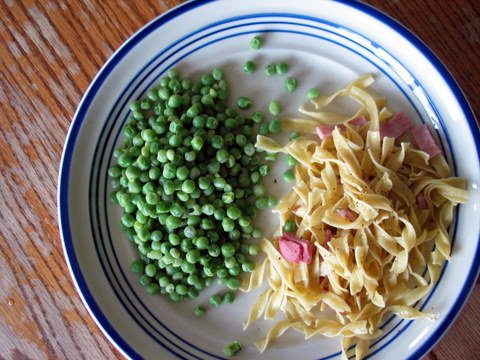
    Because I figured there was no point in freezing the peas since we could eat them up in the next couple days, I simply blanched them and put them in the refrigerator. The next day I fixed half of them for supper, and my, were they delicious. I loosely followed Julia Child’s recipe for buttered peas, and I made brown butter noodles with ham to go along with them. Mmm, butter.

    The kids thought the peas strange, claiming they liked the store-bought peas better, but they ate them anyway. (I took their complaints with a grain of salt since the stomach bug is worming its way through our family and the kids have been turning up their noses at even their favorite foods.) They fussed at the noodles and the ham (normally favorite foods) but when told that they could have one cookie for one helping of food and two cookies for two helpings, Yo-Yo and Miss Becca Boo ate generous second servings.

    As for me, I could hardly keep my hands out of the noodle pot, and I had seconds and thirds of everything—I didn’t even need a cookie afterwards (though I did eat a part of one).

    While I served the peas and noodles separately (kids, you know), they can be tossed together in one big serving bowl right before serving. That’s how I ate the leftovers.

    Buttered Peas
    Roughly adapted from Julia Child’s book Mastering the Art of French Cooking.


    I admit it seems rather scandalous to add sugar to the already-sweet new peas, but however unnecessary, it does make them good!

    4 cups new peas
    2 quarts water
    2 tablespoons salt
    2 tablespoons butter
    1 tablespoons sugar
    black pepper and salt, to taste

    Put the water in a saucepan, add the salt, and bring the water to a boil. Add the peas and quickly bring the water back to a boil. Boil for 4-8 minutes, depending on how well-done you like your peas and whether or not they have already been blanched.

    Drain the peas, return them to the kettle, and turn the burner back to medium heat. Gently cook the peas, watching them closely, till all the moisture has evaporated. Add the sugar and more salt and pepper, if needed. Add the butter, toss the peas to coat, and serve.

    Brown Butter Noodles with Ham


    1 pound medium-sized egg noodles
    4 tablespoons butter
    4 to 8 ounces deli ham
    salt
    black pepper
    1/4 cup fresh parsley, chopped (optional)

    Chop the ham into little strips, about the same width and length as the noodles.

    Cook the noodles according to the package directions, taking care not to over-cook them. Drain them and return them to the kettle.

    While the noodles are cooking, brown the butter. Put the butter in a small saucepan and melt it over medium heat. Once melted, give the pan a swirl every minute or so, watching closely to make sure the butter doesn’t burn. When there are lots of little brown specks in the bottom of the pan, remove the pan from the heat and pour it over the noodles.

    Add the sliced ham and toss to mix. Taste to check the seasonings. Transfer the noodles and ham to a serving bowl, and garnish with the parsley, if you like.

  • Not something to meddle with

    Our strawberries were less than stellar this year due to the Amazonian levels of rain. We pick over the patch every other day but the rot is always one step ahead. I would be depressed about this if it weren’t for the large quantity of strawberries that we still have in the freezer and jelly cupboard as a result of last year’s strawberry bonanza. Last year we put up way more than we could eat, and at least five different families got a turn to pick the patch. This year we’ve put up a fraction of the amount we need, and we haven’t shared with anybody.

    Oh well. Such is life in the dirty world of gardening.

    I really shouldn’t complain. We’ve been steadily eating the strawberries we have been getting, maybe even enjoying them more because we’re not totally inundated with them—the medium-sized bowl I get from picking a row or two seems too piddly to bother with putting up, so we just eat them instead.

    In the course of the last couple weeks, I have discovered a couple (*) delightful recipes that showcase these ruby jewels. The one I’ll share with you now comes from Smitten Kitchen: strawberry shortcake.


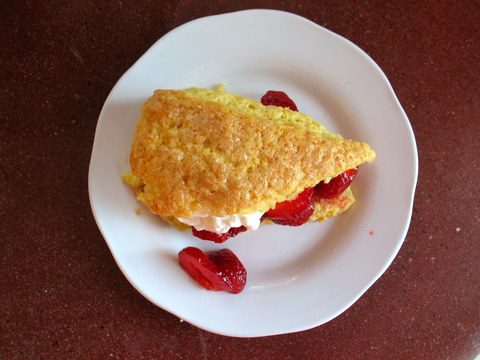
    When I was growing up, strawberry shortcake was not a dessert; it was dinner. My mother made two kinds of shortcake. The first was a plain sheet cake, though not nearly as rich or sweet as a cake, more like a cornbread without the cornmeal. The second type of shortcake was a drop biscuit that was sprinkled with sugar before baking. The sheet shortcake was cut into squares, a piece (or two) was set in the bottom of each person’s bowl and smothered in fresh strawberries, sprinkled with sugar, and drowned in milk. The biscuit shortcake was served in almost the same manner, except that each person crumbled the biscuit into the bowl before adding the fruit and milk.


    Because shortcake was the equivalent of a full meal, I never really understood how people could eat shortcake for a dessert. First, it was way too filling for a dessert course. Second, strawberries arrived in such large quantities that it was necessary to glut yourself with them. And third, both the sheet cake and the drop biscuits were never that great the second day, so it didn’t make sense to prepare it for dessert when you were bound to have leftovers that no one would want to eat. Strawberry shortcake was either all (the whole meal) or nothing.

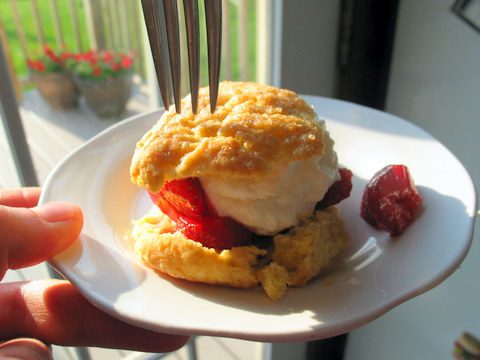
    (The fork that you see coming down from above is Mr. Handsome’s. I had snatched his plate out from under his nose and the stabbing fork was his way of telling me he was done waiting.)

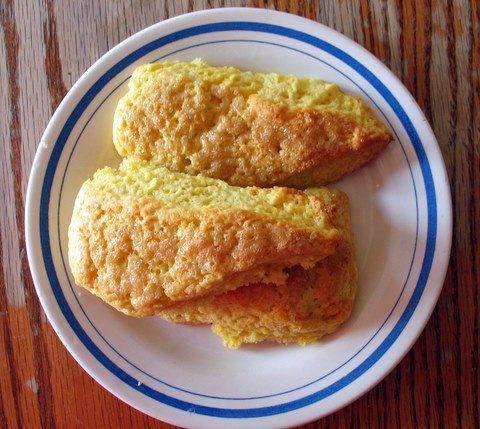
    But then I tried Deb’s shortcake and for the first time I understood how shortcake could be a dessert. This shortcake biscuit is tender and airy, almost lacy, and it is still delicious the second day (it’s true that it’s not as good, but that doesn’t really matter when you consider how off-the-charts delicious it was in the first place). In fact, Mr. Handsome and I nearly had a fight over the leftover biscuits when I came into the kitchen and discovered him eating some shortcake. He must of realized he’d crossed an unspoken line because he took one look at my horror-stricken face and started talking, fast: Isavedyousomeoverthere. Ididn’ttakeallofitbecauseIknewyouwouldwantsome. Okay?

    I said, Oh, that’s good of you. I was kind of worried, and he exhaled deeply and went back to enjoying his dessert.

    (Another shot of Mr. Handsome’s dessert. He was not very happy, and he let me know that in no uncertain terms, when I ordered he lay down his fork.)

    The key to this recipe is the lemon. There’s probably some other keys, too, like lots of butter and cream and hard-boiled egg yolks and Demerara sugar, but I think the lemon in the clincher. There is lemon zest in the biscuit, and fresh lemon juice is stirred in with the strawberries. It’s a perfect pairing, and, like my leftovers, not something you want to meddle with.


    Strawberry Shortcake
    Slightly adapted from Deb at Smitten Kitchen

    Deb says that you can use orange zest in place of the lemon. I am so sold on the lemon that I don’t ever plan to try the orange, but I’m telling you this anyway, just because I’d feel guilty if I didn’t.

    For the biscuits:
    1 2/3 cup flour
    3 ½ tablespoon sugar
    1 tablespoon, plus ½ teaspoon baking powder
    2 hard-boiled egg yolks
    1/8 teaspoon salt
    6 tablespoons cold butter, cut into chunks
    2 teaspoons lemon zest
    2/3 cup cream, plus a little extra for brushing on top of the biscuits
    Demerara sugar, for sprinkling

    Measure the first five ingredients (down through the salt) into the canister of a food processor and pulse to mix. Add the butter and zest and pulse some more. Add the cream and pulse, just until the mixture forms a ball.

    Dump the dough out onto a floured kitchen counter, knead it a couple times just to pull it together, and then shape it into a disk about one-inch thick. Cut the dough into wedges, the same way you would for scones. Place the biscuits on a baking sheet lined with parchment paper, leaving space between the biscuits (they spread a bit because they are so tender and light). Chill the biscuits, uncovered, for about 20 minutes in the refrigerator (if chilling them longer, cover them with plastic wrap).

    Remove the biscuits from the refrigerator, brush their tops with the extra cream and sprinkle them lightly with Demerara sugar.

    Bake the biscuits at 350 degrees for 15-20 minutes. Allow them to cool to room temperature before serving. (I think these would freeze well, too. Simply bag them once they are cooled, and freeze. To thaw, let them sit at room temperature, uncovered.)

    For the strawberries:
    2 cups sliced (fresh) strawberries
    2 tablespoons sugar
    1 tablespoon fresh lemon juice

    Combine the ingredients 10-30 minutes before serving.

    For the whipped cream:
    1 cup whipping cream
    1 tablespoon sugar
    ½ teaspoon vanilla

    Beat together until stiff peaks have formed.

    To assemble:
    Gently split open a biscuit (this is trickier than it sounds because the biscuits have a tendency to fall apart). Spoon some strawberries onto the biscuit, blob some whipped cream on the strawberries, and put the top half of the biscuit back on top.

    *Coming up next … A dessert for adults only: Strawberry Margarita Pie.

  • Stirring the pot

    I’ve been mulling over the issues raised in the comments section of my recent post on homeschooling. I even typed a couple pages of incoherent notes in an attempt to flush out the key points of the conversation. Finally, I’ve settled on a few main thoughts that I think are relevant and worthy of sharing, but there are so many more. For now, anyway, these are what you’ll get.

    Best I can figure, I think people are mostly concerned that homeschooled children will be behind the schooled kids. People worry that homeschooled kids won’t learn things in time (or not at all) and that when they do leave home and try to make a go of it in the big bad real world, they will fail in a big bad way. We’ve all heard the horror stories of inept parents who took their kids out of school under the pretext of homeschooling them and then let them run wild with nary a care to their physical well-being, let alone their academic success. Or, more commonly, we hear about the homeschooled kids who get to college and totally freak out, unable to handle the stress of term papers and dorm life. And it’s true; those things happen. They also happen with schooled kids.

    More often then not, though, homeschooled kids do amazingly well, testing higher academically then both their public and privately educated peers. There are screw-ups and success stories on both sides of the fence, but, sadly enough, research shows that there are more screw-ups on the school-side of the fence. Our public school system is not doing so hotsy-totsy.

    I didn’t decide to homeschool my children because of flaws in the public school system, but considering that our country’s students’ test scores are substantially lower (in this study, off-the-charts lower) than other country’s, it intrigues me that so many people clutch the measuring stick provided by our mediocre school system as a means of holding homeschoolers accountable. There’s a boatload of irony there.

    If we can, just for a minute, step away from comparing ourselves to the school system—away from fact regurgitation, away from the standard time table for learning set by some unknown (and unknowing) being, away from the focus on one or two types of intelligence instead of the multiple intelligences that we, the human race, have been gifted with—we can start to figure out what it is that we really want for our children.

    Here’s what I want. I want my children to know how to learn. I want them to be able to go after what they want and to be able to master whatever skills they need in order to accomplish their goals. Beyond that, I want them to enjoy life. I want them to feel comfortable in their own skin and to be confident enough that they can gracefully embrace the differences of others.

    That sounds pretty lofty, no? Do you want more? Alrighty then—here you go: I want my children to know how to listen, to really listen. I’m not talking about do-what-I-say-right-this-very-minute listening, though that is quite nice and has its place—I’m talking about learning to listen for the rumblings below the surface, to listen for understanding, to listen with compassion and love, to listen to the spark of goodness in each person that, when understood, can then be appreciated and bring us closer together. Now that’s lofty!

    How can we expect our children to listen to other people, to accept their differences and idiosyncrasies, if we have not listened to their—our own children’s—individual needs, instead choosing to cast our children into a societal mold that fits only a small fraction of the population? When we ignore our children’s different learning styles and emotional and physical needs, we are teaching them that differences aren’t acceptable. Without meaning to, we are teaching them to discriminate, judge, and be close-minded.

    Oh my. That was quite a little speech. I’m suddenly exhausted.

    But wait, I’m feeling some mental gurglings. Oh no! There’s more! Hold onto your seats!

    Ponder these random points:

    *Everyone’s goal in life is to find pleasure, so says my mom. And she’s right! If learning doesn’t have an element of pleasure (or joy), we shut down.

    *You know how some parents are obsessed with making sure their children know their colors as early as possible? Well, guess what! Kids will learn their colors at some point and if they don’t, then they won’t, not for lack of teaching, but because they are color blind. If parents want to spend oodles of time drilling pink, green and purple into their children’s bald noggins, then more power to them—as long as both parties are having fun. If learning is a means by which you connect and bond with your child, then play teacher all you want. If you don’t like those games, then give them up—go read books, pick potato bugs, or make brownies together. Your child will learn the (basics: their colors and the three Rs) information anyway. Which leads me to the next point…

    *We are not as important as we think we are. Yeah, yeah, parents are extremely important in many, many (many, many, many, many) ways, but really, our kids are capable of doing more then we think. They don’t need us to point out every birdie that flies by or to structure every minute of their day with educational experiences. They are quite capable of figuring out that stuff on their own, and a little boredom (or a lot) is a crucial part of the creative process.

    *On the whole spelling issue: The best teacher of spelling is good literature, and a dictionary or spell check. If a certain teaching method works, then go ahead and use it, but by far and away, a love of words will be the best teacher and that is only acquired by firsthand enjoyment. So read, read, read and write, write, write. (And remember, I am a by-produce of private and public education, with three years of homeschooling thrown in, and somehow, even though I’m weak in spelling, I still ended up receiving the English award at my highschool graduation—a Webster’s Dictionary that sits on the shelf directly above my computer!) Spelling is not an indicator of smarts or ability or anything, really. And I think the Bard would agree with me.

    *Conformity does not equal getting along. Getting along is much more complicated (and rewarding) than being in the know about the latest video game or fashion styles.

    *Remember, I’m still in the early years of growing up my kids. As my children become more advanced, more will be required by way of in-depth study. I’m not going to blithely say, “The US Constitution? Wha-a-at? You want to know about that old thing? Huh. You know where the library is—go figure it out yourself.” But then again, I might. I think I can go either way on this one, and I’ll probably end up doing a bit of both (as I am already). I’ll tell them to go figure out what it is they want to know if they really want to know it, and I’ll introduce them to, and make them learn, some of the less interesting things just because I think they hold merit. And when it comes time for the SATs (if they’re not already in school by then), they’ll put in some good hours of study, just like their peers in the public school system. And like any parent, I’ll cross my fingers and hope they do well.

    So there you have it. Did my ramblings serve to answer your question and ease your minds, or did they only bring more bothersome questions bubbling to the surface?

    Whatever you do, don’t keep your questions and concerns quiet because, like lies and dirty socks that are kept buried down deep away from light and fresh air, they will fester. And festering questions give off a killer stink. I know this for a fact.