• Pounding the pulpit

    I’m feeling rather evangelical…about…laundry detergent.


    My girlfriend Michael Ann told me about it, bless her dear little soul. It’s the good stuff, biodegradable, fragrance-free, HE compatible and whathaveyou, but the best part is that if you subscribe to it on Amazon they’ll ship it to you for free! Michael Ann had told me about it before, but last week when I stopped by her house for a brief chat (and to pick up my kids that she was so graciously watching) she sent me home with a sample of the white powder. I guess it made her feel a little evangelical, too! That afternoon I clicked over to Amazon and signed up (no fee, no commitment—can change the subscription or cancel it at any time) to have forty pounds of Country Save Detergent (equals fifty-two dollars) delivered to my front door every six months. It arrived the very next day and I felt like a million dollars (you know, from that little high you get when you buy something, plus the coffee I was slurping…), but I haven’t gotten to use it yet since I’m using still finishing up the last box of Dollar General detergent, and now it’s raining so I’m not even doing laundry anymore…

    I’m a little zealous about other, more heady, things, too, like books. I’m reading The Education of Little Tree by Forrest Carter (also recommended to me by Michael Ann—I’m tellin’ ya’, that woman belongs in sales) and am love, love, loving it! The story is simply Carter’s memories of when he was a young boy living with his Cherokee grandparents. It is a refreshing read, cleanly written and insightful.

    Here’s an excerpt from what I read this afternoon while settling The Baby Nickel for his nap: “Folks who laugh and say … that Nature don’t have a soul-spirit, have never been in a mountain spring storm. When She’s birthing spring, She gets right down to it, tearing at the mountains like a birthing woman clawing at the bed quilts.”

    And some more: “Then, when April gets its warmest, all of a sudden the cold hits you. It stays cold for four or five days. This is to make the blackberries bloom and is called ‘blackberry winter.’” Oh! So that’s what’s going on with the weather right now. Makes me feel a little better about this depressing dreary cold. At least we’ll have blackberries!

    This is a book geared for adults, but I think it would make a fabulous read-aloud to children. In fact, I’m planning on reading it to Yo-Yo and Miss Becca Boo just as soon as I’ve finished it myself—I want to read it all the way through first, just to be sure it’s okay for little ears. Granted, parts of the book are still above their heads, but I’ll gladly read it again later on. It’s the kind of book that you may want to consider purchasing for your bookshelf—one that you’ll want to hand out to others because it is certain to give you that glory-be evangelical feeling.

    The other book that I’m preaching is one that I borrowed from my sis-in-law, and then after I finished reading it I went ahead and ordered it on Amazon; it just came in the mail today. Nonviolent Communication by Marshal B. Rosenberg is a (sorry to say) dry read, but quite profound nonetheless. Even when the lines blurred and my eyes went shut, the intriguing ideas pulled me back to its pages the following day.

    Ach, droning on and on in this depressing vein is very un-saleslady-like—nobody will ever read it if I continue on like this. But hey, I just want to be honest with you. Here, let me share a few of the book’s main ideas, or at least the main ideas that I got out of the book.

    I thought the first part of the book was a little hokey (there I go again)—it was all about “I statements” and formulas (“I feel blank when blank because blank…”) and I don’t do that type of jazz (especially seeing as studies have proved them to be irrelevant—sorry to burst any I-Loving Bubbles out there). But as the book went on, it got into the parts on true listening and that part was man-oh-man profound. As in, dude, that’s deep. Basically, the key is to listen to the feelings and needs behind statements—your own and others. Sounds simple, but it’s hard—try it!

    Another thing that Rosenberg says is that “should” is the most violent word in the English language. Take heed: you should never use the word “should.” Yep, and “ain’t” ain’t a word.

    Some of the most (to me) profound ideas were on anger: “At the core of anger is a need that is not being fulfilled.” And, “Blaming and punishing others are superficial expressions of anger. If we wish to fully express anger, the first step is to divorce the other person from any responsibility for our anger. Instead we shine the light of consciousness on our own feelings and needs. By expressing our needs, we are far more likely to get them met than by judging, blaming, or punishing others.”

    Any of you well-versed in the Christian faith will quickly realized that this has a shattering effect on our church’s teachings on salvation, redemption, and forgiveness. I’m not going to say more than that, just enough to peak your interest.

    Whew! That’s enough preaching for one day. Gotta go mop my brow.

  • A last hurrah

    I’m cramming in the kitchen. I have so much to bake/cook/create and so little time. I know why I’m panicking, though. It’s because this is the last I’ll have any amount of time for creative cooking before the garden takes over and I’ll be hunched over a hot stove, slinging food into the freezer/canner at breakneck speed.

    It makes no sense really. It seems like summer would be the best time to experiment with all sorts of new recipes: pestos from different herb combinations, unusual green bean dishes, exotic berry tarts, etc. But by the time the produce starts rolling in, I’m just scrambling to keep my head above water and have zero time to ponder and experiment.


    Because for me, experimentation is a time-consuming affair. First, I read. I type an ingredient into Epicurious, or look it up in the back of a cookbook (Simply in Season is my go-to book for this kind of research), and then I browse through the recipes, looking for ones that we’ll like, that use up a lot of the specific ingredient (a half cup of fresh peas isn’t going to make a new recipe worthwhile when I have an abundance of peas), and that aren’t too complicated. I ponder and scribble notes and make plans, frittering away the minutes in a happy stupor, dreaming up a storm and cooking nothing.

    Fact: dark winter evenings by the wood stove are great for this mulling and stewing—not busy-till-bedtime summer days.

    All this to say, over the past couple dreary cold weeks I’ve been throwing a last hurrah, dreaming and experimenting, mostly with pies, breads, asparagus, and rhubarb. Just to give you a little feel for what that means: Saturday’s plans included not only working in the garden as much as possible and washing mountains of laundry, but I also hoped to make something nourishing that could be called supper, as well as an apricot-almond pastry, a rhubarb tart, a creamed asparagus soup, a newfangled (to me) French-tart crust, rhubarb punch, more rhubarb jam, and some more cream cheese pastry cookies. I’ll not going to tell you what did and didn’t get done, except to say that the dirty laundry is still dirty because it rained and it’s evidently supposed to rain for the next eternity so we’ll soon be walking around in just our birthday suits and there will be no more pictures of us on this here blog. (Giving you fair warning.)

    I dream big, and I pop my own bubbles. Don’t you come after me with any pins, okay?

    It’s one of life’s basic principles: when you have a lot of something, you have less of something else. When you have more daylight, you have less nightdark. When you have a lot of food on hand, you have less time to cook it. When you spend more time creating good food, you have less time to talk about it. When you have more cream, you eat more ice cream. Wait a sec—my theory just fell apart. Let’s move on … to rhubarb pie!


    Mm. This is a good place to be.

    This is a straightforward rhubarb pie, the classiest of the classy. It showcases the tart fruit (er, vegetable) which has undergone the simplest of preparations—chopped and then tossed with sugar, cornstarch, a pinch of salt, and some lemon zest.

    The crust, a cream cheese pastry, is as important as the fruit, a delightfully rich, buttery affair—not the type of crust that gets left behind on the plate.


    The rhubarb filling seems scant in contrast to the abundance of crust but it turns out perfect, in part because the crust is so good, but also because the fruit is so tangy-tart—the buttery crisp crust is a perfect foil for the sharp fruit. Whipped cream puts it over the top.


    The pie is best served the day it is made—that’s when the crust is crispest—but the second day the fruit mellows and the crust softens, making the pie delicious in a whole new way.

    Cream Cheese Pastry
    Adapted from The Pie and Pastry Bible by Rose Levy Beranbaum

    I’m giving you the recipe for a nine-inch double crust because you will want pastry leftovers. I’ll tell you why later, but for now save any leftover scraps—simply press them together into a ball, flatten the ball into a disk, wrap the disk in plastic wrap, put the wrapped disk in a plastic bag, and put the bag in the freezer. Trust me.

    Updated on March 16, 2011: do not blind-bake this pastry. It shrivels up and makes holes, like a piece of lace.

    12 tablespoons butter
    2 cups, plus 2 tablespoons, all-purpose flour
    1/4 teaspoon salt
    1/4 teaspoon baking powder
    4 ½ ounces cream cheese
    2 tablespoons cold water
    1 tablespoon cider vinegar

    Chop up the butter and put it in the freezer about half an hour before making the pastry.

    Using a food processor:
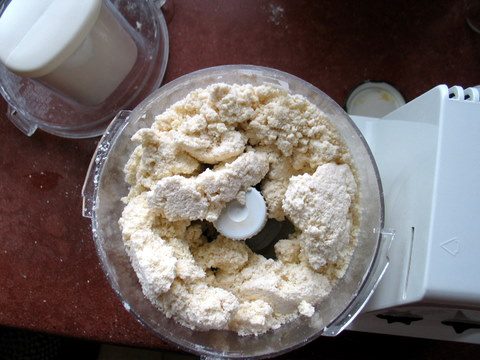
    Measure in your flour, salt, and baking powder and give it a couple whirls. Add the cream cheese and pulse briefly (till crumbly). Add the frozen butter and pulse—again, till crumbly. Add the water and vinegar and process till the mixture starts to come together (this takes about thirty seconds in my processor).

    Dump the mixture (it will still be quite sandy) onto the counter, knead briefly (just enough to pull it together—don’t overwork it) and then divide it into two parts, one being a bit larger than the other. Press each part into five-inch disks, more or less, wrap each one in plastic wrap, and set them in the refrigerator to chill for about an hour. (Or, you can double-wrap them and freeze them for several months.)

    Using the hand method:
    Measure the flour, salt, and baking powder into a mixing bowl and stir briefly. Add the cream cheese and use your fingers to mix it in. Add the butter and, working quickly since your hands are warm and you don’t want to soften the butter too much, work it in till you have a pebbly/sandy mixture. Knead in the water and vinegar. Shape into disks, wrap them in plastic, and refrigerate.

    Classy Rhubarb Pie
    Adapted from The Pie and Pastry Bible by Rose Levy Beranbaum

    4 cups rhubarb, cleaned, trimmed, and cut into ½-inch pieces
    5 teaspoons cornstarch
    2/3 cup sugar
    1 teaspoon lemon zest
    pinch of salt

    Toss together all the ingredients and macerate for about fifteen minutes.

    To shape the crust and assemble the pie:
    Place a baking stone on the bottom oven rack and preheat the oven to 425 degrees. This is one of the things I learned from Rose: placing the pie plate directly on the hot baking stone gives the pastry crust a crispy golden brown bottom and does wonders in eliminating the Soggy Pie Bottom Problem.

    Remove the disks from the refrigerator and let them rest on the counter for about ten minutes. Unwrap the larger of the two disks, situate it in the middle of a piece of plastic wrap and place a fresh piece of plastic over top. Using a rolling pin, roll the pastry into a large circle, to about an eighth-inch thickness. This step requires a lot of elbow grease and much umphing and oofing, and maybe even a few gentle curses, but it will eventually do what you want it to. I often peel off the top piece of plastic, lay it back down, flip the whole thing over, loosen the bottom-now-top piece of plastic, lay it back down, and then roll from that side. When you’re ready to fit the crust into the pie plate, do the whole peely-flippy routine that I just described, except that instead of laying the bottom-now-top piece of plastic back on, you leave it off, slip your hand under the bottom plastic and invert the whole thing into the pie plate.

    Have I totally lost you? Am I making any sense at all? Is anyone still even reading this???

    Gently press the pastry into the pie plate, smoothing out the air bubbles. Peel the piece of plastic wrap away from the pastry (the one that was on the bottom but is now on the top, of course), and trim off the excess pastry.

    Relax your shoulders. Take a deep breath. Think about weeping willow trees by a rippling brook. You’re doing great.

    Put the rhubarb in the pie shell.

    Roll out the second crust into a rectangle. Cut it into long skinny strips. Weave the strips over the rhubarb. I’m not even going to try to explain how—just do it.

    Bake the pie for about thirty minutes, or until the juices are bubbling thickly. (Mine never bubbled thickly thickly, so I increased the original four teaspoons of cornstarch to five teaspoons.) You may need to cover the edges of pie crust with some aluminum foil after the first fifteen minutes of baking—take a square of foil, cut a hole out of the center (the width of your pie top) and then bend the outside edges of the foil square so that they curl loosely down over the pie crust when arranged on top of the pie.

    Serve with whipped cream.

  • A more important matter

    I have quite a number of recipes I want to share with you. This could be either a boon or a problem, depending on how I look at it. I feel like it’s a problem (I want to write and I don’t have time!), but I’m choosing to see it as a boon (I have lots of writing material for whenever I do get a chance to park my rear and wiggle my phalanges).

    I know I promised you a rhubarb pie recipe, but I’m going to have to put that on hold, I’m afraid, in order to tell you about the ice cream we made last night.


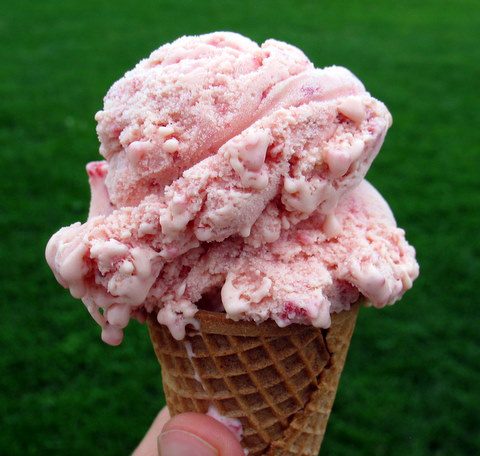
    I’m hoping you’ll forgive me the change in plans. Rhubarb is really the more important matter, considering that it is in season now and you need ways to use it up now, but come on, folks, it’s strawberry cheesecake ice cream. Priorities, schmiorities, right?

    Besides, maybe you’re in the same situation I am and it is your priority to use up all the strawberries you still have in the freezer from last year (making jam, ASAP). Either way, strawberries will soon be in season and before you know it you’ll be inundated with the ruby fruits. Consider this a friendly service announcement: make this ice cream when you get strawberries! Or, if you don’t have time in the heat of The Berry Moment, crush up some of the berries and freeze them in two cup portions—then you’ll have them on hand when you do have a little more breathing space.


    Strawberry Cheesecake Ice Cream
    Adapted from Jude’s blog Apple Pie, Patis, and Pâté

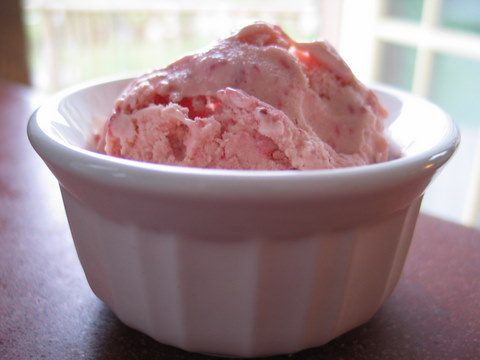
    When eaten fresh, this is a very soft ice cream. We churned it before supper and then kept it in the freezer for the next hour or two till we got around to eating it. (I make it sound as if we were dreading the proposition—oh darn, I made ice cream and now I have to eat it—which wasn’t the case at all. We had company and were busy enjoying them). At that point it was still really soft, but a couple hours later (after the company left and the kids were in bed and the dishes were mostly washed) when I transferred the leftover ice cream from the canister to freezer containers, the ice cream was nice and firm. It tasted really good, too. (Why is it that ice cream tastes better at ten at night, eaten directly from the container?) My point is: make this ice cream ahead of time to give it time to set up.

    Also, this recipe makes a lot of ice cream—small ice cream makers will overflow. If you do have a small maker, churn the cream cheese base and then dump it into a large bowl to stir in the strawberries.

    Oh yeah, in keeping with my cream-loving nature, I changed the recipe to include more cream. The original recipe called for 2 ½ cups whole milk and ½ cup cream and I reversed that. You can flip it back to the lean version (ho-ho-ho), if you wish, or, if you’re even more cream-infatuated than I am, omit the milk entirely (and then tell me—I’d like to meet you).

    1 pound fresh strawberries, crushed (or two cups crushed frozen berries)
    1 3/4 cups sugar, divided
    3 egg yolks
    2 ½ cups cream
    ½ cup milk
    1 teaspoon vanilla
    1/8 teaspoon salt
    1 pound cream cheese, softened
    1 teaspoon lemon zest
    1 ½ tablespoons lemon juice

    Stir ½ cup sugar into the crushed berries and refrigerate till ready to use (the berries need at least half an hour to macerate, so don’t do this step at the last minute).

    Pour the cream into a saucepan, add the salt and 3/4 cup sugar, and heat over medium-high heat. While the cream is heating, beat the egg yolks. Temper the yolks by whisking in a half-cup of the hot cream a little at a time. Pour the tempered yolks into the saucepan, whisking furiously. When the cream has thickened slightly (do not boil), remove it from the heat and whisk in the half cup of milk to stop the cooking. Add the vanilla. Pour the mixture through a fine-mesh sieve, cool to room temperature, and chill thoroughly.

    In a large mixing bowl, beat together the cream cheese, remaining ½ cup sugar, zest, and lemon juice. Gradually beat in the chilled cream mixture. (I added my cream while it was still quite hot and had no problems). Chill the ice cream base in the refrigerator, or, if you’re like me, you can speed-chill it in the freezer for a little while.

    Churn the ice cream. When it’s done, add the strawberries and churn for another couple minutes. For (very) soft serve ice cream, eat immediately. For hand-dipped ice cream, freeze for at least four hours.

    Update, August 17, 2009
    Variation: Use mashed peaches in place of the strawberries for some delightful Peaches-and-Cream Ice Cream.