• Cold Soup, Perfected

    Every year the women on my mom’s side of the family get together at my Aunt Dr. Perfection’s house for our annual fall soiree. We descend upon her house, hungry for the fantastic food she fixes, ready to spend the next 24 hours eating, talking, eating, lounging (we rotate between the front porch, the back yard garden, and the sunroom), and eating some more.

    Obviously, she’s a good cook. Otherwise we wouldn’t eat so much.

    A couple years ago, she served us a cold corn soup. It was spectacular—cold, creamy, lemony—so I copied the recipe down (from one of her cookbooks, possibly a Williams-Sonoma book) and brought it home with me.

    This past week my mother sent me a couple boxes of exceptionally sweet and delicious white corn that my father had grown. It was nearly bedtime when the corn arrived at my house (we had met halfway between our houses in one of our send-a-child-to-the-grandparents’ expeditions), so I cooked it up for a bedtime snack, and then cut the rest off the cob and tucked it into the fridge. A couple days later I dug my aunt’s soup recipe out of my recipe box and got to work.

    Cold Curried Corn Soup
    Adapted from the recipe book that my Aunt Doctor Perfection has sitting on her little wire shelf in her kitchen.


    This is a great soup to have on hand during the hot days of August (that actually haven’t been so hot this year). Serve it as a first course to a fancy meal, as a simple lunch, or as a refreshing mid-afternoon snack.

    2 tablespoons olive oil
    1 small onion, finely chopped
    2 small potatoes, peeled and coarsely chopped
    5-6 cups of fresh corn
    2 ½ teaspoons curry powder
    5-6 cups chicken stock
    juice from one lemon, about 2 tablespoons
    salt
    white pepper
    thin lemon slices
    some sour cream, about half a cup
    some finely chopped parsley, about 3 tablespoons

    In a medium to large soup pot, saute the onion with the olive oil. Add the potatoes and the corn and saute for another couple minutes. Add the curry powder and cook for yet another minute. Add the chicken stock and the lemon juice and simmer for twenty minutes, or until the potatoes are quite tender.

    In small batches and using great caution (I gave myself a talking to about being careful and still I spritzed corny soup all over the kitchen counter), puree the soup in a blender. Pour the pureed soup through a sieve to remove the fiber stuff—you’re going for a creamy soup here. This part takes a little bit of time because it seems like the soup will never go through. Just be patient and stir the soup while it’s sitting in the sieve, pressing on the sides and jouncing it up and down a little. You should have about a cup of goop left in the sieve when you’re all done—feed that part to the chickens. Season the pureed, sieved, creamy soup with salt and white pepper, pour it into a jar (I had a little over two quarts of soup), and put it in the refrigerator to chill.

    To serve, garnish with the sour cream, chopped parsley, and the lemon slice. Mmm, perfect.

  • A Mandatory Suggestion

    Last year I discovered a new way to preserve Roma tomatoes: roasted, in the oven. I’m sure that all of you have access to Romas, either from your garden, your neighbor’s garden, or the Farmers’ Market. My point is, you need to go buy some and then make these tomatoes.


    I am not sure what is the best, most efficient way to do these tomatoes—I’m still experimenting. So I’m just going to tell you about the several different methods I have employed. The recipe and method are flexible, so you’ll have to play around with the ingredients yourself. My point is, pretty much anything you try will be fine.

    But whether or not you make these tomatoes is non-negotiable. That’s my main point.

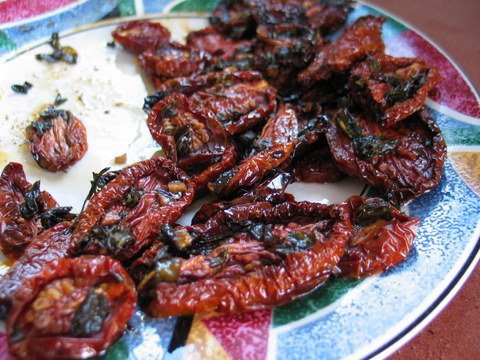
    First thing: Don’t burn them. But even that is a matter of taste. My mother thinks that anything that has a caramelized flavor tastes burned. I happen to love the caramelized flavor—the bits of the tomato that turn dark brown and chewy. I was able to salvage a small fraction of the tomatoes pictured above. My mother would’ve chucked them all.

    Oven-Roasted Roma Tomatoes
    I think this is adapted from Barbara Kingsolver’s book, Animal, Vegetable, Miracle, but I’m sadly too lazy to go look it up and double check on that. You ought to read the book anyway. Let me know if you find the recipe there, okay?


    A medium-sized bowl of Roma tomatoes
    about a cup of chopped, mixed fresh herbs (basil, oregano, thyme, parsley, rosemary)
    several cloves of minced garlic
    a couple splashes of olive oil, maybe 1/4 cup
    a couple splashes of red wine, optional
    salt and black pepper

    Wash the tomatoes, cut the tops off, and slice them in half, lengthwise. Lay them skin side down on a large cookie sheet that has sides and that has been lined with tinfoil. To make this whole process worthwhile, you’re going to want to fill your oven with as many trays of tomatoes as will fit on your racks, and lay the tomatoes as close together as is possible without them laying on top of each other. They will shrink to about half their original size. I do two big trays at a time, though I would do more if I had more racks for my oven. (Mr. Handsome, can you please help me out here? Find me another two racks?)

    Now, there are different methods for the next part. Here’s three of them. Pick one, or create a new one.

    Method #1
    In a small bowl, mix together the chopped herbs, garlic, olive oil, red wine, salt, and pepper. Using your fingers, distribute the herb mixture over the tomatoes, making sure that each tomato has received a little dollop of green goodness and juice.


    Method #2
    Sprinkle the chopped herbs over the tomatoes. Then the chopped garlic, the salt, and the pepper. Drizzle the olive oil over all, followed by a couple splashes of wine.


    Method #3
    Put the prepared tomatoes in a large bowl. Add the olive oil, wine, and garlic and gently toss to coat. Lay the tomatoes out on the trays. Sprinkle the chopped herbs over all.

    Another idea, which may become Method #4 in the near future
    Prepare them as in method #3, but use herbes de Provence in place of fresh herbs, as in the Tomato Bread Pudding recipe that nearly slayed me.

    Last night I lighted on the best way to roast these tomatoes. See, they take a long time in the oven and during the day I often run into trouble because I want to bake granola or bread or potatoes or something and the tomatoes are in there, hogging up all the space. Also, I’ve been roasting them a little too quickly and they’ve been too caramelized (okay, Mom, burned) while at the same time still being a bit too juicy. So last night I turned the oven to 225 degrees right before I went to bed (around 9:30 pm) and they roasted all night long. I could smell them when I got up to go to the bathroom, and that made me smile to myself because I was being productive even while I was sleeping. I checked on them at around 6:15, and only about six halves were too heavily caramelized—the rest were just fine, and about half of them were not quite done. Tonight I’ll set the oven to just 200 degrees.

    Pull the tomatoes off the trays, one by one, as they finish roasting, and lay them on a dinner plate. When they are all off the trays and have cooled to room temperature, put them in a quart jar, label it “Roasted Romas ‘08″, and put them in your freezer.


    These tomatoes are fabulous in grilled cheese sandwiches, or any kind of sandwich for that matter. They taste rich and warm and darkly tomato-y. Chop them up and add them to pasta dishes, pesto, salads, dips, dressings, and so forth. They will disappear pretty fast, so you better run your oven every night for the rest of the month of August if you plan to have enough to make it through the winter.

    Just a suggestion.

  • Two Morals

    Out on yesterday’s pre-dawn run-slash-walk I passed a house that has two enormous pear trees out front. I’ve been watching these trees for several years now. I’ve toyed with the idea of knocking on the people’s door and seeing if they wanted their pears, but the trees seem cared for and last year they even had ladders out there and were filling buckets with pears, so I decided that I didn’t have a chance. But this morning as I came puffing down the road, I saw an older man walk out to the end of the driveway to check his mailbox. So I stopped and politely inquired (that means I said “sir”) if those pear trees were his. They were, he said. Do you use them? No. Could we have them? Yes. I explained where I lived (I didn’t want him to go and give the pears to someone else because I was just a nobody to him), and we talked about how and when to pick them and I ran away, nay, bounded away, for I was filled with that tickle-ly gleeful feeling.

    After my morning café con leche, I made a 30 mile round trip to pick up more produce. At the first farm I bought two bushels of Rambo apples and a bushel of nectarines. I’ve never done nectarines before, but I decided since it was a good year for fruit and the farm had them, I might as well make hay (or rather, jams, dried fruit, canned fruit, and sauces) when the sun shines.

    Then I drove a few more miles to a neighboring farm where two bushels of Romas were waiting for me. A young man came out and loaded them into the car for me. I noticed that they had been sorting peppers, they were all over the place, so I asked if they ever sell seconds of the peppers. He said, “Oh, you can just have those.” I gaped at him, “Are you serious?” He gave me a box and I filled it with giant, only very slightly blemished (what are knives for anyway?) yellow, orange, red, and green peppers. He offered to get me another box, but I declined, all the while feeling guilty for turning him down since I could see the sun was shining and I knew I should be making hay.

    But I can only make so much hay.


    I don’t even know what to do with all these peppers. Freeze them? I still have peppers in the freezer from last winter. If I had a grill I’d roast them. Just saute a big ol’ pile and wolf them down?

    The moral of my tale is this:

    1. Early morning exercise pays off.

    2. Don’t drink coffee before going to pick up produce. The general feeling of well-being that comes from drinking coffee eventually wears off and then you suddenly realize that there is a lot of work to do. It’s rather dismaying. And sobering. The only remedy is to go drink another cup of coffee and blog about it.